
Bird-Safe Cookware: What to Replace, What to Keep, and Why

Overheated nonstick cookware can release fumes that kill a pet bird in another room, often before any warning sign. Switching to bird-safe cookware removes that risk. Here is what to replace first, what can stay, and how to read a label before you buy.
Replace PTFE (Teflon-type) nonstick items that heat up, starting with skillets, saucepans, griddles, waffle irons, and coated air fryer baskets. Overheated PTFE releases fumes that can kill birds. For bird-safe cookware, keep stainless steel, cast iron, and glass.
Why Nonstick Coatings Endanger Birds
The trouble is polytetrafluoroethylene (PTFE), the nonstick coating best known by the brand name Teflon, according to VCA Animal Hospitals. When PTFE overheats, it gives off particles and acidic gases. They have no color and no smell, so people rarely notice them.
The Merck Veterinary Manual calls PTFE gas poisoning common in pet birds kept in or near kitchens. Small birds often die suddenly after minimal exposure. Larger birds may first show labored breathing, wheezing, wobbling, weakness, or seizures. Often, though, sudden death is the only sign.
VCA explains that a bird’s highly efficient respiratory system makes it very sensitive to anything it breathes in. That sensitivity also means distance offers little protection. The same source notes that PTFE fumes can sicken birds in other rooms, too.
VCA considers smaller birds the most sensitive, including the budgerigar (budgie). Cornell University’s College of Veterinary Medicine cites a budgerigar study with a stark result. In that study, 97 percent of budgerigars exposed for nine minutes or longer showed signs of poisoning and died.
Any bird that may have breathed these fumes needs an avian vet right away, even if it looks normal. The emergency steps are near the end of this guide.
The Temperature Figure Is a Warning Line, Not a Safe Limit
Merck and VCA put the release point at 536°F (280°C), the same for a budgerigar as for a macaw. Cornell agrees that PTFE starts breaking down above that temperature. But VCA adds a caveat, noting poisonings tied to PTFE products used at recommended temperatures.
So treat that figure as a warning line, not a safe ceiling. Most poisonings start with an ordinary slip, VCA says, such as a nonstick pot boiling dry on the stove.
Bird-Safe Cookware: What to Replace First
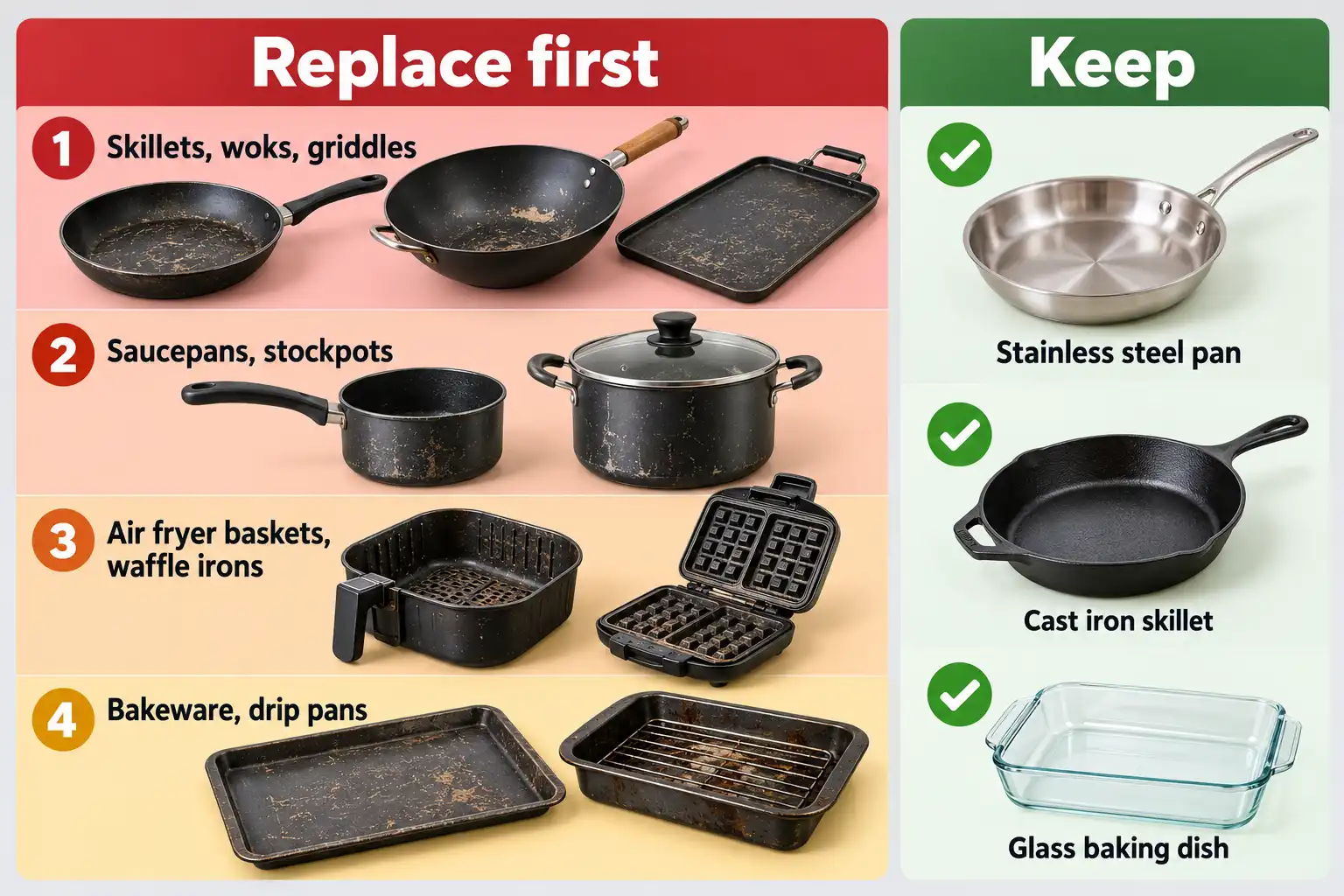
Replace the items most likely to overheat first. Those are the ones that heat while empty, sit on high burners, or can boil dry while you step away.
- Nonstick skillets, woks, and griddles. These see the highest stovetop heat, often while empty during preheating.
- Nonstick saucepans and stockpots. A pot that boils dry is the classic case VCA describes.
- Appliances with coated plates, baskets, or pots. VCA lists waffle irons. Sandwich makers, electric griddles, air fryers, rice cookers, and slow cookers belong here too if their cooking surface is nonstick. If the manual says to preheat one empty, move it up the list.
- Coated bakeware and stovetop drip pans. VCA names drip pans as a PTFE source. Coated sheet pans that go under the broiler belong here too.
If the budget forces a gradual switch, start with whatever you use hottest and most often. A coated muffin tin used twice a year carries less risk than a skillet used every morning.
Other Heated Items That Can Carry PTFE
PTFE also coats items that never touch food. Merck and VCA both list sources outside the cookware drawer. The rule stays the same: if it heats and has a coating, check it.
| Item | Listed by | What to do |
|---|---|---|
| Clothes irons and ironing board covers | Merck, VCA | Iron in a ventilated room away from the birds, or choose an uncoated soleplate and cover |
| Some self-cleaning ovens | Merck | Clean by hand, or run the cycle while the birds stay elsewhere |
| Heating elements, including some in reverse-cycle heat pumps | VCA, Merck | Check the manual or ask the maker before running one near birds |
| Some heat lamps | Merck, VCA, Cornell | Brood chicks and ducklings under a heat source with no PTFE coating |
| Stovetop drip pans | VCA | Swap coated drip pans for plain metal ones |
Heat lamps deserve extra care if you raise chicks and ducklings. Cornell’s veterinary college notes that some heat lamps carry a shatter-proof PTFE coating to help prevent barn and coop fires. In one case it documented, three healthy ducks died within about 12 hours of a new PTFE-coated lamp going in. Their 8 by 10 foot room had its windows closed.
So read the package, or ask the maker, before anything goes under a shatter-resistant bulb. An uncoated bulb gives up that shatter protection, so mount any heat source securely and away from bedding.
What to Keep, and What to Buy Instead
Uncoated cookware has no PTFE to break down. These materials can stay in a home with birds.
| Material | PTFE coating | What to know |
|---|---|---|
| Stainless steel | None | Some pans sold as stainless have a nonstick interior, so check the cooking surface |
| Cast iron | None | Oven seasoning can smoke, so season it with the birds out of the room |
| Carbon steel | None | Needs seasoning like cast iron, and rusts if left wet |
| Enameled cast iron | None (glass enamel) | Heavy, and the enamel can chip |
| Glass and plain ceramic bakeware | None | Can crack with sudden temperature changes |
| Ceramic nonstick sold as PTFE-free | None, if the specs say so | Confirm “PTFE-free” in writing, and skip empty preheating |
Any pan still makes smoke when food burns. VCA’s household hazards guide warns that birds react badly to smoke of any kind, including cooking fumes and oven smoke. So a stainless skillet still calls for the exhaust fan.
VCA also calls it generally unwise to house a bird in the kitchen. Hot burners, open pots, and full sinks add risks, as do foods that are toxic to birds.
PTFE-free ceramic coatings remove the PTFE risk. Still, no veterinary source we checked covers what they release when badly overheated. So treat them like any other pan: no empty preheating, and no birds in the kitchen.
How to Read a Cookware Label
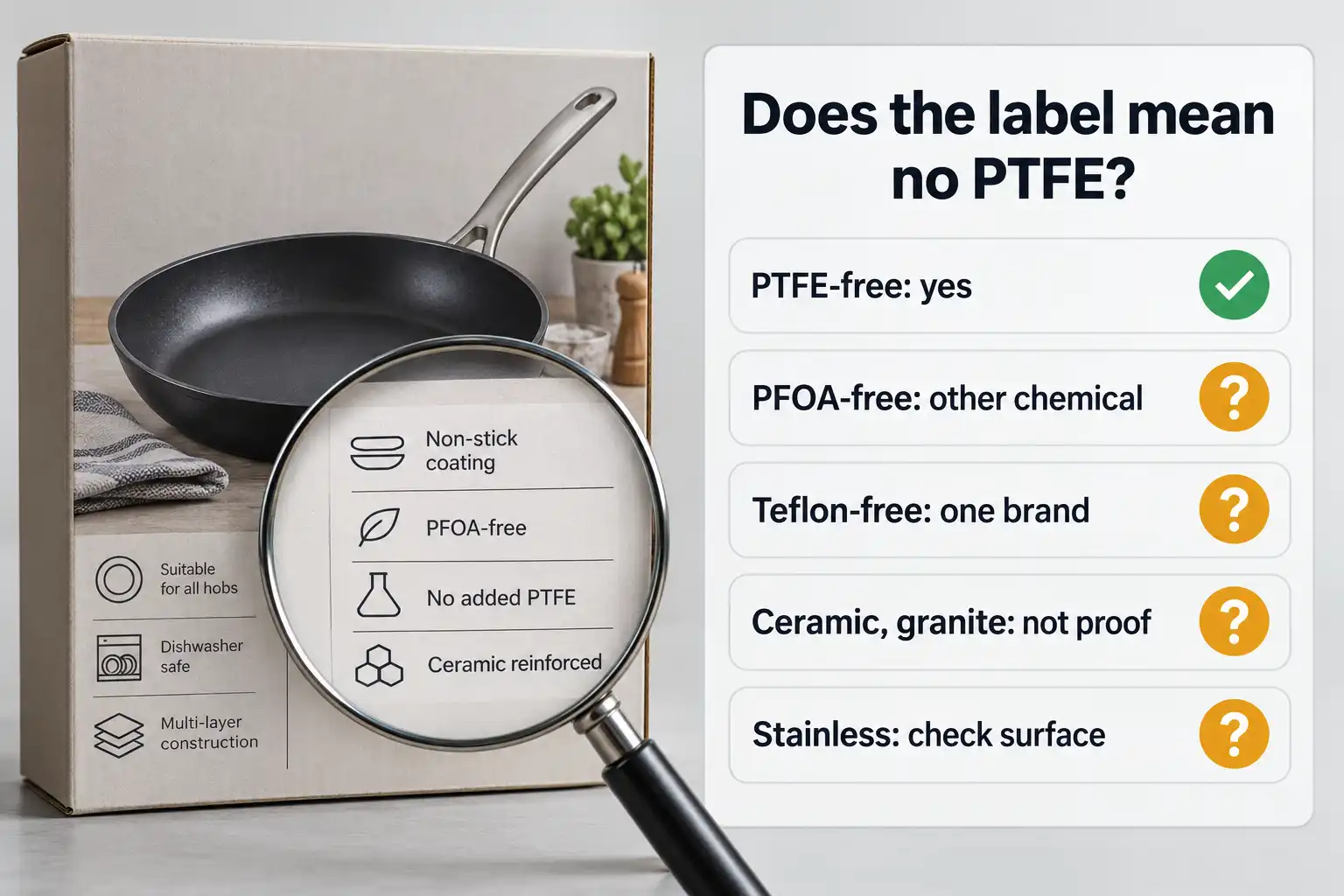
Look for the words “PTFE-free” in the maker’s specifications. Other labels sound reassuring but answer different questions.
- PFOA-free refers to a different chemical, not the PTFE coating.
- Teflon-free rules out one brand, not the material. VCA calls Teflon the best-known brand of PTFE coating, so other brands exist.
- Ceramic, granite, stone, titanium, or diamond can describe a color, texture, or added material. On its own, none of these words tells you whether the coating is PTFE.
- Stainless steel describes the pan’s body. The cooking surface can still carry a nonstick layer.
Factories once used PFOA, a separate processing chemical, to make nonstick coatings. The eight companies in EPA’s PFOA Stewardship Program say they met its goal of removing PFOA from products by 2015. EPA also reports a US phaseout of PFOA manufacture and import under the program. So a PFOA-free label on a new pan tells you nothing about PTFE.
If the specifications don’t say, ask the maker. If you can’t get a clear answer in writing, treat the coating as PTFE.
Replace It All, or Use Nonstick Carefully?
Replacing PTFE items is the safer choice, and the only approach VCA calls reliable. For homes that keep PTFE items, VCA adds precautions. Ventilate well, run the exhaust fan, and keep birds out of the kitchen and laundry room. Never overheat a coated item, and never leave cooking unattended.
That second route works only if nobody slips. It has to hold for guests, house-sitters, and anyone who steps away while a pot boils.
Count the cooking sessions ahead with one formula: sessions = 365 x the species’ lifespan in years. The Merck table of popular pet birds lists 5 to 10 years for budgerigars and 30 to 60 years for macaws. At one cooking session a day, that is about 1,800 to 3,650 sessions for a budgie. For a macaw, it is about 11,000 to 22,000. Every one of them has to go right.
If you can replace everything now, do. If not, replace the skillets, saucepans, and any appliance that preheats empty first. Then follow VCA’s precautions until the last coated item leaves the house.
Mistakes That Still Put Birds at Risk
- Moving the cage one room over. PTFE fumes reach other rooms, as VCA notes, so distance is not a fix.
- Trusting your nose. VCA’s rule of thumb says anything you can smell may harm a bird’s airways. PTFE fumes have no smell, so that check misses them.
- Preheating an empty coated pan or basket. It follows the same pattern as a pot boiling dry, the classic case VCA describes.
- Melting plastic in the microwave. Merck lists plastics melted or burned in a microwave among fumes that can irritate or poison caged birds.
- Keeping one old nonstick pan “just in case.” A guest or house-sitter may reach for it, so take it out of the house.
Candles, aerosols, and air fresheners raise separate concerns. The section on keeping household air safe for birds covers them. If any of these mistakes has already happened and your bird seems off, call an avian vet now.
What to Do After Possible PTFE Exposure
Treat possible fume exposure as an emergency, even if the bird looks normal. Merck calls this condition PTFE toxicosis, and VCA’s advice is to act fast.
- Turn off the heat source.
- Move the bird to fresh air right away, inside its cage or a carrier so it can’t escape.
- Open windows and run the exhaust fan.
- Call your avian veterinarian or an emergency clinic that treats birds, and say the bird may have breathed PTFE fumes.
If no vet answers quickly, call the ASPCA Animal Poison Control Center at (888) 426-4435, any hour. A consultation fee may apply.
Watch for the signs VCA lists: agitation, fast or labored breathing, wheezing, wobbling on the perch, weakness, and seizures. A bird may also seem sleepy or slow to respond. These overlap with other warning signs of illness in birds, so let the vet sort out the cause.
VCA says exposed birds generally need hospital care, and birds with severe signs have a poor chance of survival. Merck describes treatment as supportive care, and the specifics are the vet’s decision.
Find an avian vet before you need one. The Association of Avian Veterinarians keeps a directory, and the section on choosing an avian vet covers what to ask.
FAQs about Bird-safe Cookware
Is scratched nonstick more dangerous for birds?
Heat causes the fumes, not scratches, since Merck and VCA both tie PTFE poisoning to overheating. A brand-new, unscratched nonstick pan carries the same risk to birds once it gets too hot.
Is ceramic cookware safe for birds?
Ceramic nonstick sold as PTFE-free removes the PTFE fume risk, but confirm “PTFE-free” in the maker’s specifications first. Any pan still smokes when food burns, and VCA warns that birds are highly sensitive to smoke.
Are air fryers safe to use around birds?
An air fryer is only as safe as its basket and tray. If either carries a PTFE coating, it belongs on your replacement list, near the top if it preheats empty.
Is nonstick safe if the bird stays in another room?
No, moving the bird to another room doesn’t make nonstick cookware safe. VCA notes that PTFE fumes can poison birds in other rooms too, so the cookware itself has to change.
Can PTFE fumes make people sick?
Yes, occasionally, though VCA calls it rare and birds face far greater danger from the same fumes. People exposed to burned PTFE can develop fever, weakness, shivering, a sore throat, and trouble breathing.
Is it safe to run a self-cleaning oven with birds at home?
Not while the birds are home, because Merck lists some self-cleaning ovens as a PTFE source. Clean by hand, or run the cycle while the birds stay elsewhere and air the house before they return.
Is cast iron safe to use around birds?
Yes, cast iron has no PTFE coating to break down, even when it gets very hot. Season it with the birds elsewhere, because seasoning can smoke and smoke irritates bird airways.
Where to Start
Start with the skillet, the saucepans, and any coated appliance that preheats empty, since those overheat most easily. Next, check irons, heat lamps, and the self-cleaning oven. Keep birds out of the kitchen even after the switch. Then save your avian vet’s number and the ASPCA Animal Poison Control Center line in your phone today.
