
Cats and Birds in One Home: A Two-Barrier Safety Plan
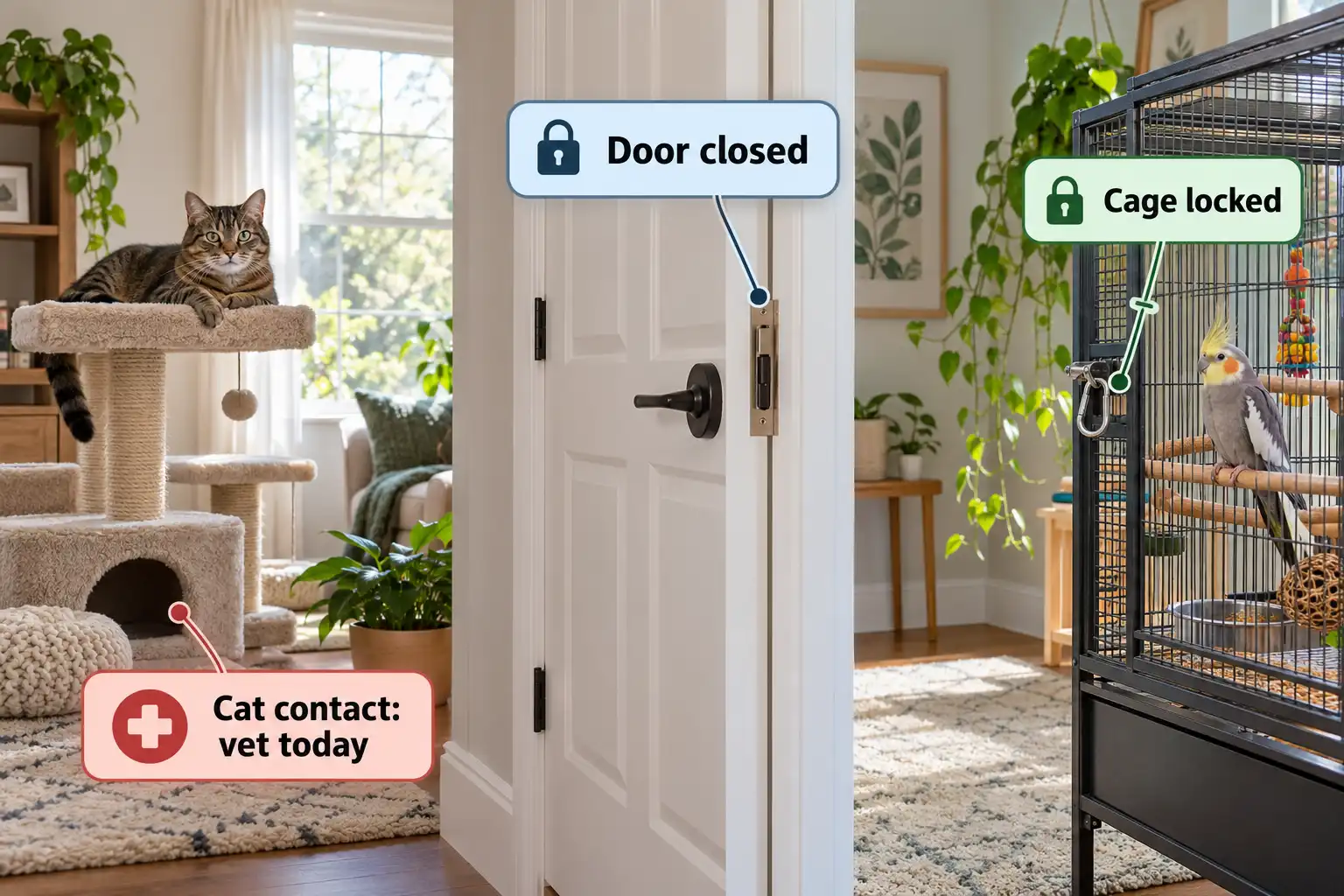
A cat and a pet bird can share a house, but never the same space. Keeping cats and birds in one home works through separation, not trust. This plan covers rooms, cages, routines, hidden health risks, and what to do if contact happens.
Full separation keeps cats and birds in one home safe: the bird lives behind a closed door in a locked cage. Any cat contact, even without a wound, means a same-day avian vet visit.
Can Cats and Birds Live in the Same House?
Yes, as long as they never share space. A cat’s hunting instinct is only half the danger. The other half is bacteria.
Cats carry Pasteurella multocida in their mouths. In AFA Watchbird, the American Federation of Aviculture’s journal, four avian veterinarians explained the risk. Three of them held board certification in avian practice. When a cat grooms, it spreads the bacteria over its fur and claws. So a bite, a scratch, or a cat simply holding a bird in its mouth can pass it on.
That makes a playful swat as risky as an attack. Training may teach a cat to leave the cage alone, but it can’t clean its claws.
The vets made no exception for size, either. Their advice covers any contact between a cat and a bird, whether it’s a budgerigar (budgie) or a macaw.
These injuries aren’t rare. Merck’s chapter on traumatic injury in pet birds lists cat and dog bite wounds among injuries that occur frequently. So a dog in the house calls for the same caution.
Any Cat Contact Means an Avian Vet Today
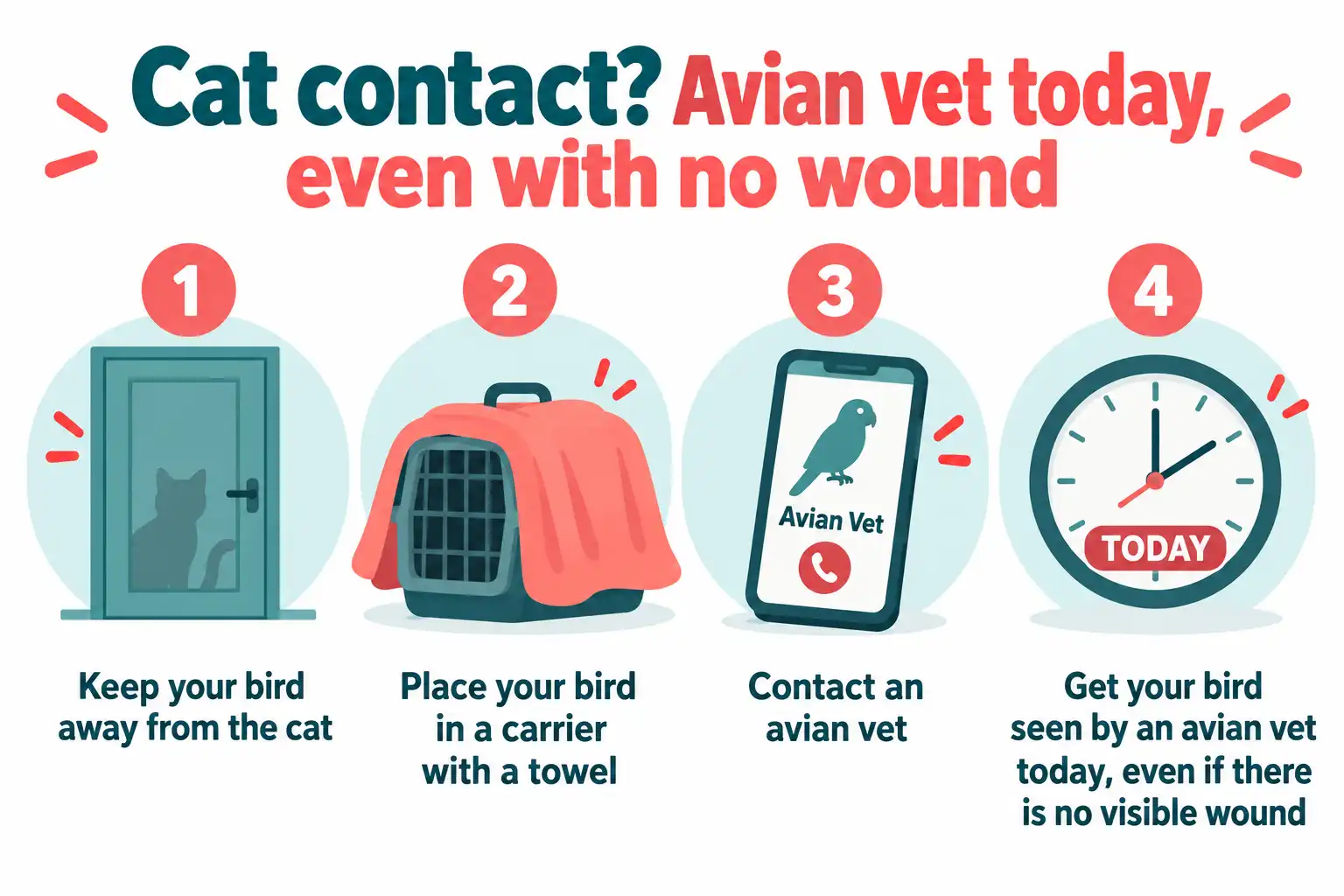
See an avian vet the same day after any contact with a cat, even with no visible wound.
Contact means more than a bite. A scratch counts, and so does a paw through the bars or a bird in the cat’s mouth. Feathers can hide small punctures. If you aren’t sure, treat it as contact. Veterinarian Rose Ann Fiskett wrote in Watchbird that even suspected exposure to cat saliva needs immediate care.
Rhoda Stevenson, another vet on the panel, wrote that death from a bloodstream infection can follow within 48 hours. Often there’s no sign of illness until a couple of hours before death. A third, Amy Worell, had seen survivors of an attack die about three days later. So looking fine proves nothing.
Merck’s professional guidance calls antibiotics essential for predator bite wounds. The drug and the amount are your vet’s decision, so don’t treat at home.
Before you leave:
- Shut the cat in another room.
- Put the bird in a secure, well-ventilated carrier.
- Cover at least three sides with a towel, and keep it warm.
- Call ahead. If your vet is closed, go to an emergency hospital that treats birds.
Merck’s first aid advice for bird owners sums up the trip as warmth, darkness, and a secure carrier. If you don’t have a bird vet yet, start finding a vet who treats birds while your bird is healthy.
A Two-Barrier Plan for Cats and Birds in One Home
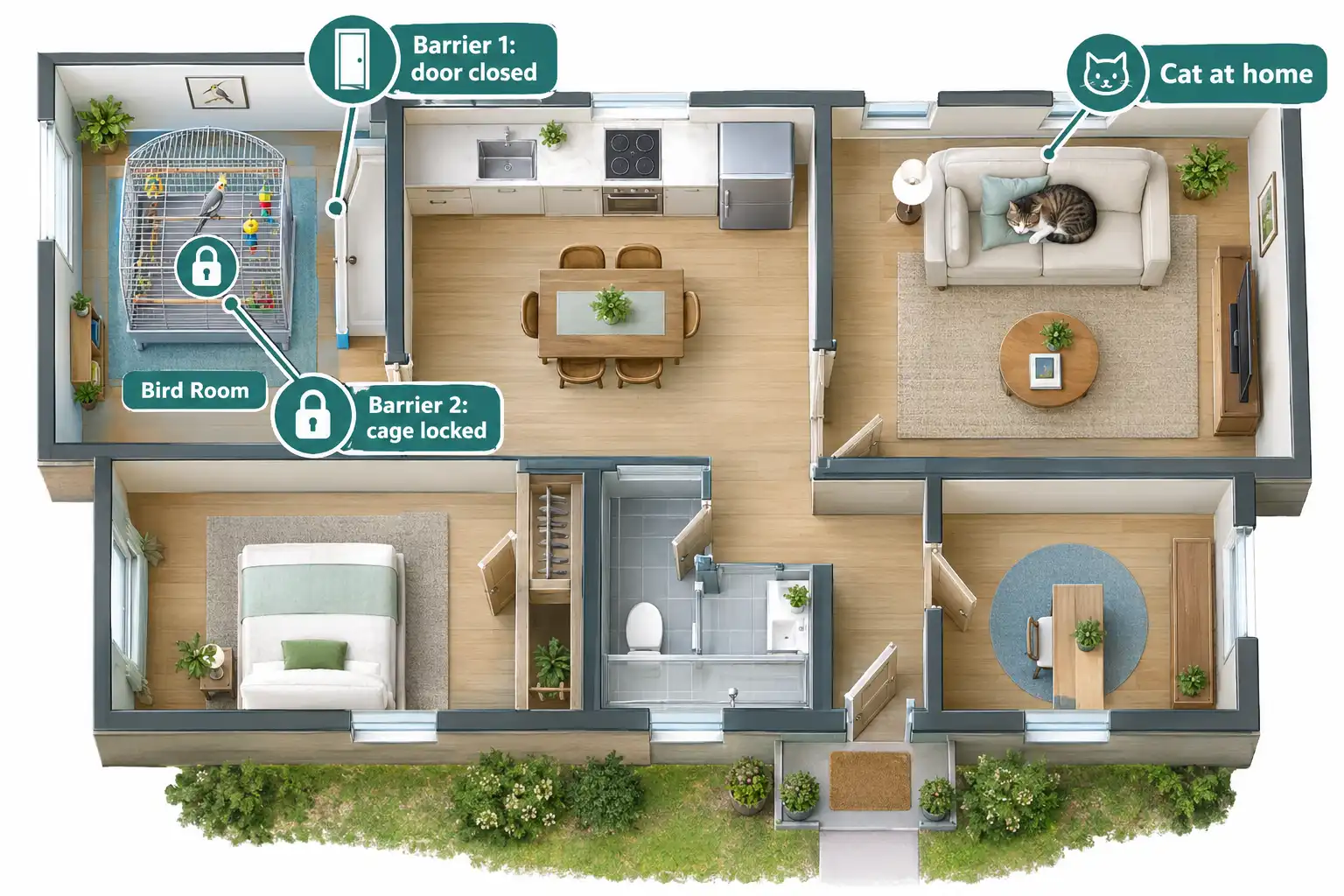
Keep two closed barriers between your cat and your bird at all times. Then, if one fails, the other still holds. Rhoda Stevenson’s Watchbird answer set the minimum: confine one animal whenever the other is out. The second barrier covers the day someone forgets a latch.
Barrier 1: A Bird Room the Cat Never Enters
Give the bird its own room with a latching door, and keep the cat out at all times. Close the door every time you pass through, even for a minute.
A cage in the family room lets you watch the cat. But it also lets the cat watch the bird when you can’t. UC Davis guidance on feather-picking lists other pets in the house among a bird’s possible stressors. It also notes that some birds need a separate dark room to sleep well. A bird room solves both.
Barrier 2: A Cage the Cat Can’t Open, Tip, or Reach
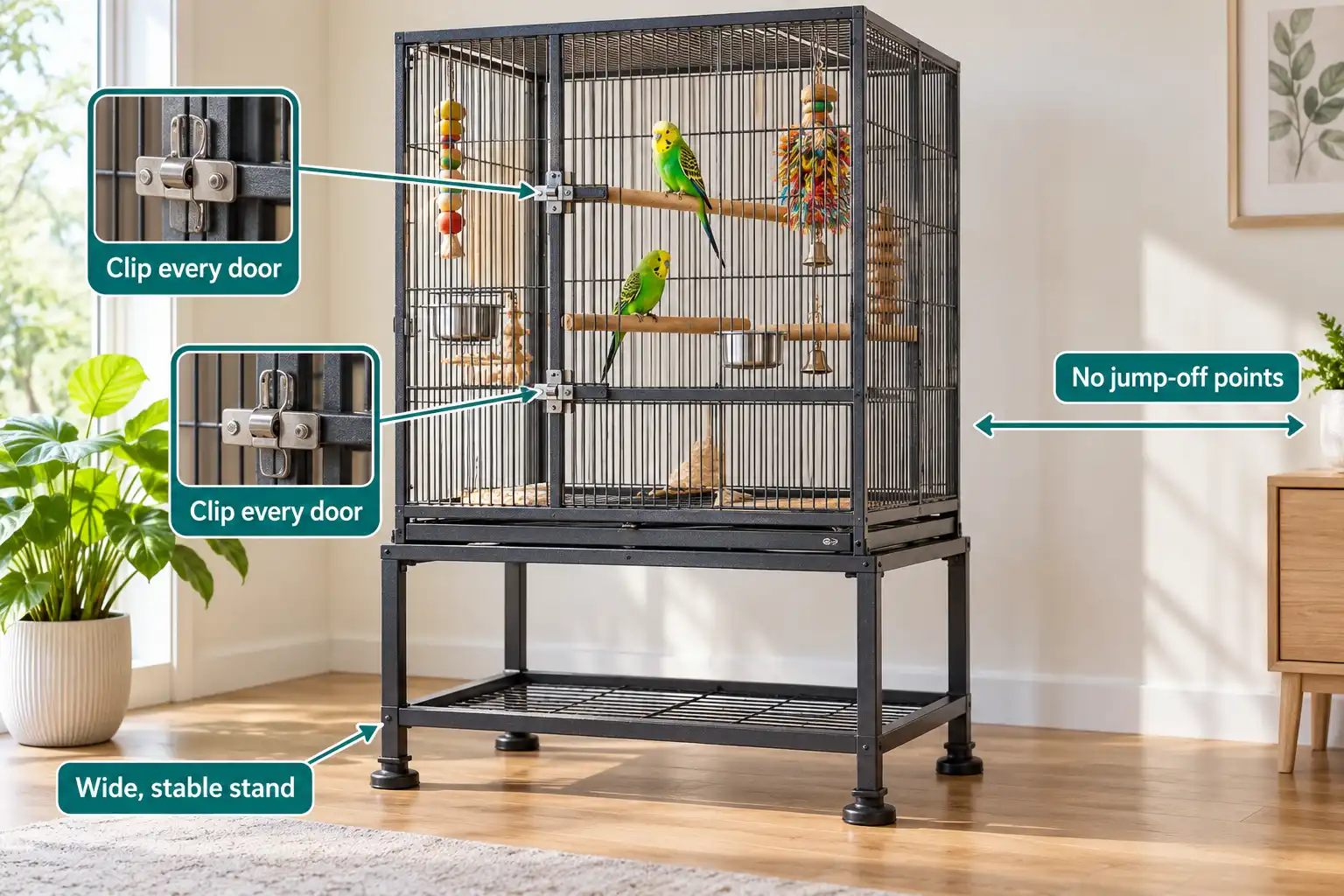
Start with the cage size and bar spacing your species needs. Then prepare it for the day a cat slips in by mistake:
- Clip or lock every door, including the small feeding doors.
- Choose a cage on a wide, stable stand that won’t tip.
- Keep it away from shelves and furniture a cat could jump from.
Bars keep a bird in, but they won’t always keep a paw out. A swat through the bars still counts as contact.
Daily Routines That Keep the Plan Working
The barriers matter most at two moments: when the bird comes out, and when someone new comes in.
Out-of-Cage Time: Shut the Cat Away First
Before you open the cage, find the cat and shut it in another room. Then close the bird room door behind you, so two closed doors stand between them.
Merck’s household hazards guide for bird owners also says to close windows and doors before letting a bird out. It advises watching the bird the whole time, too. When play time ends, lock the bird in its cage before you let the cat out.
House Rules Everyone Follows
The plan works only when everyone in the home follows it.
- Set one rule: nobody opens the cage until they know where the cat is.
- Teach children to check the cage lock before they leave the bird room.
- Put a note on the bird room door for guests and repair workers.
- Give pet sitters a one-page written plan with both vet numbers.
Hidden Risks Beyond Claws
Teeth and claws are the obvious danger. These three are easier to miss.
Bacteria on Your Hands
Grooming spreads Pasteurella over a cat’s fur, too. So wash your hands after petting the cat and before you handle the bird or its food.
The Litter Box
Toxoplasma is a parasite that cats shed in their feces. According to the Merck Veterinary Manual, it can infect any warm-blooded animal, birds included, through contaminated food or water. Merck adds that its egg-like oocysts need 1 to 5 days outside the cat to become infectious. A daily scoop removes them before then.
- Keep the litter box out of the bird room.
- Store bird food in sealed containers.
- Feed the cat dry, canned, or cooked food rather than raw meat, as Merck advises.
Most cats shed the parasite only once in their lives, Merck notes, and healthy adult animals usually show no signs. So treat this as a hygiene habit, not a reason to worry.
Flea Sprays and Foggers
The AVMA’s household hazards page warns that birds are especially sensitive to fumes from aerosol products and air fresheners. It also says to ask your veterinarian before using any insect control product around pets. So ask which flea treatment suits a home with a bird, and skip sprays and foggers. Keep plug-in air fresheners out of the bird room too, and check the cleaning products you use near birds.
How Long the Plan Has to Last
This plan has to hold for as long as your bird lives, which can mean decades. The Merck Veterinary Manual’s table of popular pet birds lists these average lifespans:
- Budgerigars (budgies): 5 to 10 years
- Canaries: up to 15 years
- Cockatiels and lovebirds: up to 20 years
- Macaws: 30 to 60 years
So a young cockatiel brought home in 2026 could still need this plan in 2046. A young macaw could need it until 2086. Those years bring moves, new roommates, new pets, and new sitters. Re-check every door and latch after each change.
Troubleshooting: When the Plan Slips
Small gaps in the routine are easy to close once you spot them.
| Problem | What to do |
|---|---|
| The cat waits outside the bird room door | Feed and play with the cat elsewhere, and block the gap under the door |
| The cat learned to open the door | Swap the lever handle for a round knob, or add a latch up high |
| Someone left the bird room door open | Fit a self-closing hinge, and check that the cage stayed locked |
| The bird got loose in the house | Find the cat and shut it away first, then recover the bird |
| The bird started plucking after the cat arrived | Book an avian vet exam to rule out illness, as UC Davis advises, then cut the cat’s access further |
| Moving day, a party, or repair work | Keep the bird caged in a closed room and the cat shut in another until the house is quiet |
FAQs about Cats and Birds Safety
Can a cat and a bird ever be friends?
Not safely, even if the cat seems to ignore the cage for years. Its claws and mouth still carry bacteria, so one playful swat poses the same risk as an attack.
Is it safe to keep the cage in the same room as my cat?
It’s safer to keep the cage in a room the cat never enters. UC Davis lists other pets as a stressor, and a paw through the bars still means a same-day vet visit.
My cat only touched my bird’s feathers. Does it still need a vet?
Yes, take the bird to an avian vet the same day, even if it seems fine. Feathers hide small punctures, so the Watchbird vets advise an exam and antibiotics after any contact.
Can I get a cat if I already have a bird?
Yes, if your bird can have a room with a door the cat never passes. Without that room, the cage becomes the only barrier, so hold off until you can set one up.
Can my bird catch anything from the cat’s litter box?
It’s possible, since Merck notes that Toxoplasma spreads through food or water contaminated with cat feces. Keep the litter box out of the bird room, scoop it daily, and store bird food sealed.
Where to Start
Start with the room. Pick one with a door that latches, move the litter box out, and clip every cage door tonight. Then save your avian vet’s number and the nearest emergency hospital that treats birds. That way, a scratch at midnight won’t leave you searching for help.
