
How Do Parrots Talk? The Science Behind Their Speech
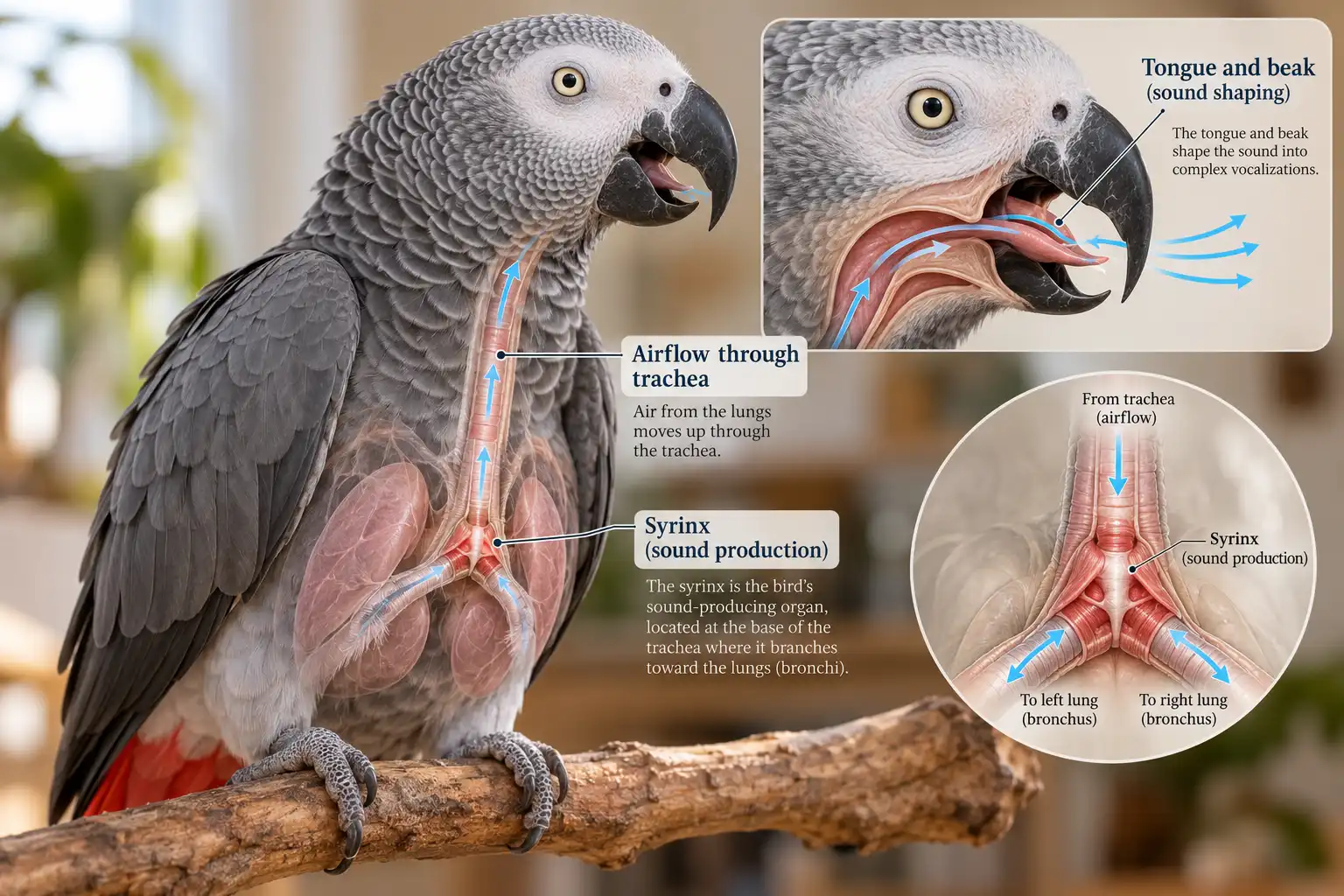
How do parrots talk without human vocal cords? The answer involves a specialized sound-producing organ, flexible mouth movements, and an unusual ability to learn sounds. Understanding these mechanisms also explains why some parrots imitate words clearly, while others never speak.
Parrots talk by producing sound in the syrinx, near the base of the windpipe. Their tongue and beak shape that sound, while specialized brain circuits help them learn human speech patterns. Mimicking words does not always mean understanding them.
How Do Parrots Talk Without Vocal Cords?
Parrots produce recognizable speech using the syrinx, a vocal organ located where the trachea divides into the two bronchi.
Humans make their voices using vocal folds in the larynx. Parrots have a larynx, too, but their main sound-producing organ is the syrinx.
Three processes allow parrots to imitate words.
- Sound production: Air passes from the lungs through the syrinx, causing specialized tissues to vibrate.
- Sound control: Muscles around the syrinx adjust the vibrations, helping regulate pitch and other sound characteristics.
- Sound shaping: The tongue, beak, and vocal tract modify the resulting sound, making speech-like patterns possible.
The tongue plays a particularly interesting role. A 2004 study published in Current Biology examined how tongue movements affected sound in five monk parakeets.
Researchers found that changing tongue position significantly altered acoustic resonances. These findings help explain how parrots produce sounds resembling human speech. Therefore, parrots do not need human-style vocal cords or lips to imitate words.
Why Can Parrots Mimic Human Speech?
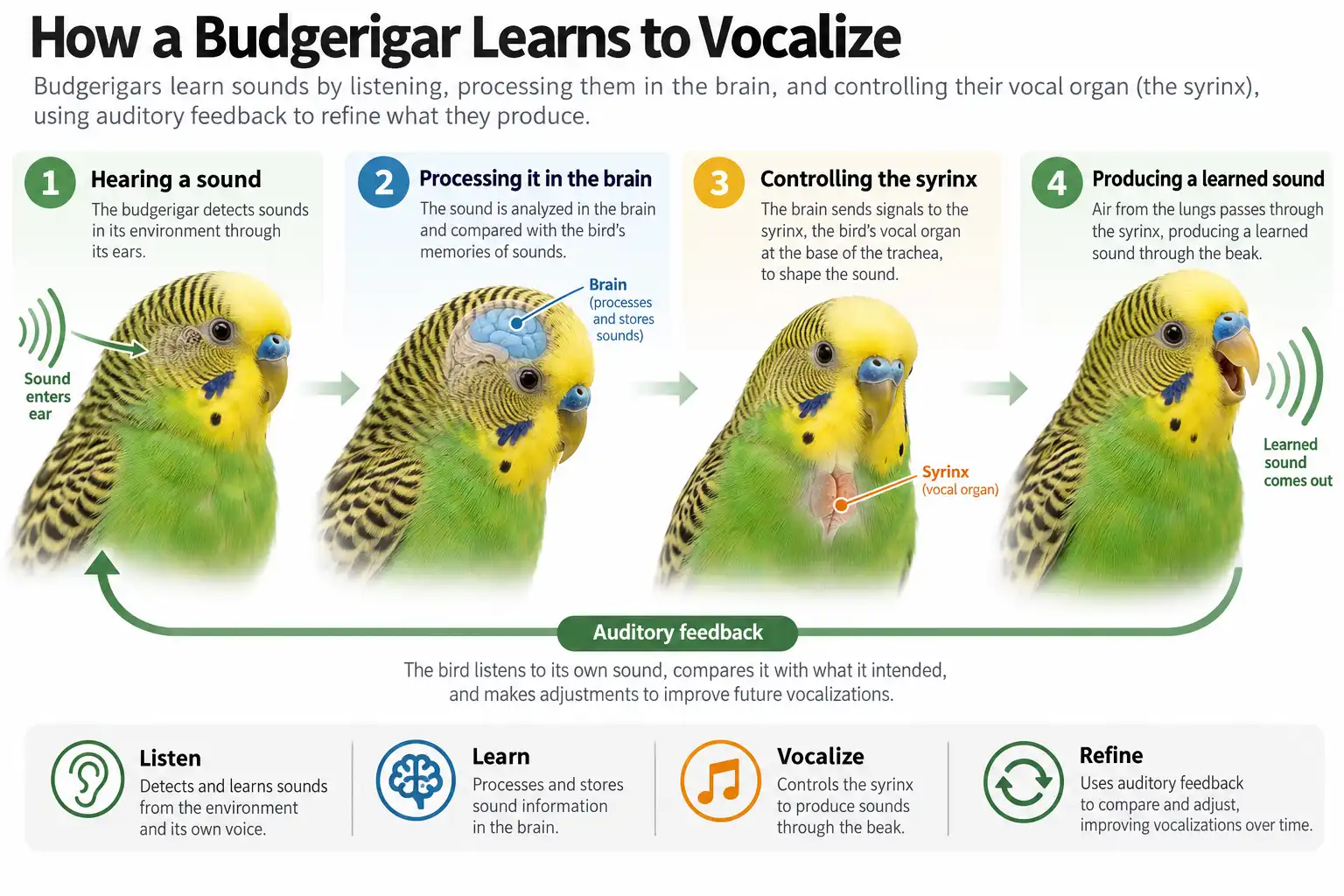
Parrots imitate human speech because they are vocal learners. This means they can learn new sounds by hearing them and practicing their production. Many animals communicate using inherited vocal patterns. Parrots have greater flexibility in what they learn to produce.
How does a parrot’s brain learn speech?
Specialized brain circuits help parrots control and reproduce learned sounds. A 2025 study published in Nature investigated vocal-control neurons in the budgerigar (budgie).
Researchers found that a brain region called the central nucleus of the anterior arcopallium represents vocal features, including pitch. Its activity showed notable similarities to aspects of human speech motor control.
However, this does not mean budgerigars process language exactly like humans. The finding helps explain their remarkable control over learned vocal sounds.
Why do parrots repeat human words?
Parrots naturally communicate through social calls. Many species learn and adjust vocalizations during interactions with other parrots. In a home, human voices become familiar sounds.
A companion parrot may imitate:
- Greetings such as “hello”
- Familiar names and short phrases
- Laughter, whistles, and coughing
- Phone rings, alarms, and other electronic sounds
Repeated exposure can help a parrot remember sounds. Social interaction may also influence which sounds it chooses to reproduce.
Do Parrots Understand What They Say?
Some parrots can associate words with objects, actions, or situations. However, repeating human speech does not necessarily mean they understand its meaning. There is a difference between mimicry and meaningful word use. For example, a parrot might say “hello” when someone enters a room.
It may have learned that this sound accompanies a greeting. That association does not prove it understands language as a human does.
What did Alex the African gray parrot understand?
Researcher Irene Pepperberg studied an African gray parrot named Alex to investigate communication and cognition. In a 1988 study published in the Journal of the Experimental Analysis of Behavior, Alex answered questions about similarities and differences between objects. He responded using learned labels for color, shape, and material. He also used the response “none” when appropriate.
The findings provided evidence that Alex understood certain learned concepts rather than simply repeating sounds.
However, his abilities developed through extensive training.
Alex’s performance does not mean every talking parrot understands words at the same level.
Parrot speech can range from simple sound imitation to meaningful use of particular learned words.
Can All Parrots Talk? Which Birds Are Best at Speaking?
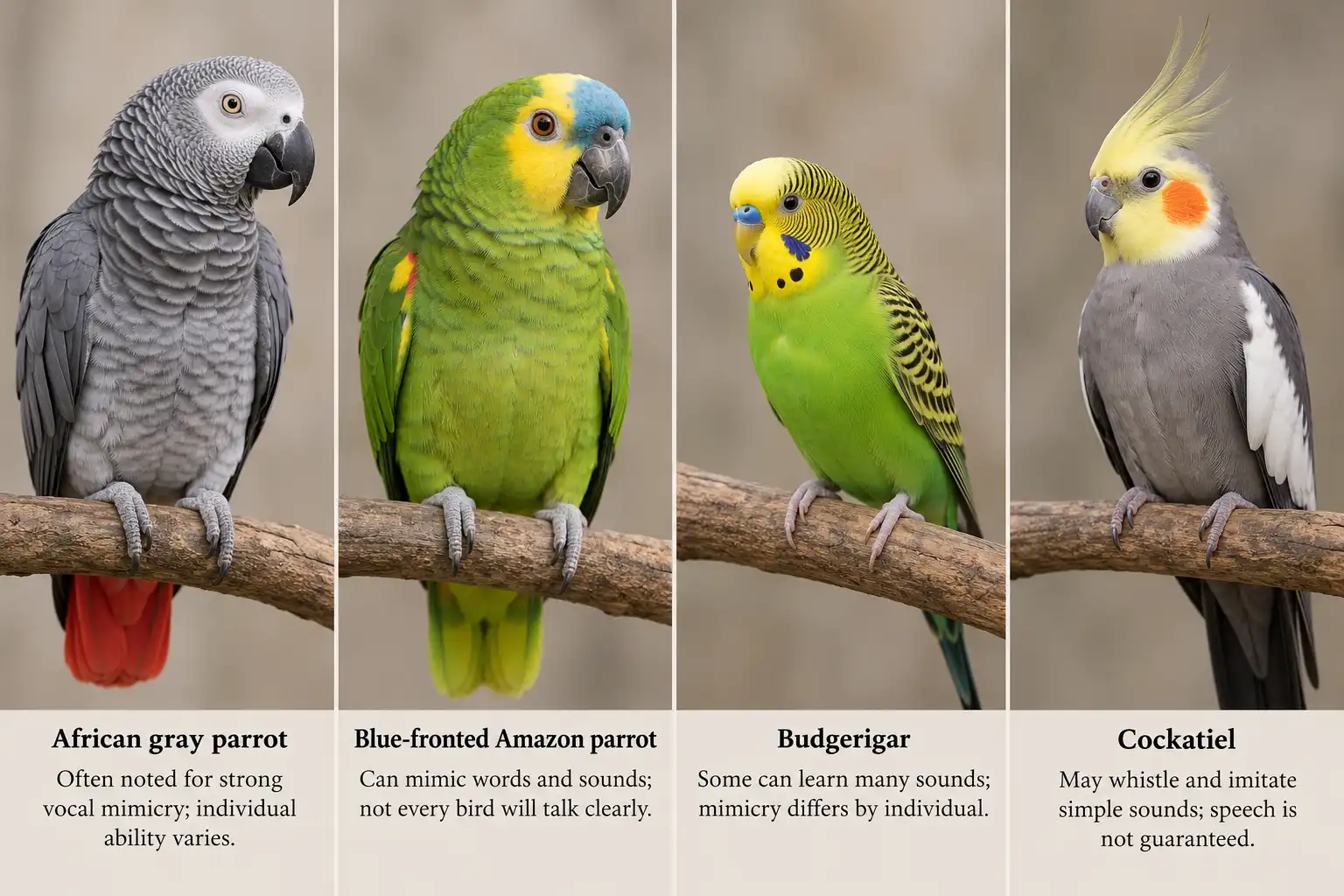
No. Not every parrot learns human words, even within species known for excellent mimicry. A 2022 study published in Scientific Reports analyzed owner-reported vocal repertoires from 877 parrots representing 73 species. African gray parrots had the largest reported mimicry repertoires in the sample.
However, the researchers also found considerable variation between individual birds.
The study relied on owner reports and attracted many participants whose parrots already mimicked sounds. Its findings cannot predict whether an individual bird will talk.
Which parrot species can imitate human speech?
| Parrot species | Speech characteristics |
|---|---|
| African gray parrot | Often capable of extensive vocal mimicry, although individual abilities vary |
| Amazon parrot | Many imitate words, songs, and household sounds |
| Budgerigar (budgie) | Some learn large repertoires of words, often spoken rapidly in high-pitched voices |
| Cockatiel | Frequently imitates whistles and melodies; some also learn words |
| Macaw | Some imitate recognizable phrases, alongside their natural calls |
Budgerigars are small parrots often called parakeets in the United States. However, the word “parakeet” also refers to several other parrot species.
Which is better for someone who wants a talking bird?
An African gray parrot is a reasonable species to research for its documented vocal abilities, but talking should never be the only reason to choose one. Budgies can also imitate speech despite their small size.
For people comparing smaller companion birds, the differences in budgie and cockatiel behavior and care matter more than a promise of talking.
No species, sex, age, or purchase price guarantees a talking bird.
How Do You Teach a Parrot to Talk?
Teach a parrot to talk through repeated words, consistent situations, and positive reinforcement. A calm, comfortable bird is more likely to participate voluntarily. Avoid forcing interactions or expecting immediate results. VCA Animal Hospitals recommends patience and positive reinforcement in companion bird training.
Step 1: Start with one simple word
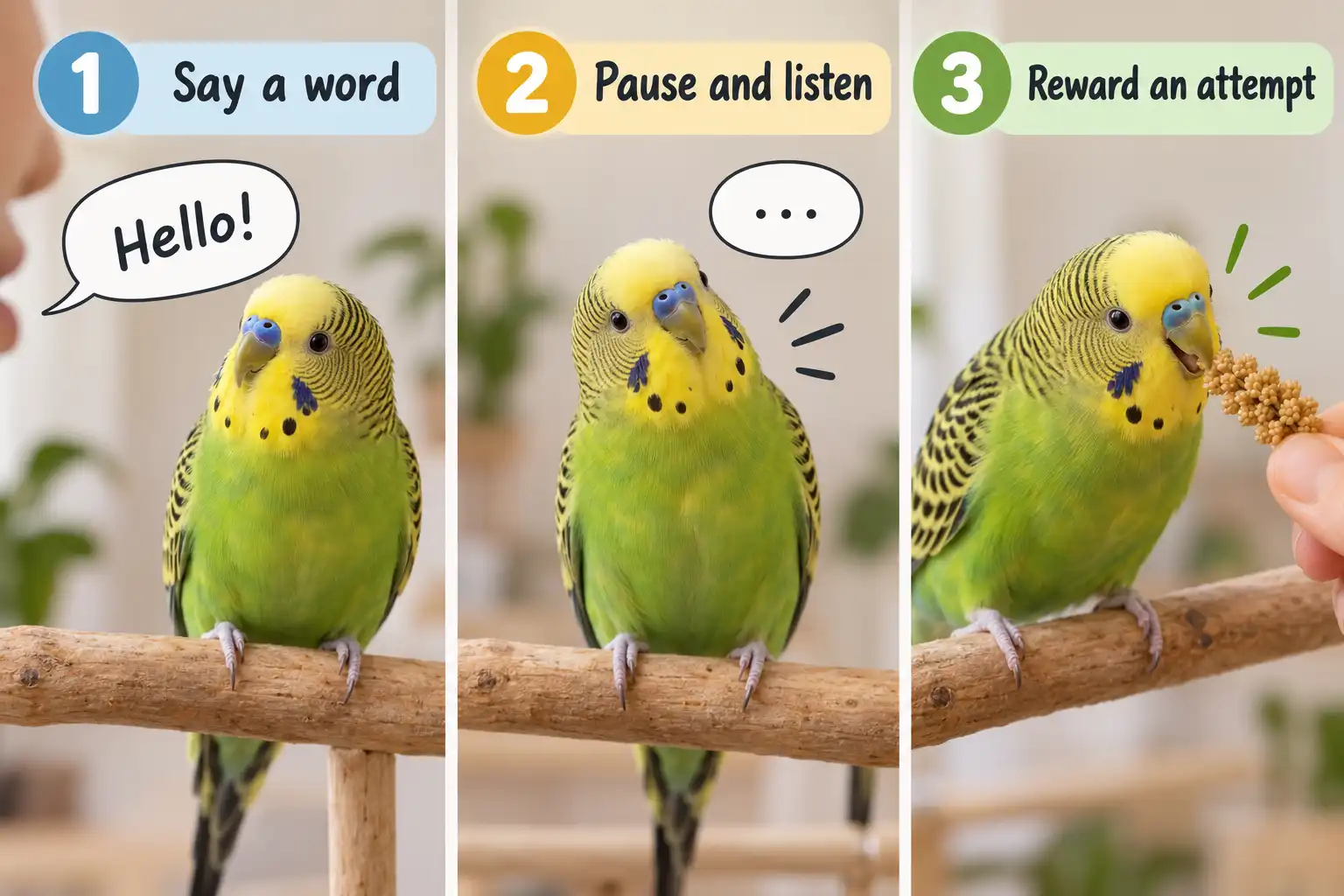
Choose a short, familiar word such as “hello.”
Use it consistently during greetings. Starting with one word makes practice easier to organize.
Step 2: Keep training sessions short
Try one or two brief sessions per day.
VCA’s general bird-training guidance suggests starting with sessions lasting 5 to 10 minutes. This is not a proven speech-learning timetable.
Stop earlier if your parrot loses interest.
Step 3: Say the word clearly
Speak naturally and use consistent pronunciation.
After saying the word, pause and allow your parrot an opportunity to respond.
Avoid overwhelming it with continuous repetition.
Step 4: Reward voluntary attempts
Offer praise when your parrot attempts the sound.
You may also use a suitable food reward from its normal diet. Choose rewards according to your parrot’s species and appropriate pet bird nutrition.
Never withhold food to encourage speech.
Step 5: Connect words to situations
Use “hello” when greeting your bird and “good morning” during the morning routine.
Consistent contexts may help it associate sounds with particular events.
Progress should remain voluntary. Never punish a parrot for remaining silent.
How Long Does It Take a Parrot to Learn Words?
There is no reliable timeline for when an individual parrot will say its first recognizable word. Some parrots begin by imitating whistles and household noises. Others gradually produce clearer word-like sounds. Some never develop recognizable speech.
The 2022 Scientific Reports survey found that age-related patterns differed between species. Among the African gray parrots studied, reported repertoire size did not increase during adulthood.
That finding does not mean adult African grays cannot learn new words. The survey measured reported repertoires, not each bird’s lifetime learning limit.
If you are teaching a parrot, keep a simple record of new sounds and attempted words.
Review progress over several weeks, but avoid setting a deadline. Successful training cannot guarantee speech.
Why Is My Parrot Not Talking?
A parrot that has never spoken may simply prefer natural calls, whistles, or other sounds. However, a sudden decrease in normal vocal activity deserves prompt veterinary attention. Birds often hide illness, so an unexpected change in behavior should not be dismissed.
The Merck Veterinary Manual lists reduced talking or singing among possible signs of illness.
Seek same-day veterinary care if your parrot stops eating, sits fluffed on the cage floor, or develops tail bobbing or open-mouth breathing.
If your parrot is otherwise healthy, consider these common training difficulties:
| Situation | What to try |
|---|---|
| Never attempts words | Accept normal vocal preferences and continue optional, gentle practice |
| Only whistles or makes calls | Reinforce desired attempts without discouraging natural sounds |
| Loses interest quickly | Shorten sessions and reduce distractions |
| Copies sounds but not the chosen word | Use one consistent word during a familiar daily activity |
| Suddenly becomes unusually quiet | Contact an avian veterinarian instead of increasing training |
Changes in appetite, energy, breathing, or droppings also warrant attention. Learn to recognize early warning signs of illness in birds.
Is Talking Necessary for a Parrot’s Well-Being?
No. A parrot does not need to speak human words to communicate or enjoy a healthy, enriched life. Natural calls, whistles, body movements, and other behaviors all serve communication purposes.
Speech practice should never replace social interaction, suitable exercise, foraging activities, or other enrichment. Talking ability also does not guarantee a quiet pet. Parrots still make natural calls, and their volume varies by species and individual.
Before choosing a talking species, consider the long-term commitment involved in parrot lifespans.
FAQs about Parrot Speech
Can female parrots talk?
Yes. Female parrots can imitate human words, and males are not universally better talkers. The 2022 Scientific Reports survey found no consistent overall sex effect, although certain species showed differences in reported repertoires.
Can parrots speak English and other languages?
Yes. Parrots with vocal mimicry abilities can reproduce sounds from English and other languages they hear. However, copying words from a language does not mean they understand its grammar or every word’s meaning.
Can an older parrot learn to talk?
Yes. Parrots have the capacity for lifelong vocal learning, so adulthood does not automatically prevent new sound imitation. Individual differences remain substantial, and an older parrot may never develop recognizable human speech.
Can parrots learn words from recordings?
Some parrots may imitate sounds from recordings, but repeatedly playing words does not guarantee learning or comprehension. Interactive practice provides a natural context for words and opportunities to reinforce voluntary attempts.
Are parrots the only birds that can talk?
No. Some mynah birds, starlings, and members of the crow family can also imitate human speech. This ability does not make wild birds suitable pets, and native wild birds should never be captured for speech training.
How much does a talking parrot cost?
There is no single U.S. price for a talking parrot. Adoption and purchase costs vary by species and source, while housing, food, enrichment, and veterinary care add ongoing expenses; no price guarantees speech.
What Makes Parrot Speech Remarkable?
Parrots produce speech-like sounds through a combination of syrinx vibrations, vocal-tract movements, and learned brain control.
Some imitate words without clear comprehension. Others associate certain words with meaningful situations or concepts.
If you live with a pet parrot, encourage communication through patient, positive interactions. Talking is an interesting ability, but it is not a measure of a bird’s intelligence or well-being.

