
How Long Do Parrots Live? Lifespans for 12 Pet Species, Budgie to Macaw
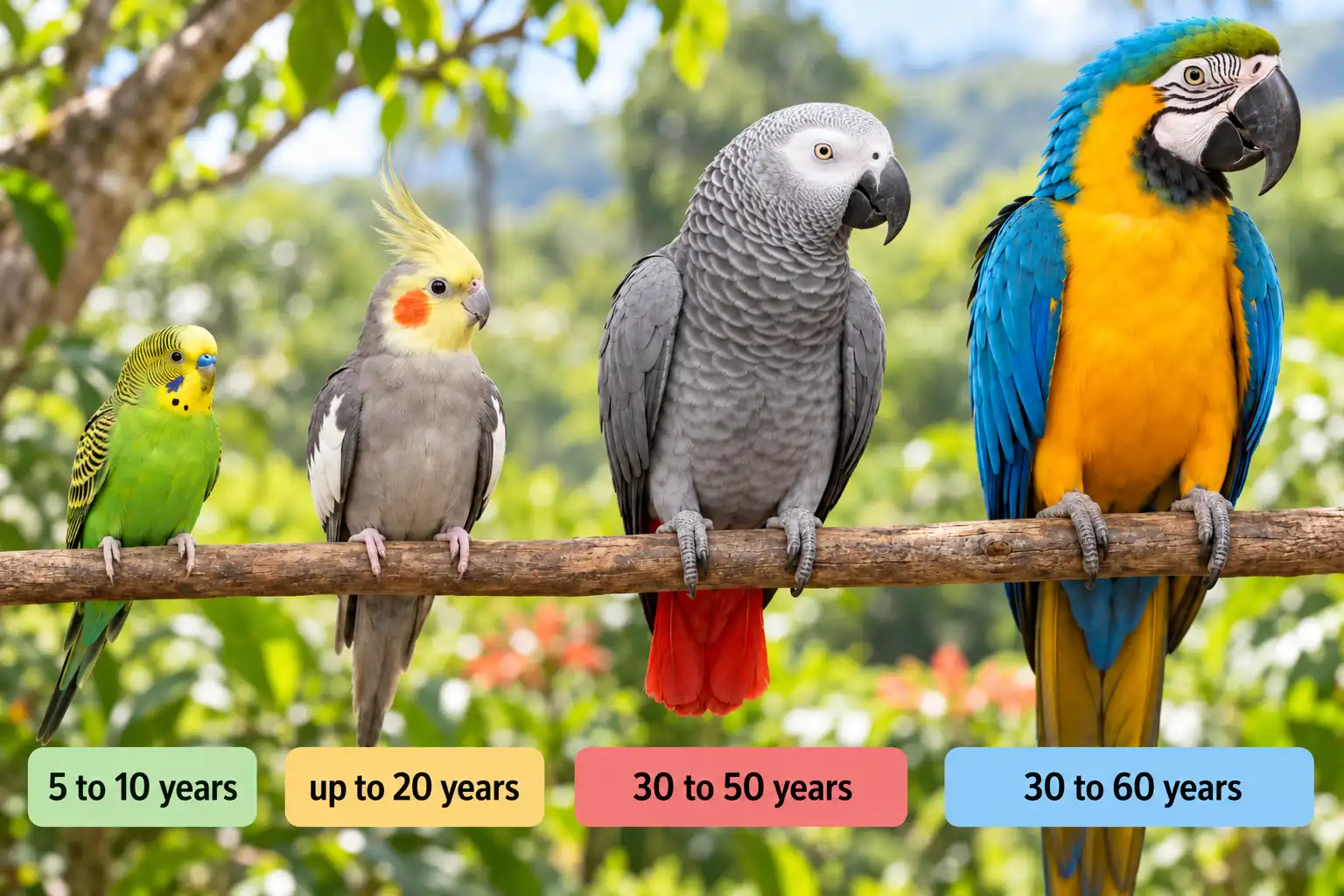
How long do parrots live? Species decides most of it, then diet, vet care, and safety at home. Below, you’ll find published ranges for 15 pet species and why vet references disagree. You’ll also see when a bird counts as old and how old you’ll be by then.
How long parrots live depends mainly on species. The Merck Veterinary Manual lists 5 to 10 years for budgerigars and up to 20 for cockatiels. It gives African grays 30 to 50 and macaws 30 to 60.
How Long Do Parrots Live as Pets? Lifespans by Species
As pets, budgerigars live 5 to 10 years and macaws 30 to 60, per Merck’s table of popular pet birds. Every other species below falls between those two. The last column shows how old a 40-year-old buyer would be when the bird reaches its range.
| Species | Average lifespan (Merck) | If you buy one at 40, you’ll be |
|---|---|---|
| Budgerigar (budgie) | 5 to 10 years | 45 to 50 |
| Parrotlet | Up to 20 years | Up to 60 |
| Lovebird | Up to 20 years | Up to 60 |
| Cockatiel | Up to 20 years | Up to 60 |
| Indian ring-necked parakeet | Up to 20 years | Up to 60 |
| Green-cheeked conure | Up to 25 years | Up to 65 |
| Sun conure | Up to 30 years | Up to 70 |
| Caique | 20 to 30 years | 60 to 70 |
| Quaker (monk) parakeet | 20 to 30 years | 60 to 70 |
| Pionus parrot | 25 to 30 years | 65 to 70 |
| Eclectus parrot | 20 to 50 years | 60 to 90 |
| Cockatoo | 25 to 50 years | 65 to 90 |
| African gray | 30 to 50 years | 70 to 90 |
| Amazon parrot | 40 to 50 years | 80 to 90 |
| Macaw | 30 to 60 years | 70 to 100 |
Size drives the pattern. Merck calls the macaw the largest of the parrots, and its range reaches highest. The small budgerigar’s range is the shortest.
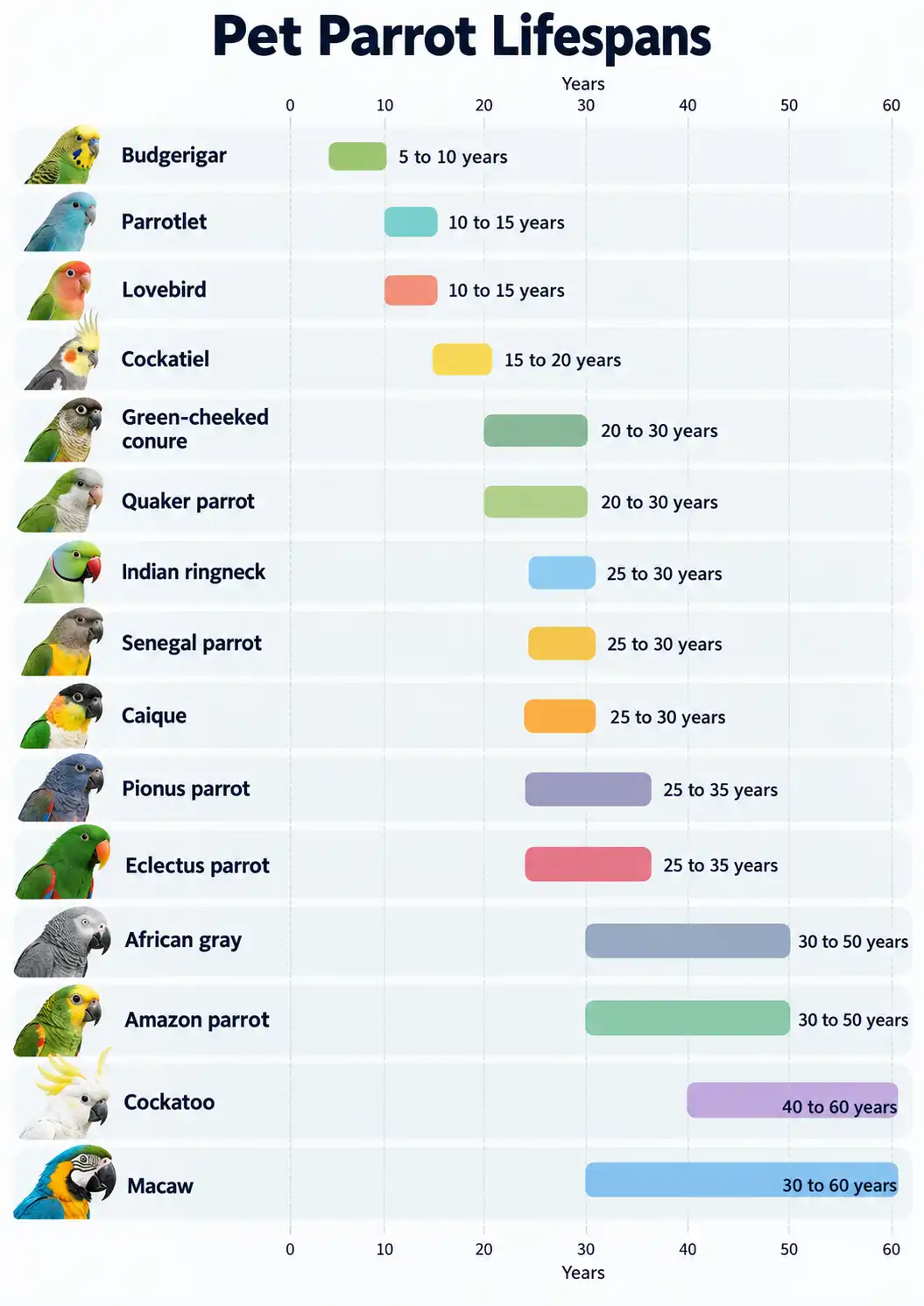
Species by Species: Where Merck and VCA Differ
VCA Animal Hospitals publishes its own lifespan figures in client handouts written by veterinarians. Where VCA and Merck differ, both appear below.
Budgie and Other Parakeet Lifespans
A budgerigar (budgie) lives 5 to 10 years on average, according to Merck. VCA notes that budgerigars also go by parakeet, yet other parakeets live far longer. Merck gives Indian ring-necked parakeets up to 20 years and Quaker (monk) parakeets 20 to 30.
Check the law before buying a Quaker, though. Merck lists 12 states where owning one is illegal. They are California, Colorado, Connecticut, Georgia, Hawaii, Kentucky, Maryland, New Jersey, Pennsylvania, Rhode Island, Tennessee, and Wyoming. Because state rules change, confirm with your state wildlife or agriculture agency first.
How Long Do Cockatiels Live?
Cockatiels live 10 to 14 years on average, with a maximum of 24, according to VCA Animal Hospitals. Merck puts the upper end at 20 years. The two fit together, since VCA gives the typical span and Merck’s “up to” marks the top. So plan for about 20 years. Deciding between a cockatiel and a budgie? Then compare the budgie and cockatiel on noise, feather dust, and cost too.
Lovebird and Parrotlet Lifespans
Lovebirds average 10 to 15 years, with a maximum around 20, per VCA. Merck gives both lovebirds and parrotlets, which it notes are also called pocket parrots, up to 20 years. That puts a lovebird closer to a cockatiel than to a budgie.
Green-Cheeked and Sun Conure Lifespans
A green-cheeked conure can live up to 25 years, per Merck, which groups it with the small Pyrrhura conures. Larger conures such as the sun conure reach up to 30 years, Merck says. VCA’s conure handout, by contrast, gives 20 to 35 years for conures as a group, without splitting small from large.
African Gray (Grey) Parrot Life Expectancy
African gray parrots, often spelled grey, live 30 to 50 years, according to Merck. Diet matters a great deal for this species. Low blood calcium shows up more often in African grays fed all-seed diets, Merck notes, and seeds hold little calcium. The condition can cause weakness, tremors, and seizures.
Amazon Parrot Life Expectancy
Amazon parrot life expectancy runs 40 to 50 years, per Merck. No species in Merck’s table has a higher minimum. Weight is the risk to watch, though. Merck says Amazon parrots, macaws, galah cockatoos, and Quaker parrots are especially likely to become obese.
Cockatoo Lifespan, Including the Sulfur-Crested
Cockatoos live 25 to 50 years, per Merck, and 25 to 45 years, per VCA. VCA adds that larger cockatoo species can reach 70 to 80 years, so size within the group matters. VCA counts the Goffin’s, lesser sulfur-crested, and citron-crested among the smaller cockatoos.
For the greater sulfur-crested cockatoo, zoo records in the Max Planck study averaged about 25 years from hatching. The oldest parrot on record was a cockatoo, too. Guinness World Records lists Cookie, a Major Mitchell’s cockatoo, at no less than 82 years and 88 days.
How Long Can a Macaw Live?
A large macaw, such as the blue-and-gold, scarlet, green-winged, or hyacinth, can live 50 to 60 years, according to VCA. VCA puts the maximum near 75 and mentions reports of large macaws living past 90. Mini-macaws, such as Hahn’s, yellow-collared, and severe macaws, live 30 to 40 years, per VCA. Merck, meanwhile, lists 30 to 60 years for macaws as a group. Scarlet macaws averaged more than 35 years from hatching in the Max Planck study’s zoo records. That was the study’s highest estimate.
Why Published Parrot Lifespans Disagree
Searches for the average life expectancy of parrots turn up three different kinds of numbers:
- Vet reference ranges describe how long a pet of that species tends to live. Merck labels its column “average lifespan,” but many entries read “up to,” which marks the upper end.
- Zoo life expectancy is the average age at death of every bird in the records, counted from hatching. Chicks that die young pull it down.
- Record ages belong to single, exceptional birds, such as Cookie the cockatoo.
The zoo figures below come from a 2022 study led by the Max Planck Institute of Animal Behavior. It drew on Species360 records for 133,818 zoo parrots. Its authors described it as the most comprehensive analysis of parrot longevity at the time. The study also warns that a record age depends heavily on how many birds were counted.
| Species | Vet reference range | Zoo life expectancy from hatching |
|---|---|---|
| Budgerigar | 5 to 10 years (Merck) | 4.6 years |
| Cockatiel | 10 to 14 years, maximum 24 (VCA) | 8.3 years |
| Congo African gray | 30 to 50 years (Merck) | 18.6 years |
| Sulfur-crested cockatoo | 25 to 50 years for cockatoos (Merck) | 25.2 years |
| Scarlet macaw | 30 to 60 years for macaws (Merck) | 35.5 years |
Every zoo average lands below the vet range or in its lower part, as expected once early deaths count. For planning, use the top of the vet range, since a well-kept bird can reach it.
When Does a Parrot Count as Old?
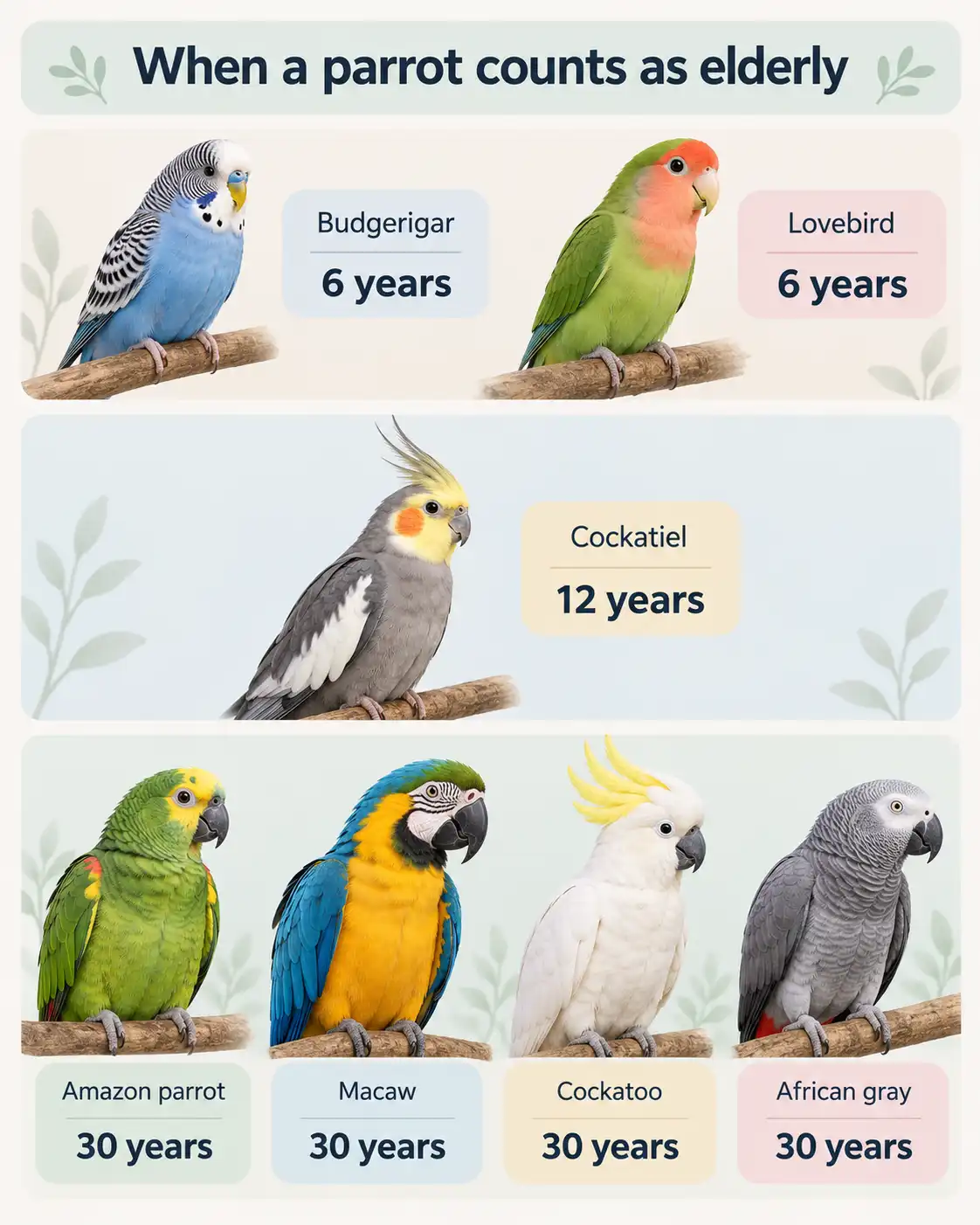
A 2009 Zoo/Exotic Pathology Service summary counted budgerigars as elderly from 6 years and cockatiels from 12. It put large parrots such as Amazons, macaws, cockatoos, and African grays in that group from 30. Its lovebird group started at 6 years.
So a 6-year-old budgie is already a senior, while a 6-year-old macaw has decades ahead. A 2010 review by veterinary pathologists Drury Reavill and Gerry Dorrestein describes how aging shows up. Atherosclerosis, cataracts, long-term lung and liver scarring, and some tumors turn up more often in older parrots.
Checkups matter more with age. VCA’s handouts call for exams twice a year for budgerigars, African grays, and Amazon parrots. For cockatiels, conures, cockatoos, and lovebirds, VCA advises once a year. Ask your avian vet whether an older bird needs more.
How Old Will You Be When Your Parrot Is Old?
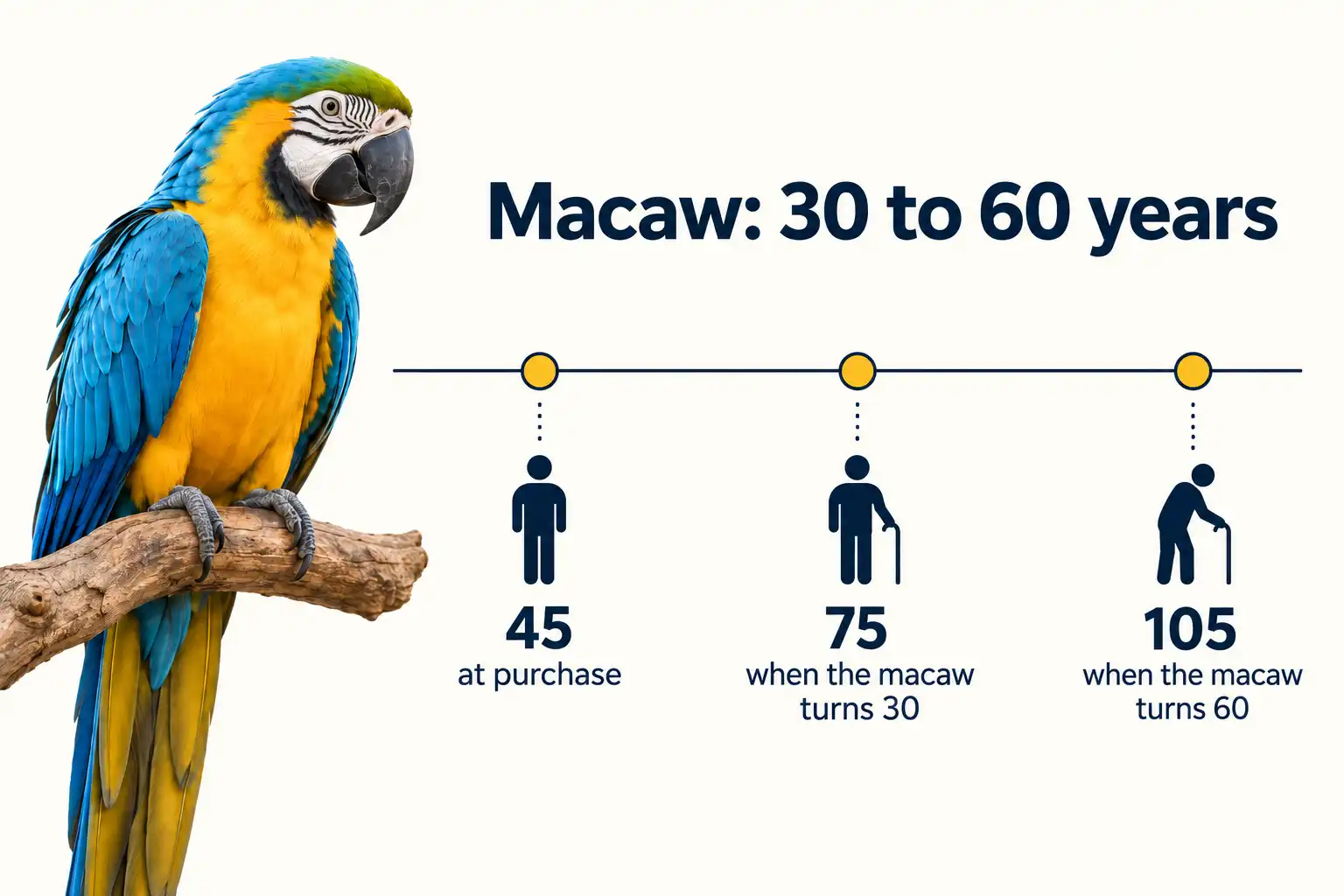
Add the species’ lifespan range to your age today. The result is your age when a young bird reaches the span its vet reference lists.
Your age at the end = your age today + the species’ lifespan range
Say you’re 30 and buy a budgerigar. You’ll be 35 to 40 by the end of Merck’s 5 to 10 years. With an Amazon parrot, you’d be 70 to 80 by Merck’s figures. With a macaw, Merck’s range puts you at 60 to 90. That’s how a large parrot can outlive the person who buys it.
An adult bird changes the math. A 10-year-old cockatiel has already lived half of Merck’s 20-year ceiling for the species, which can suit an older owner.
If a parrot’s age span runs past your own plans, prepare now.
- Name a caregiver, in writing, who has agreed to take the bird.
- Set aside money for food, housing, and avian vet care.
- Ask an attorney whether a pet trust fits your situation.
- Keep a care sheet listing diet, routine, and vet contacts.
What Shortens a Parrot’s Life, and What Helps
Diet, household hazards, and hidden illness can all cut a parrot’s life short. Each one has a fix.
Seed-Heavy Diets and Extra Weight
The Merck Veterinary Manual updated its pet bird nutrition guidance in May 2026. It warns that high-fat seed and nut diets lack many essential vitamins and minerals. Instead, Merck’s goal is a balanced pelleted diet with a smaller share of fresh vegetables and fruit. Birds that eat mostly seed should switch gradually. Build your bird’s daily menu around pellets, then add the fresh foods.
Extra weight is the other risk. Merck defines obesity as 20% over ideal weight and calls galahs, macaws, Amazon parrots, and Quaker parrots especially prone. The causes, per Merck, are high-fat food, too much food, and too little exercise. Merck’s veterinary edition also advises weighing birds weekly. So ask your avian vet for your bird’s ideal weight, then check it each week on a gram scale.
Weight change (%) = (this week’s grams minus ideal grams) ÷ ideal grams × 100
For example, a lovebird with an ideal weight of 50 grams that now weighs 60 is 20% over. That’s the point Merck calls obese, so book an avian vet visit.
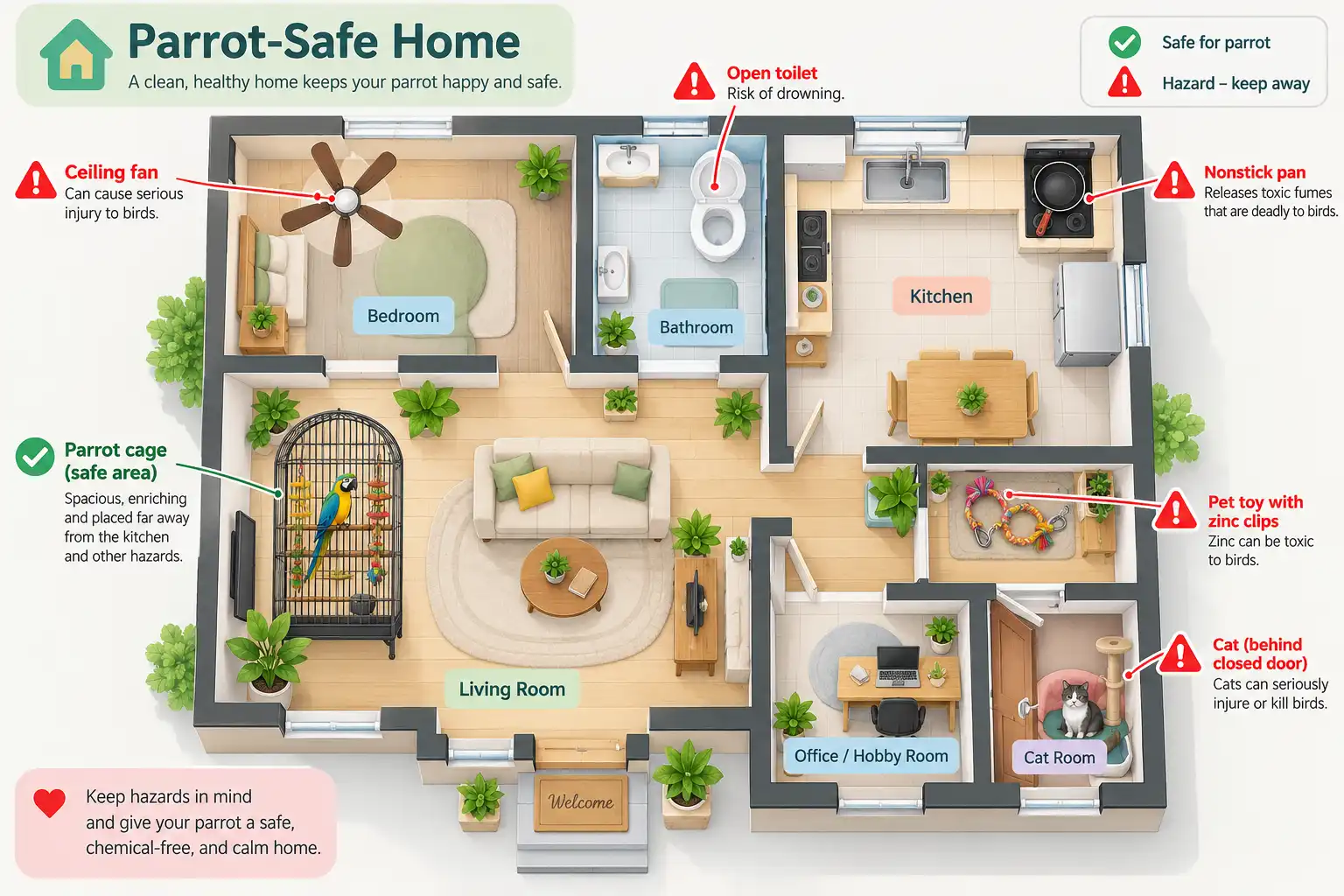
Fumes, Metals, and Other Household Hazards
VCA Animal Hospitals warns that overheated nonstick (PTFE) coatings release toxic particles and gases. In many cases, birds die suddenly, before or soon after signs appear. Any bird exposed to those fumes needs a vet immediately. Most PTFE poisonings start with overheated nonstick cookware, VCA notes, so bird-safe pots and pans remove the most common source. VCA also advises keeping birds out of the kitchen.
VCA’s list of other dangers includes:
- Smoke from cigarettes, cooking, or a fireplace
- Open water in toilets, sinks, and fish bowls
- Running fans, especially ceiling fans
- Lead or zinc in some toys and household items, a life-threatening poisoning risk
- Cats and dogs, which VCA says never to leave alone with a bird
Already have a cat? Plan a home shared by a cat and a bird before the bird arrives.
Illness That Stays Hidden
Regular exams catch problems you can’t see. VCA notes that checkups can uncover hidden illness. To find an avian vet, VCA points owners to the Association of Avian Veterinarians website.
Call an avian vet the same day for any of these signs:
- Sitting fluffed up on the cage floor
- Tail bobbing or open-beak breathing
- Not eating
- Bleeding that won’t stop
- A hen straining without passing an egg
- Any contact with a cat’s teeth or claws
- Possible exposure to fumes
Merck notes that puffed-up feathers can mean a bird is sick. Learn the early signs of illness that need a vet before you need them.
FAQs about Parrot Lifespan
Can a parrot live to 100?
Not that anyone has verified, according to Guinness World Records, which tracks the world’s oldest animals. Its oldest parrot ever, a Major Mitchell’s cockatoo named Cookie, died in 2016 aged at least 82 years.
How old is a parrot in human years?
There’s no reliable conversion, because species age at very different speeds. Senior ages work better, per Zoo/Exotic Pathology Service: 6 for budgies, 12 for cockatiels, and 30 for large parrots.
Do parrots live longer in captivity than in the wild?
For most species, nobody can say, because good wild lifespan data is scarce. The Max Planck team chose zoo records partly because captivity removes most predation and starvation, so aging shows clearly.
What is the longest-living pet parrot?
Large macaws and cockatoos live longest, and the Max Planck zoo study ranked them the longest-lived groups. VCA gives large macaws 50 to 60 years and says larger cockatoo species can reach 70 to 80.
Do bigger parrots always live longer?
Mostly, though body size isn’t the whole story behind a long life. In the Max Planck study, bigger species tended to live longer, as did species with bigger brains for their size.
Which parrot suits an older owner?
A shorter-lived species or an adult bird fits best, since adopting a grown bird trims the years ahead. Merck lists 5 to 10 years for budgerigars and up to 20 for cockatiels and lovebirds.
Key Points for Your Bird
Pick a species whose lifetime ends at an age you can plan for, using the top of its range. Feed a pellet-based diet, weigh weekly, and keep PTFE, smoke, and unsupervised pets away from the bird. Then book checkups on VCA’s schedule for your species, and name a caregiver in writing.

