When Do Chickens Start Laying Eggs? Age, Daylight, and Breed
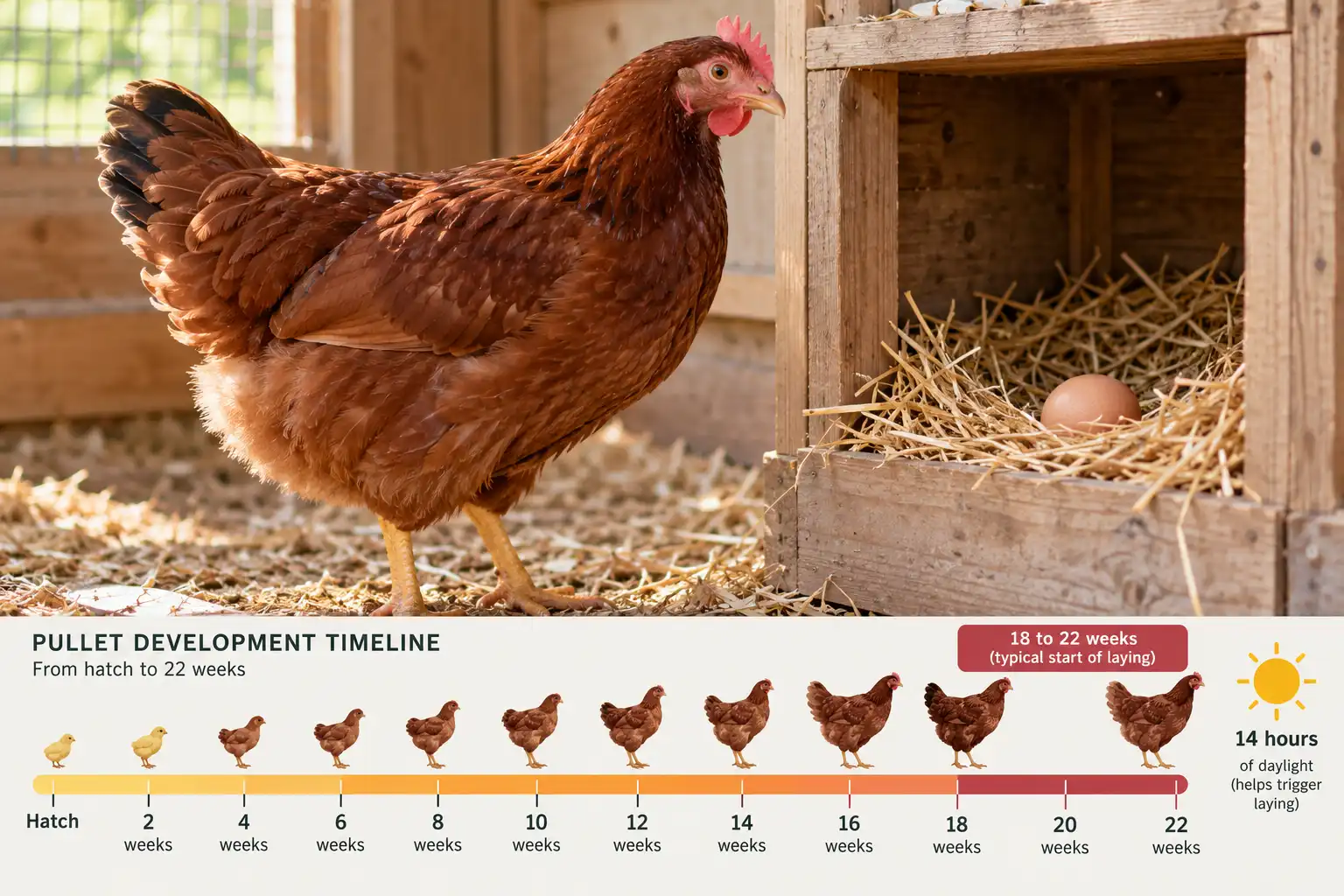
When do chickens start laying eggs? Age sets a window of a few weeks. Breed, day length, and feed decide where your pullets fall inside it. Short winter days can push the first egg past it entirely.
Most chickens start laying eggs at 18 to 22 weeks old, about 4 to 5 months, per UF/IFAS and UW Extension. Breed shifts timing within that range, and short winter days can delay a pullet’s first egg until spring.
How Old Are Chickens When They Start Laying Eggs?
Most chickens lay their first egg at 18 to 22 weeks old. UF/IFAS Extension gives that range for backyard chicken flocks, with breed and season deciding where a flock lands. The University of Wisconsin-Madison Extension gives chickens the same 18 to 22 weeks. That figure assumes the chickens get 14 to 16 hours of light, good feed, and sound housing.
High-output strains follow the same timeline. Texas A&M AgriLife Extension says Leghorn-strain chickens, its top layers, begin at about 5 months. It also notes that some keepers skip the wait and buy ready-to-lay pullets at 16 to 18 weeks old.
So what age do hens start to lay eggs in your own flock? Expect a spread. Poultry Extension notes that hens in one flock don’t all begin on the same day.
How Daylight Changes When Chickens Start Laying Eggs
Chickens come into lay as days get longer. Dr. Jacquie Jacob of the University of Kentucky, writing for Poultry Extension, calls them long-season breeders for that reason. UF/IFAS adds that laying chickens need about 14 hours of light to keep producing. On natural light alone, it expects flocks that stop in fall to start again in spring.
That makes a pullet’s hatch date more useful than her age alone.
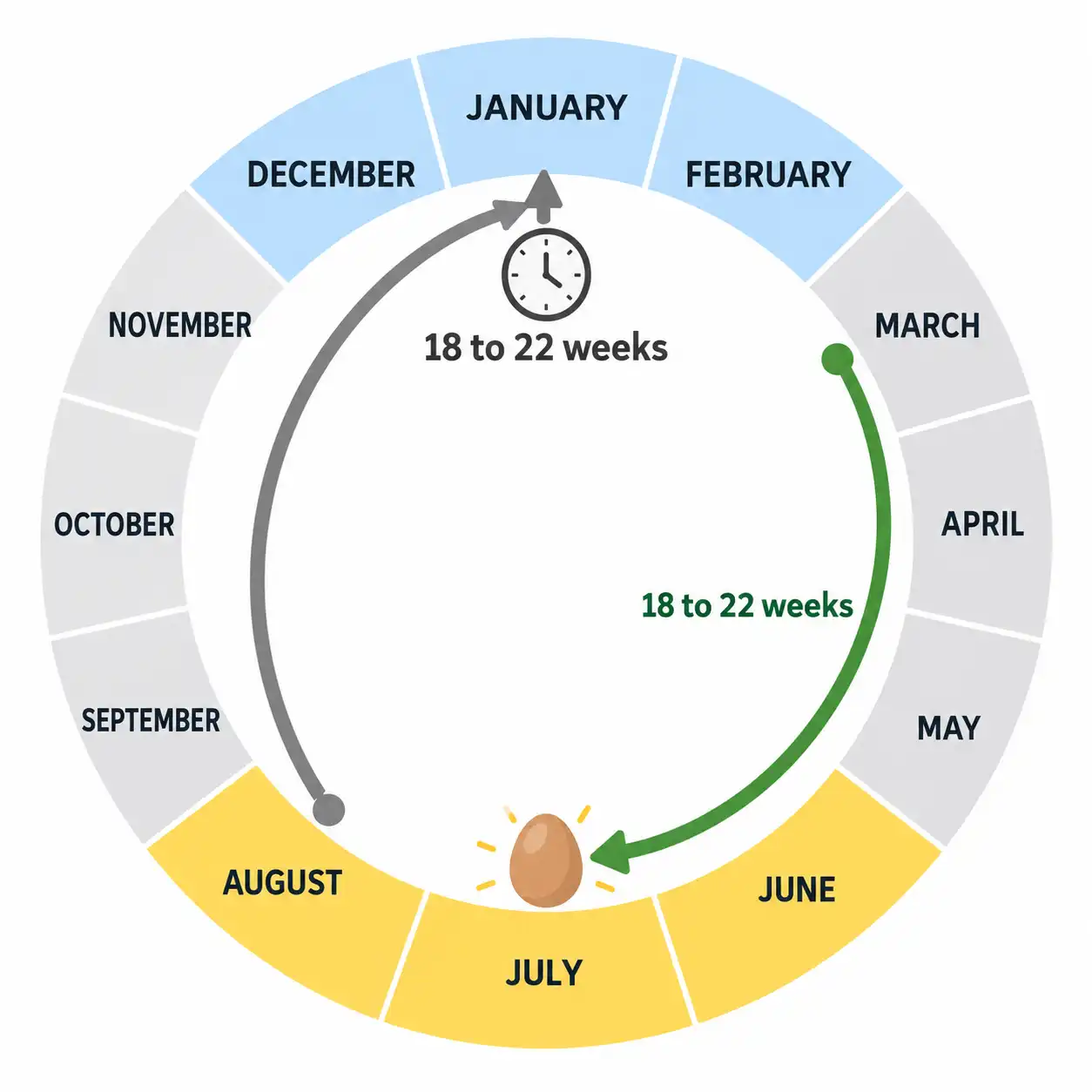
Work Out Your Pullets’ First Egg Window
Run this check for your own chicks:
First egg window = hatch date + 18 to 22 weeks
Then see where that window falls on the calendar.
- Hatched March 1: the pullets reach 18 weeks on July 5 and 22 weeks on August 2. Days are long, so first eggs usually show up on time.
- Hatched August 15: the pullets’ window runs from December 19 to January 16, the shortest days of the year. On natural light, expect the first egg to wait for longer days.
Should You Add Light?
Extra light is optional. If you add it, Texas A&M AgriLife advises no artificial light for pullets before 18 weeks, then a 14-hour day. UW Extension suggests a timer that adds morning and late-afternoon light, letting the chickens roost at sunset.
Don’t rush it, though. Poultry Extension warns that pullets starting too early may develop prolapse and lay smaller eggs for the whole cycle. Tissue pushing out of a hen’s vent needs a vet the same day.
Signs a Pullet Is Close to Laying
Watch her comb first. In many breeds, a laying hen has a large, bright red comb and wattles, according to Poultry Extension. So a small, pale comb that grows and reddens is a good sign eggs are on the way.
Her body changes too. Poultry Extension also gauges laying by the width between a hen’s pubic bones. A laying hen has more room there.
Set up nests before the first egg is due. Texas A&M AgriLife recommends one nest for every four laying chickens, set 24 inches above the litter. Line the nests with shavings or hay to keep eggs clean.
When to Switch Pullets to Layer Feed
Switch at the first egg, not before. Texas A&M AgriLife keeps pullets on a developer ration until the first egg appears. It also warns against layer feed for pullets younger than 16 weeks.
Calcium is the reason. UF/IFAS says a chicken’s calcium need rises at least fourfold when she lays her first eggs. Before that point, a high-calcium layer diet throws a young chicken’s calcium and phosphorus out of balance. UF links that imbalance to more illness and deaths. Poultry Extension adds that layer-level calcium harms any chicken that isn’t laying. If a pullet turns dull or stops eating after weeks on layer feed, call a vet who treats poultry.
Once she’s laying, offer oyster shell in a separate dish. Poultry Extension calls it an excellent calcium supplement for a laying flock. Go easy on scratch grains and table scraps too, since UF/IFAS warns they unbalance a laying diet. For more on rations, see these bird nutrition basics.
How Many Eggs Do Chickens Lay a Day?
A chicken lays one egg a day at most, and she skips days. Poultry Extension explains that a chicken’s egg takes 26 hours to form. The next one starts shortly after she lays. So each egg arrives a little later in the day. Eventually she lays too late to start another, so she skips a day or more.
Across a flock, UF/IFAS describes a typical laying curve. A chicken flock climbs to a peak of about 90 percent production 6 to 8 weeks after laying begins. Production then eases to about 65 percent after 12 months of lay. At 90 percent, about 9 in 10 hens lay on a given day.
Turn that curve into eggs for your own coop:
Weekly eggs = number of hens × 7 days × laying rate
- Four hens at the 90 percent peak: 4 × 7 × 0.90 = about 25 eggs a week
- The same four hens after a year of lay, at 65 percent: 4 × 7 × 0.65 = about 18 eggs a week
Those rates fit productive laying strains. For a yearly figure, Poultry Extension puts the White Leghorn at 260-plus eggs in 12 months. It says chickens bred for egg production can lay more than 300 a year.
For dual-purpose breeds such as Plymouth Rocks and Rhode Island Reds, Poultry Extension gives no yearly count. It describes them as breeds whose hens lay “reasonably well,” so plan on fewer eggs than egg-type strains give. Weigh that trade-off when you pick breeds for a backyard chicken flock.
How Long Do Chickens Lay Eggs?
Most backyard chickens lay well for two to three years, then taper off, per UF/IFAS. It stresses that this varies greatly from bird to bird. UW Extension says most backyard chicken flocks produce eggs for 3 to 4 years. Poultry Extension adds that each year brings fewer eggs and weaker shells than the year before.
Breed changes the shape of those years. Texas A&M AgriLife says Leghorn-strain chickens lay at an acceptable rate for 14 to 16 months. Poultry Extension notes that commercial-type hens lay more at first, while other breeds tend to lay for more years.
Expect breaks along the way. UF/IFAS says good laying chickens lay for about 50 to 60 weeks, then rest during a molt. A molt is a break to shed and regrow feathers. UF also notes that shortening fall days can stop laying and bring on a molt.
A Backyard Chicken’s Laying Life at a Glance
| Age or stage | What happens | Source |
|---|---|---|
| Under 16 weeks | Growing pullet, no layer feed yet | Texas A&M AgriLife |
| 16 to 18 weeks | Ready-to-lay pullets go on sale | Texas A&M AgriLife |
| 18 weeks | Earliest point for added light | Texas A&M AgriLife |
| 18 to 22 weeks | First eggs in most flocks | UF/IFAS, UW Extension |
| 6 to 8 weeks after the first egg | Flock peaks near 90% production | UF/IFAS |
| 50 to 60 weeks of lay | Good layers molt and rest | UF/IFAS |
| 12 months of lay | Flock near 65% production | UF/IFAS |
| After 2 to 3 years | Many hens lay far fewer eggs | UF/IFAS |
| 3 to 4 years | Laying winds down in most flocks | UW Extension, Poultry Extension |
| 6 to 8 years | Typical backyard lifespan | UW Extension |
Plan for the Years After Laying Slows
Run the numbers before you buy. UW Extension says backyard chickens may live 6 to 8 years, while most flocks lay for 3 to 4. That can leave a chicken 2 to 5 years of eating, roosting, and needing care with few or no eggs. To keep eggs coming, UW Extension suggests adding pullets every 2 to 3 years. That means more birds in the coop. Check whether local rules on keeping hens count retired birds toward a flock limit.
Why a Pullet Hasn’t Started Laying Yet
Usually she’s still young or the days are short, but rule out illness first. Call a vet who treats poultry the same day if a hen:
- Strains without passing an egg
- Sits fluffed up and still
- Breathes with her mouth open
- Stops eating
Those warning signs that can’t wait matter more than any laying schedule. If your pullets look healthy, the UF/IFAS and Poultry Extension checklists point to these usual causes.
| Likely cause | How to tell | What to do |
|---|---|---|
| Still young | Under 22 weeks old | Wait, since breed sets the pace |
| Short days | Laying age fell in late fall or winter | Wait for spring, or add light after 18 weeks |
| Thinned-out diet | Lots of scratch, scraps, or treats | Go back to a complete ration |
| Water trouble | Frozen, hot, or empty waterers | Fix water first, since thirst hits hens harder than hunger |
| Mites or lice | Restless birds, pests near the vent | Ask a vet or extension agent about treatment |
| Hidden nest | Free-range hens; a faded vent on a yellow-skinned breed means she’s laying | Search hedges, sheds, and corners |
| Missing eggs | Eggs vanish or break | Check for snakes, predators, or egg-eating hens |
A sudden drop in a flock that was already laying is different. USDA APHIS lists a drop in egg production among the signs of highly pathogenic avian influenza. Soft-shelled or misshapen eggs, sudden deaths, a swollen comb and wattles, and gasping are on its list too. If you see those signs, call your vet, your state veterinarian, or USDA’s sick bird line at 1-866-536-7593.
Handle the First Eggs Safely
Fresh eggs can carry germs from the coop. The CDC notes that eggshells can pick up Salmonella from droppings. Chickens can also look healthy while still spreading germs, it warns. Its egg advice is short:
- Wash your hands with soap and water after collecting eggs.
- Collect eggs often. Texas A&M AgriLife suggests twice a day.
- Throw away cracked eggs.
- Brush off dirt with fine sandpaper, a brush, or a cloth. Skip washing warm eggs, because colder water can pull bacteria inside.
- Refrigerate eggs after you collect them.
- Cook eggs until the yolk and white are firm. Cook dishes made with your chickens’ eggs to 160 degrees F or hotter.
Salmonella is just one of the germs people can catch from birds. For backyard poultry, the CDC also lists Campylobacter, E. coli, and bird flu.
FAQs about Chicken egg-laying
Do hens need a rooster to lay eggs?
No, UW Extension says hens release yolks with or without a rooster, so a male only matters for hatching chicks. The CDC adds that many cities ban roosters because their crowing breaks noise ordinances.
Do chickens lay eggs in winter?
Many slow down or stop, since UF/IFAS says laying chickens need about 14 hours of light a day. UW Extension notes that adding light to reach 14 to 16 hours can keep chickens laying through winter.
At what age do chickens stop laying eggs?
There’s no single age, but UF/IFAS says many chickens lay far fewer eggs after two or three years. UW Extension says most backyard chicken flocks lay for 3 to 4 years, and UF notes wide variation between hens.
How many hens do you need for a dozen eggs a week?
Plan on three laying hens, since two chickens cover a dozen only at the 90 percent peak UF/IFAS describes. At about 65 percent after a year of lay, three chickens still give roughly 14 eggs a week.
Should you start with chicks or ready-to-lay pullets?
Either works, but ready-to-lay pullets, which Texas A&M AgriLife lists at 16 to 18 weeks, cut the wait to weeks. Poultry Extension suggests asking the seller about their light and feed history, since that shapes how they lay.
Key Points for Your Flock
Count 18 to 22 weeks from your chicks’ hatch date, then check the calendar for short winter days. Keep pullets on developer or grower feed until the first egg. Expect one egg a day at most from each chicken. A chicken flock’s laying peaks within two months, then slows after two or three years. Plan for the retired years, and call your vet or USDA if laying drops suddenly and birds look sick.