When Do Ducks Start Laying Eggs? Ages by Breed and Hatch Month
Ducks don’t all start laying at the same age. Breed sets part of the timeline, and the month a duckling hatches sets the rest. Here’s when ducks start laying eggs, what each common breed produces, and how long their eggs take to hatch.
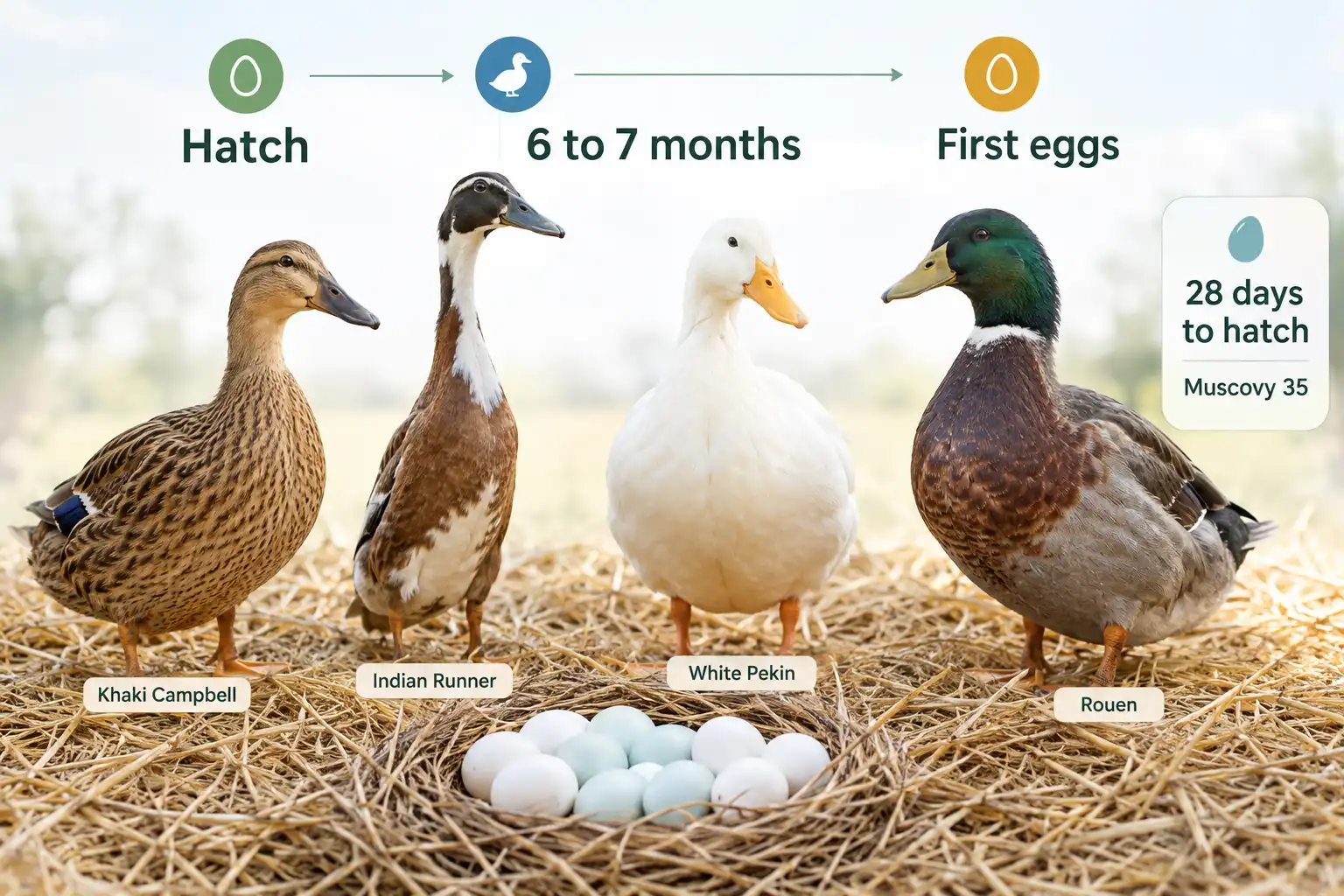
Most domestic ducks start laying eggs at about 6 to 7 months. Khaki Campbells mature near 6 months and Pekins at 26 to 28 weeks. Ducks hatched in fall or winter often start a month or two sooner.
When Do Ducks Start Laying Eggs?
Most domestic ducks begin laying at about 6 to 7 months of age. That figure comes from Australia’s New South Wales Department of Primary Industries (NSW DPI). After the first egg, production climbs fast. Within 5 weeks, NSW DPI expects a duck flock to reach about 90% lay, or roughly 9 eggs a day from 10 ducks.
University of Georgia Extension adds one caution. It advises against bringing ducks into production before 7 months, because early eggs run small and hatch poorly. That matters most if you plan to hatch ducklings. For the kitchen, a small first egg is still a good egg.
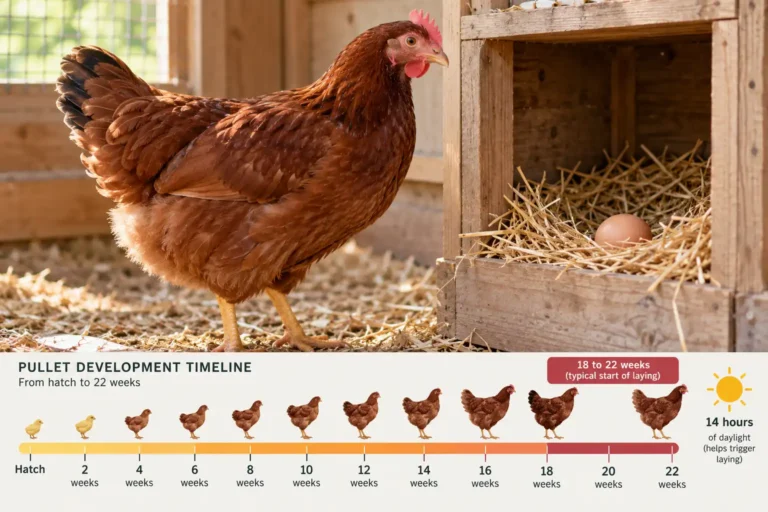
Within that window, two things move the date: breed and hatch month. Both get their own sections below. Chicken pullets follow a separate calendar, so check when backyard hens begin to lay if you keep both.
Duck Laying Age by Breed
Published laying ages exist for some breeds and not for others. Where no extension source gives a breed figure, the table says so instead of guessing.
| Breed | First eggs | Eggs per year | What to expect |
|---|---|---|---|
| Khaki Campbell | About 6 months | 200 to 300 | Seldom broody; lays through winter with added light |
| Indian Runner | No breed figure; plan on 6 to 7 months | 100 to 150 (some utility strains over 300) | Rarely builds a nest |
| Pekin | 26 to 28 weeks | 100 to 180 | About 160 eggs over 40 weeks of lay |
| Rouen | No breed figure; plan on 7 months | 40 to 60 | Can lay blue-tinted eggs |
| Muscovy | No breed figure; plan on 6 to 7 months | 60 to 120 | Often broody; lays in batches of about 20 |
The yearly egg counts come from the University of Kentucky Extension duck breed guide. Campbell timing also comes from Kentucky, while the Pekin and Muscovy notes come from NSW DPI. Treat every figure as a flock average, because individual ducks vary.
When Do Pekin Ducks Start Laying Eggs?
Pekins usually start laying at 26 to 28 weeks, or about 6 to 6.5 months, per NSW DPI. Its figures show about 160 eggs over a Pekin’s first 40 weeks or so of production.
Kentucky’s numbers run a little differently. Its breed table lists 100 to 180 eggs a year for Pekins. Its breed notes, though, put Pekins near 200 white eggs a year. The two sources count different periods in different flocks. So plan on 100 to 200 eggs a year from a Pekin, not any single figure.
That middling count fits the breed’s purpose. Kentucky reports that about 90% of US duck meat comes from Pekins. It still calls them a general-purpose breed, because they lay well enough to earn a place in a home flock.
When Do Rouen Ducks Start Laying Eggs?
Plan on about 7 months for a Rouen. None of the extension sources we checked gives a Rouen-specific age. So UGA’s general 7-month guideline is the safest planning date. Rouens are heavy ducks, and Kentucky notes that most of their weight gain comes after 12 weeks of age.
Eggs are not the breed’s strength. Kentucky’s table lists 40 to 60 eggs a year for Rouens, among its lowest counts. The eggs can be blue-tinted, though. Kentucky describes the Rouen as a meat bird that’s popular on ponds for its Mallard coloring. So keep a Rouen for its looks, not a full egg basket.
When Do Indian Runner Ducks Start Laying Eggs?
Plan on 6 to 7 months for an Indian Runner, the general window NSW DPI gives for ducks. The extension guides we checked publish no Runner-specific start age.
Kentucky does record how Runners lay once they start: about four eggs a week for roughly eight months. Strain changes that a lot. Exhibition lines lay fewer, while some utility strains have passed 300 eggs a year.
Runners also rarely build nests. Instead, they drop eggs wherever they happen to be, so Kentucky suggests shutting them in overnight. The darker varieties lay blue-tinted eggs.
How Hatch Month Changes the Start Date
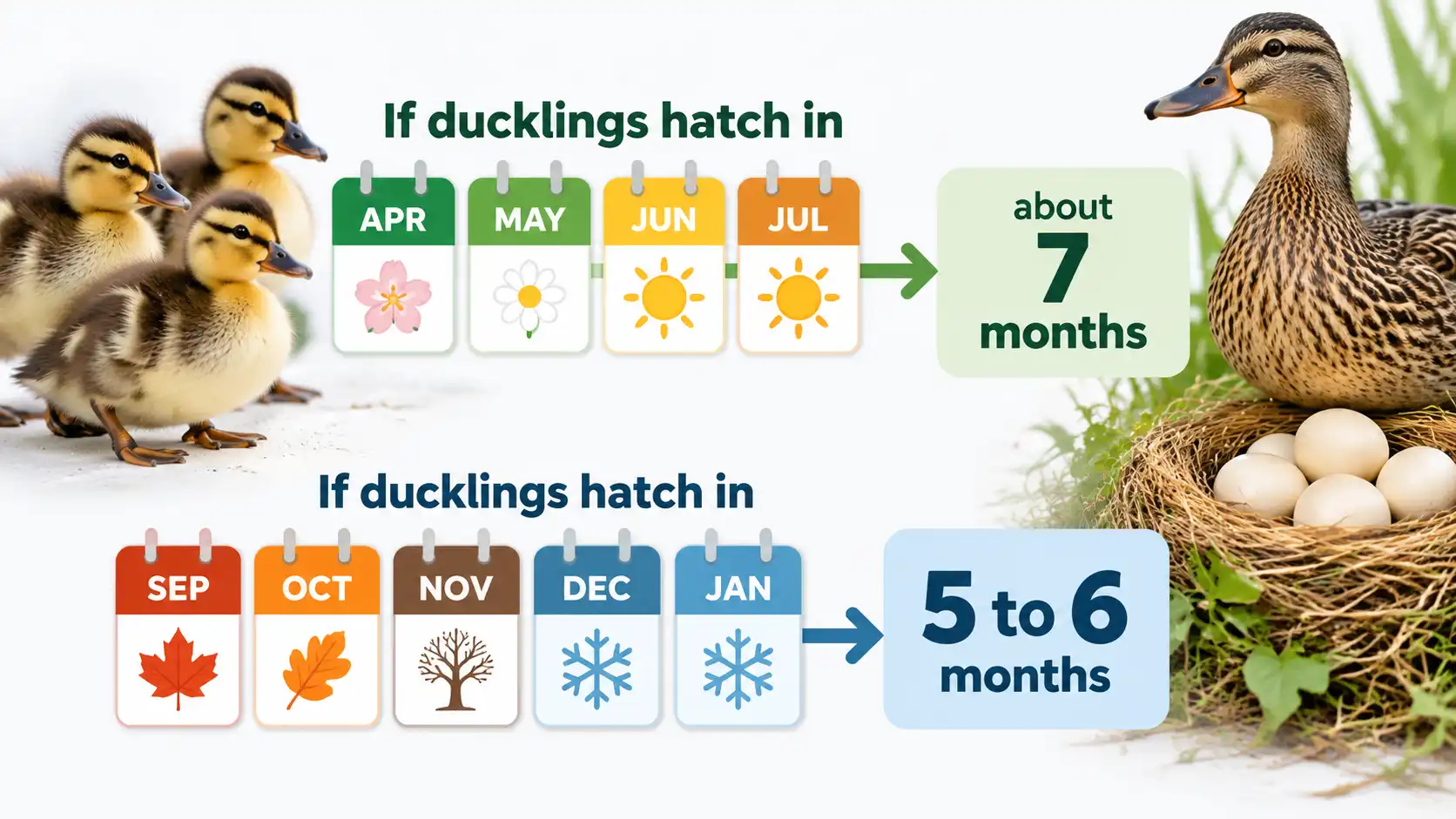
Day length can move a duck’s first egg by a month or two. UGA Extension explains that ducks hatched April through July mature at about 7 months. They grow up while days shorten. By contrast, ducks hatched September through January mature 1 to 2 months early, because days lengthen as they grow.
| Duck hatch month | Age at maturity (UGA) | Likely first eggs |
|---|---|---|
| April | About 7 months | November |
| May | About 7 months | December |
| June | About 7 months | January |
| July | About 7 months | February |
| September | 5 to 6 months | February to March |
| October | 5 to 6 months | March to April |
| November | 5 to 6 months | April to May |
| December | 5 to 6 months | May to June |
| January | 5 to 6 months | June to July |
To run it for your own duck, use this:
First-egg month = hatch month + 7 months        (April to July hatch)
First-egg month = hatch month + 5 to 6 months   (September to January hatch)
UGA’s guide doesn’t cover February, March, or August hatches. For those ducks, use NSW DPI’s general 6-to-7-month window.
Also look at the April and May rows. Those ducks mature in November and December, close to the shortest days of the year. That’s where added light comes in.
How Many Eggs to Expect Each Week
Yearly totals are hard to plan around. Weekly numbers are easier, and two lines of math get you there:
Eggs per duck per week = eggs in a laying run / weeks in that run
Ducks needed = eggs you want each week / eggs per duck per week
Here’s how that works for a dozen eggs a week:
- Khaki Campbell: Kentucky says a Campbell can lay an egg a day for ten months. That’s 7 a week, so two Campbells cover a dozen.
- Indian Runner: Kentucky’s four eggs a week means three Runners give about 12.
- Pekin: NSW DPI’s 160 eggs over 40 weeks works out to 4 a week. So three Pekins also give about 12.
- Rouen: Even spread across a whole year, Kentucky’s 40 to 60 eggs comes to about one a week at most.
These are in-season rates. UGA notes that meat-type duck breeds stay above 50% lay for about 5 months, while egg breeds hold on longer. Laying also stops for a while during the molt, which NSW DPI describes as a pause in production.
What Helps a Young Duck Start Laying
Give Mature Ducks Enough Light
Long days drive laying. UGA brings mature ducks into full production with 14 hours of light a day. NSW DPI’s duck lighting program aims for about 15 hours. The two figures differ by an hour, so treat 14 to 15 hours as the working range for laying ducks.
Timing matters too. UGA starts its 14-hour program once ducks reach sexual maturity. With that kind of lighting, Kentucky notes, Khaki Campbells keep laying through winter.
Feed a Laying Ration
Egg production raises a duck’s need for calcium and protein. Kentucky stresses calcium and protein-rich feed for Runners through their long laying season. For top production, UGA recommends a commercial breeder diet, because laying ducks need a ration balanced for reproduction.
Set Up Nests and a Morning Routine
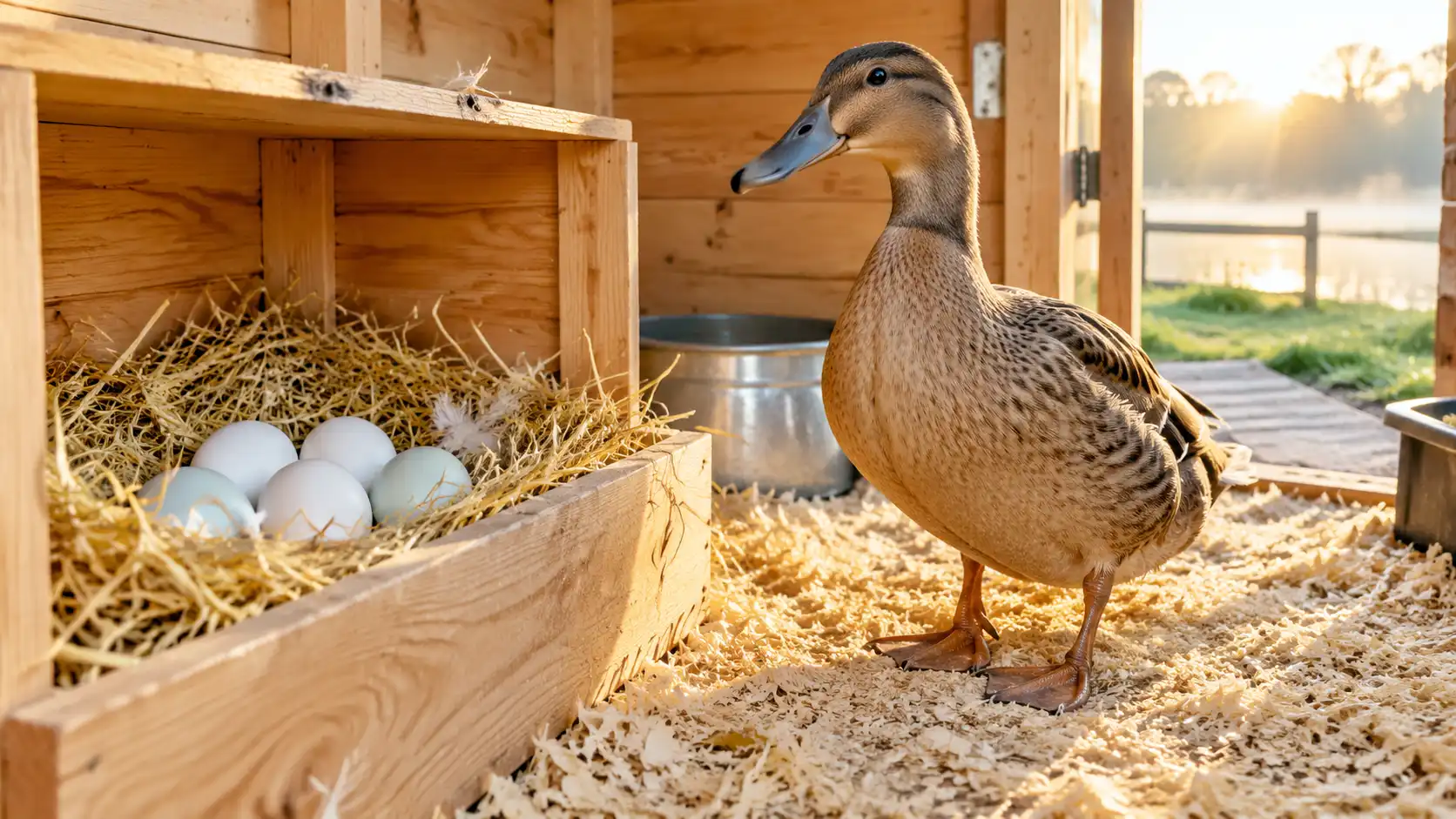
Ducks lay early. UGA says most duck eggs arrive before 7 a.m. Kentucky says ducks lay most eggs within three hours after sunrise. So keep the flock shut in until mid-morning. That way you find eggs in the house instead of the pond.
For nesting, UGA sizes duck nest boxes at 12 inches wide, 18 inches long, and 12 inches deep. Ducks will also shape their own nests if you give them clean straw or wood shavings.
Duck Egg Incubation Time
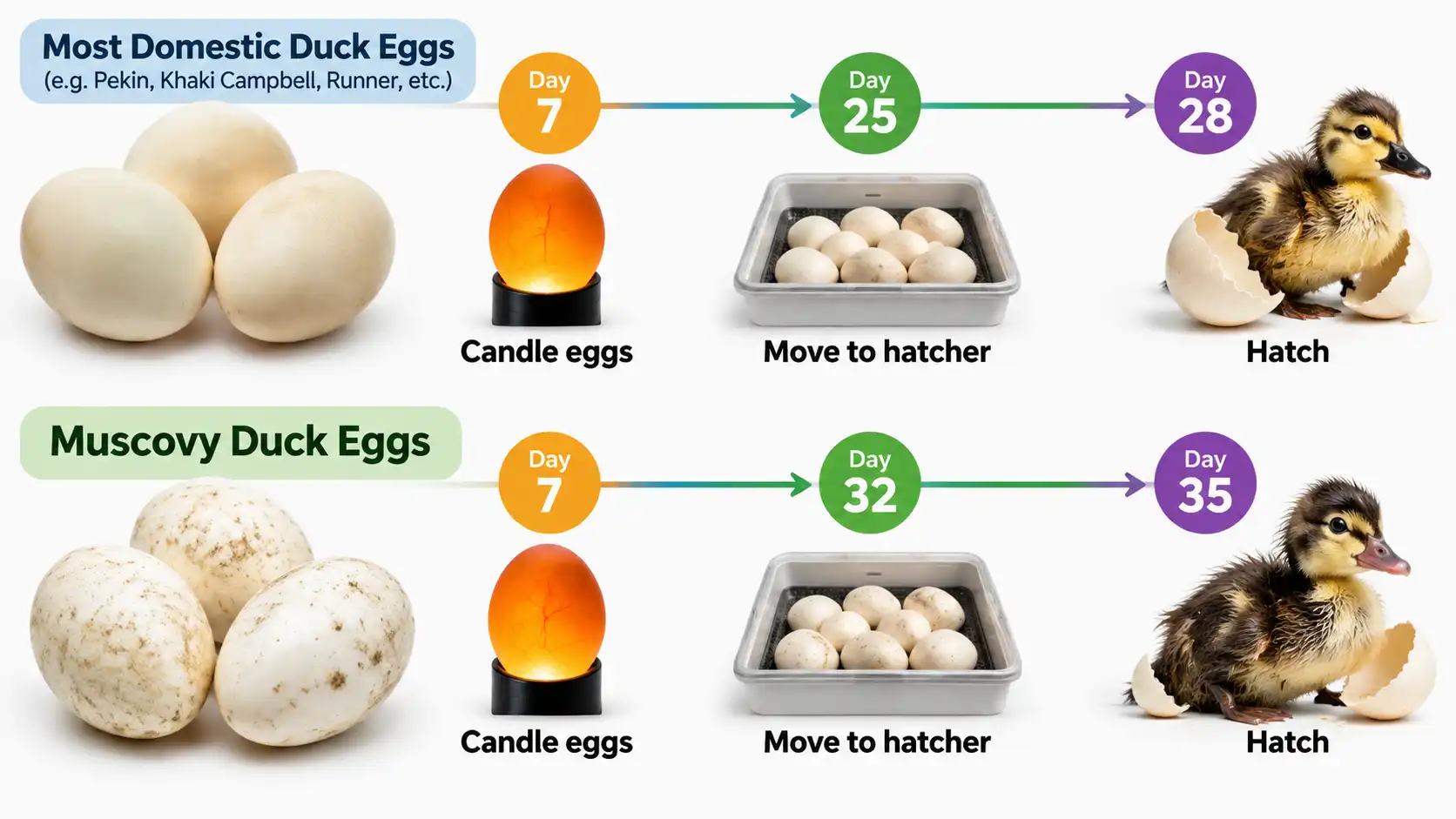
Most domestic duck eggs hatch in about 28 days, while Muscovy eggs take about 35. Kentucky and NSW DPI both give those figures. Kentucky also notes that the Muscovy is a separate species from other domestic ducks.
The count starts when the eggs warm up, not when the duck lays them. UC Cooperative Extension’s duckling hatching guide explains that the embryo only starts developing at incubation temperature.
How Many Days Do Duck Eggs Take to Hatch?
Most duck eggs hatch in about 28 days, but the exact count varies by type. UC Cooperative Extension breaks the incubation period down further:
- Mallards: about 26.5 to 27 days
- Runners: about 28.5 days
- Most other domestic duck breeds: about 28 days
- Muscovies: about 35 days
Old eggs or a cool incubator stretch those times, while an incubator running warm shortens them. UC and NSW DPI both incubate duck eggs at 99.5°F (37.5°C) in an incubator with a circulating fan. Only fertile eggs hatch, so you’ll need a drake in the flock.
NSW DPI adds that Muscovy eggs are very hard to hatch artificially. A broody Muscovy duck is the easier route, and she can cover about 16 eggs.
Duck Incubation Period at a Glance
| Stage | Most domestic ducks | Muscovy |
|---|---|---|
| Candle to check fertility | Day 7 | Day 7 |
| Last candling, move to the hatcher | Day 25 | Day 32 |
| Expected hatch | Day 28 | Day 35 |
NSW DPI sets the candling and hatcher days in this table. UC’s 4-H guide also takes standard duck eggs off the turner on day 25.
When to Call a Vet About a Laying Duck
A laying duck that strains without passing an egg needs a vet the same day. The Merck Veterinary Manual describes egg binding as a female bird that can’t pass an egg. It’s most common in overweight, inactive birds. Its listed signs include weakness, straining, bloody droppings, tail bobbing, a sudden stop in laying, and a swollen belly. Merck also says tissue pushing out through the vent needs immediate veterinary care.
Call a vet the same day for any of these:
- Straining with no egg
- Tissue showing at the vent
- Tail bobbing or open-mouth breathing
- Bleeding that won’t stop
- Refusing food
Several problems look alike from the outside. So the vet decides what’s wrong and how to treat it. Other early signs a bird is unwell deserve the same quick call.
Check ahead that your vet treats ducks, and line one up before laying starts. Help with finding a vet who treats poultry saves time in an emergency. If several ducks fall sick at once, or any die suddenly, call your state veterinarian.
Handling Duck Eggs Safely
Ducks can carry Salmonella while looking healthy and clean, according to CDC guidance for backyard flocks. The germs spread easily to anything in the area where ducks live. So the CDC’s backyard flock advice applies to every egg:
- Wash your hands with soap and water right after touching ducks, eggs, or their housing.
- Collect eggs often, and throw away cracked ones.
- Rub dirt off with fine sandpaper, a brush, or a cloth.
- Refrigerate eggs, then cook them until the yolk and white are firm.
On washing, the sources differ. The CDC says not to wash eggs, because colder water can pull germs inside. UGA, writing about hatching eggs, allows washing soiled duck eggs in water warmer than the egg, at 110 to 115°F. Both agree that cold water is the problem.
The CDC also says children under 5 shouldn’t touch ducklings or other backyard poultry. The same handwashing habit protects against other germs people can catch from birds.
What About Wild Duck Eggs?
Leave them where they are. Kentucky’s extension guide notes that the 1918 Migratory Bird Treaty Act protects wild Mallards. So it’s illegal to take Mallard ducks or their eggs from the wild. That includes a nest in a garden bed or beside your pond.
If you find an injured or orphaned wild duckling, call a licensed wildlife rehabilitator or your state wildlife agency. Don’t try to raise it yourself. For a nest near the house, keep pets and people back, as with other wild birds nesting in yards.
FAQs about Duck Laying Age
Do ducks need a drake to lay eggs?
No, a duck lays eggs with or without a male, because a drake only makes those eggs fertile. If you plan to hatch ducklings, UGA Extension recommends one drake for every six ducks.
Are a young duck’s first eggs smaller than normal?
Often, yes. UGA says ducks brought into lay before 7 months produce small eggs, and NSW DPI notes that the first few eggs of a Muscovy’s first batch are small.
Why is my 7-month-old duck still not laying?
Check for hidden eggs and short days first. Kentucky notes that Runners rarely nest and drop eggs anywhere, and UGA brings mature ducks into full production with 14 hours of light a day.
How long can fertile duck eggs wait before incubation?
Ideally less than a week. NSW DPI says duck eggs lose hatchability sharply after 7 days in storage, while UGA allows up to two weeks at 55°F with the small end down.
Can a chicken hen hatch duck eggs?
Yes, NSW DPI says both standard duck breeds and Muscovies can hatch under broody chicken hens. Expect her to sit about 28 days for most duck eggs, or about 35 for Muscovy eggs.
Key Points for Your Ducks
Count 6 to 7 months from hatch for most ducks, then adjust for hatch month. Spring hatches mature near 7 months, while fall or winter hatches come a month or two sooner. Pick Khaki Campbells or Runners for eggs, Pekins for a general-purpose duck, and Rouens for looks. Then give mature ducks 14 to 15 hours of light and collect eggs early. Wash your hands after every visit to the flock.