
How Long Do Cockatoos Live? 25 to 50 Years, Species by Species
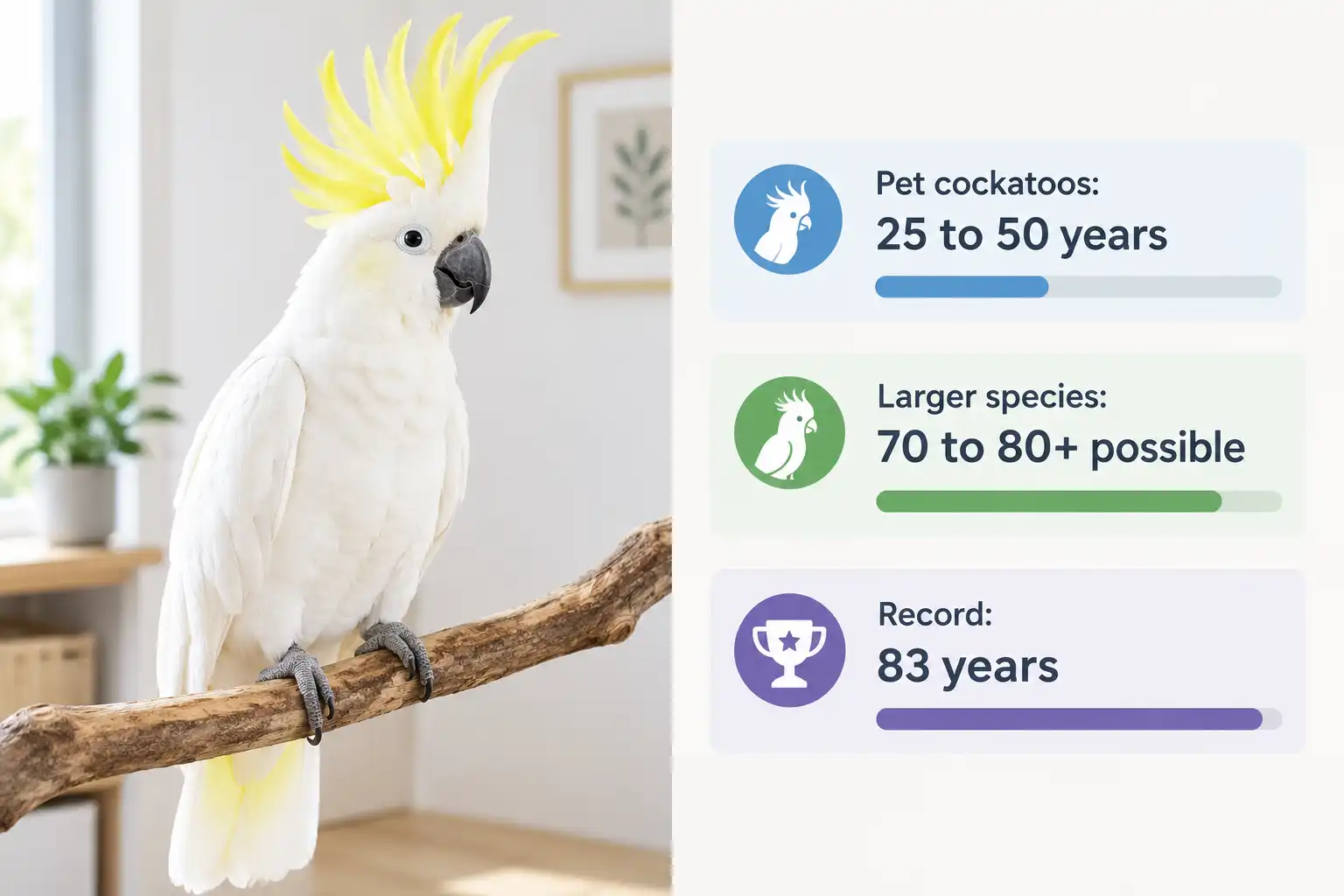
How long do cockatoos live? Long enough to shape decades of your life. The figures change by species, and the sources don’t all agree. Below are vet ranges, zoo figures by species, and the record holder. You’ll also see what the numbers mean for your age.
Pet cockatoos live 25 to 50 years, according to the Merck Veterinary Manual. VCA Animal Hospitals gives most cockatoos 25 to 45 years. It adds that larger cockatoo species can live upwards of 70 to 80 years.
Which Birds Count as Cockatoos?
Cockatoos make up the parrot family Cacatuidae, and a movable crest on the head is their defining feature. VCA Animal Hospitals describes them as large, slender-bodied parrots whose crest stands up when they’re alarmed or excited. They come from mainland Australia and the islands around it.
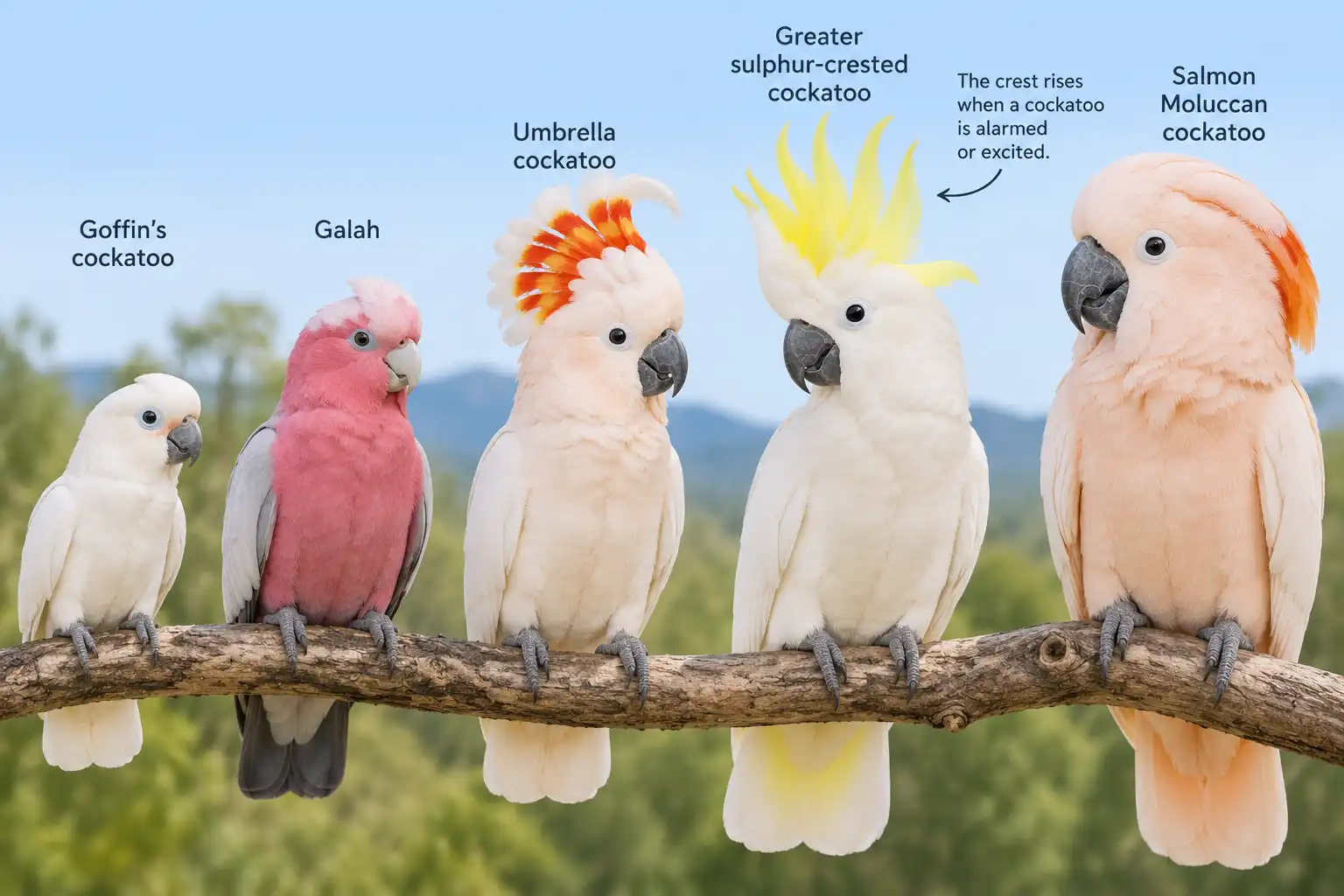
Most cockatoos are mainly white. However, the Moluccan cockatoo is salmon, the rose-breasted cockatoo (galah) is pink and gray, and several black cockatoo species exist. VCA puts cockatoos at 300 to 900 grams (10 to 30 ounces), depending on the species. Cockatoos measure 12 to 27 inches long, per VCA.
The cockatiel belongs to the same family. Still, it’s far smaller and shorter-lived, so a cockatiel’s life expectancy has its own figures. This guide covers the larger cockatoos.
How Long Do Cockatoos Live in Captivity?
A pet cockatoo usually lives 25 to 50 years, per the Merck Veterinary Manual’s table of popular pet birds. Merck treats cockatoos as one group in that table and notes that several rare species are available.
VCA gives a slightly lower range of 25 to 45 years. However, VCA also says larger cockatoo species can live upwards of 70 to 80 years.
So the two sources agree on the low end and part ways at the top. Merck’s range covers every cockatoo at once. VCA, by contrast, separates out the larger species, where the longest lives turn up.
For planning, use 50 years for most cockatoos. If you’re looking at one of VCA’s large species, such as the Moluccan or greater sulphur-crested, plan for more.
Cockatoo Lifespan by Species
Neither Merck nor VCA gives a lifespan for each cockatoo species. Instead, the best species-level figures come from zoo records. A 2022 study led by the Max Planck Institute of Animal Behavior used records of 133,818 zoo parrots. It appeared in Proceedings of the Royal Society B.
The table pairs those zoo estimates with VCA’s size groups. Zoo figures are in years.
| Cockatoo species | VCA size group | Zoo life expectancy at birth |
|---|---|---|
| Bare-eyed cockatoo (little corella) | Not listed | 28.6 |
| Greater sulphur-crested cockatoo | Large | 25.2 |
| Umbrella cockatoo | Medium to large | 21.6 |
| Lesser sulphur-crested cockatoo (includes citron-crested) | Smaller | 19.8 |
| Moluccan (salmon-crested) cockatoo | Large | 18.2 |
| Rose-breasted cockatoo (galah) | Medium | 16.0 |
| Goffin’s cockatoo | Smaller | No estimate |
| Major Mitchell’s cockatoo | Not listed | No estimate |
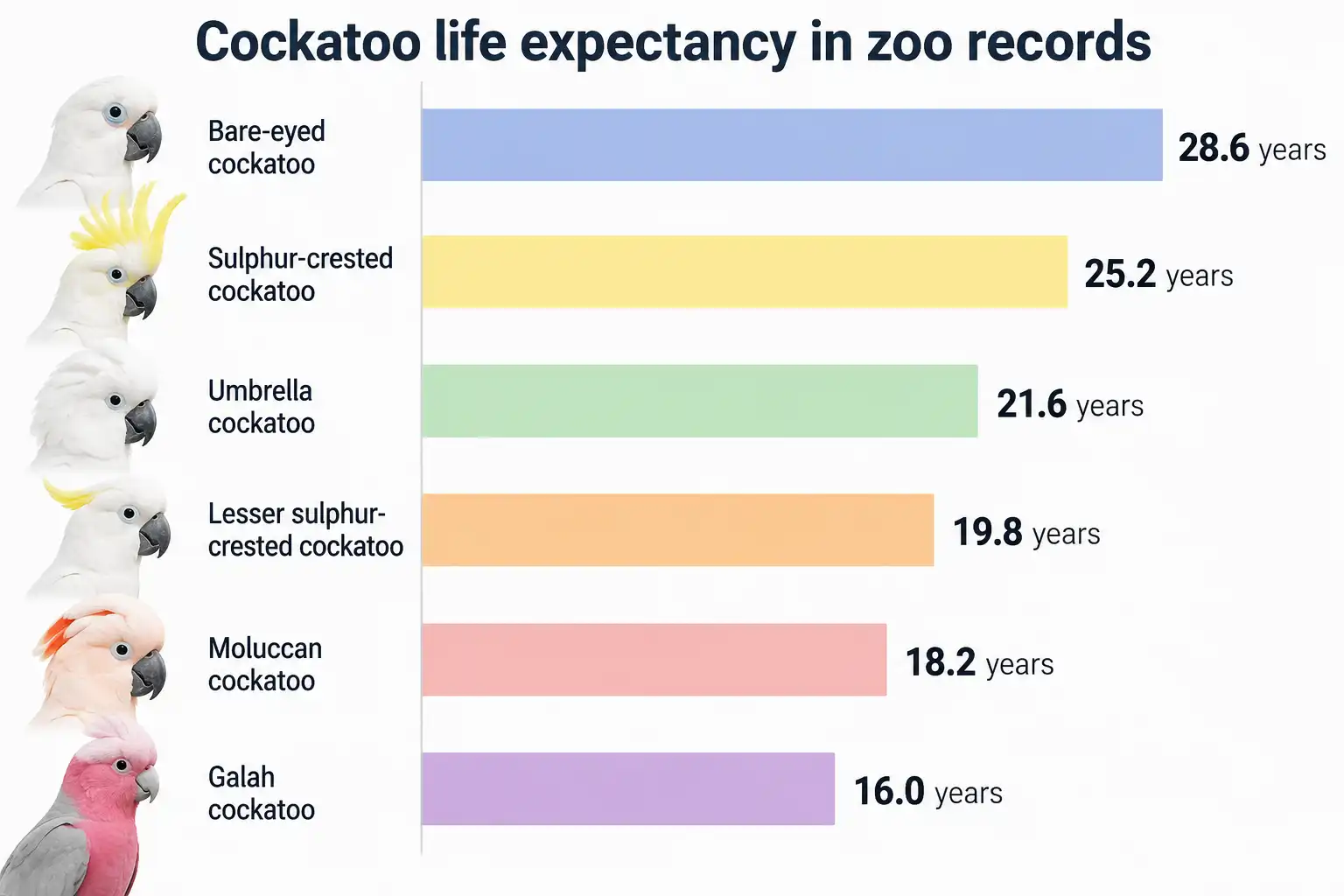
Zoo figures run lower than the vet ranges for a simple reason. The study counts life expectancy from birth, so chicks that die young pull every average down.
As a result, treat the zoo column as a way to compare species. Then use the vet range to plan.
How Long Do Sulphur-Crested Cockatoos Live?
Sulphur-crested cockatoos live 25 to 50 years as pets, under Merck’s range for cockatoos. VCA counts the greater sulphur-crested as a large cockatoo. That puts it in the group VCA says can pass 70 to 80 years. VCA describes it as very energetic and in need of a fair amount of training.
In zoo records, sulphur-crested cockatoos averaged 25.2 years from birth. That ranked sixth of the 218 parrot species with an estimate. The Max Planck team named it among the longest-lived parrots in the study.
The lesser sulphur-crested cockatoo is a separate, smaller species. It averaged 19.8 years in zoo records, and VCA groups it with the smaller, high-strung cockatoos.
How Long Do Umbrella Cockatoos Live?
Umbrella cockatoos live 25 to 50 years as pets, under Merck’s cockatoo range. VCA describes the umbrella as an all-white, medium to large cockatoo. Still, it gives the species no figure of its own.
Zoo records give umbrella cockatoos 21.6 years from birth. That placed them 17th of 218 parrot species.
VCA calls the umbrella the “Velcro-Bird” because it likes to be held and petted by its owner. That need for contact bears on its lifespan, too. As the behavior section below explains, the wrong kind of handling can lead to feather picking.
How Long Do Goffin Cockatoos Live?
No veterinary source gives Goffin’s cockatoos a lifespan of their own. So Merck’s 25 to 50 years for cockatoos is the safest range to plan around.
VCA groups Goffin’s with the lesser sulphur-crested and citron-crested as smaller cockatoos. It describes all three as high-strung and very active. However, it gives none of them a separate figure.
The zoo study couldn’t fill the gap either. Its records produced no estimate for Goffin’s cockatoos, and none for Major Mitchell’s. Species-specific Goffin’s figures do circulate online. We couldn’t trace them to a veterinary source or study, so we’ve left them out.
How Long Can a Cockatoo Live?
A cockatoo can live past 80 years. The record belongs to Cookie, a Major Mitchell’s cockatoo at Brookfield Zoo near Chicago. Guinness World Records lists him as the oldest bird ever.
Cookie arrived at the zoo in May 1934, estimated to be at least a year old. He died on August 27, 2016. Guinness verified his age as at least 82 years and 89 days. The zoo had given him a June 1933 hatch date, which made him 83.
Still, one bird says little about a typical one. The Max Planck study calls maximum recorded lifespan a problematic measure, because it depends so heavily on sample size. For that reason, VCA’s 70 to 80 years or more for larger species is the better guide.
How Long Do Cockatoos Live in the Wild?
Veterinary references don’t give a wild lifespan for cockatoos. Neither Merck nor VCA publishes one, and the zoo study covers only captive birds. Wild figures quoted online rarely say where they came from, so we don’t repeat them.
Cockatoos Compared With Macaws and Other Parrots
Cockatoos sit among the longer-lived groups in Merck’s table of popular pet birds. Here’s how Merck’s average lifespans line up:
- Budgerigars (budgies): 5 to 10 years
- Cockatiels: up to 20 years
- Cockatoos: 25 to 50 years
- African gray parrots: 30 to 50 years
- Amazon parrots: 40 to 50 years
- Macaws: 30 to 60 years
So how long can a macaw live compared with a cockatoo? Merck’s macaw range tops out 10 years higher, at 60. Zoo records point the same way. The scarlet macaw averaged 35.5 years from birth, the highest of any parrot in the study. The sulphur-crested cockatoo, by comparison, averaged 25.2. The figures for each macaw species show how wide that gap runs.
Even so, cockatoos outlast most parrots. Half of the 218 species with a zoo estimate averaged under 10 years from birth. All six cockatoo species with an estimate in the table above beat that. The cockatiel, at 8.3 years, did not.
When Does a Cockatoo Count as Old?
A cockatoo counts as elderly from about 30 years. That threshold comes from a 2009 summary by the Zoo/Exotic Pathology Service, published on IVIS. It grouped cockatoos with Amazons, macaws, and African grays. By contrast, cockatiels counted as elderly at 12 years.
The summary also looked at 27 cockatoos aged 30 to 45. Tumors and body-wide inflammation each turned up in about 30 percent of them. Inflammatory skin lesions followed, at 11 percent.
So a 30-year-old cockatoo may still have years left, but it needs closer watching. Ask your avian vet whether an older bird needs checkups more than once a year.
What Shortens a Cockatoo’s Life?
Behavior problems, diet, infectious disease, and household hazards all cut cockatoo lives short. First, though, know when to act fast. See an avian vet the same day if a cockatoo:
- Sits fluffed up on the cage floor
- Bobs its tail or breathes with its mouth open
- Stops eating
- Bleeds and the bleeding won’t stop
- Strains without passing an egg, in a hen
- Has had any contact with a cat’s teeth or claws
- May have breathed fumes
Birds hide illness, so a cockatoo that looks sick is often very sick. That’s why the early signs of illness in pet birds are worth learning now. VCA also recommends a yearly checkup, plus an exam soon after a new cockatoo comes home.
Over-Bonding and Feather Picking
Over-bonding is the problem most specific to cockatoos. Merck notes that cockatoos may demand a lot of handling and cuddling, which can add to hormonal behavior problems. VCA advises stroking a cockatoo’s head only, not its body, because body stroking can cause hormonal stimulation.
A frustrated, over-bonded cockatoo may turn possessive or aggressive, VCA says, and start feather picking. VCA’s answer is structure. Set a daily schedule and give attention at predictable times. Then teach the bird to forage and play alone in its cage.
That training matters most after sexual maturity. VCA puts it at 2 years for smaller cockatoo species and 3 to 4 for medium ones. Larger cockatoo species mature at 5 to 6.
A cockatoo that starts feather plucking needs an avian vet exam first. Medical problems can look the same from the outside.
Diet and Weight
VCA recommends pellets as the base of a cockatoo’s diet, with fresh or frozen vegetables every day. Fruit and seed stay occasional treats. Your avian vet can adjust that for your bird’s age and activity. Meanwhile, a pellet-based diet for pet birds is a good place to start.
Weight gain is a real risk. Merck’s pet owner pages list galahs (rose-breasted cockatoos) among the birds especially likely to become obese. In turn, obesity raises the risk of arthritis, fatty liver disease, atherosclerosis, and heart disease, per Merck.
Weight loss matters too. So weigh your cockatoo on a gram scale each week and run this check:
Weight change (%) = (this week’s grams minus usual grams) divided by usual grams, times 100
Say your umbrella cockatoo usually weighs 500 grams and drops to 470. That’s a 6 percent loss. Call your avian vet, even if the bird seems fine.
Beak and Feather Disease
Psittacine beak and feather disease (PBFD) was first recognized in cockatoos in the 1970s, according to the Merck Veterinary Manual. It’s caused by a circovirus and mainly affects young parrots. Merck notes few clinical cases in birds over 3 years old.
Affected birds grow pinched or clubbed feathers that fall out easily and regrow slowly, or not at all. Merck says there’s no specific treatment, and the outcome in birds showing signs is generally terminal.
The good news is that PCR screening has greatly cut PBFD in captive-bred cockatoos. Merck advises testing every new susceptible bird before it joins others. So ask your avian vet about a PBFD test for any new cockatoo.
Fumes and Metal
Nonstick (PTFE) cookware can kill a bird fast. VCA reports bird poisonings from PTFE products even at recommended temperatures. Sudden death often comes before or soon after any signs appear. Switching to cookware that’s safe around birds removes that source of fumes.
Chewing adds a second risk. Merck notes cockatoos are very likely to chew wood, plastic, and other materials. VCA calls heavy metal poisoning life threatening. So check toys and cage hardware for lead or zinc a cockatoo could chew off. Any suspected exposure needs a vet the same day.
How Old Will You Be When Your Cockatoo Is Old?
Add the cockatoo’s remaining years to your age today:
Your age at the end = your age today + (the species’ lifespan minus the bird’s age now)
The table assumes a young cockatoo and uses three markers. Twenty-five years is the low end of both Merck’s and VCA’s ranges. Fifty is the top of Merck’s range. And 70 is where VCA’s figure for larger species begins.
| Your age when you bring home a young cockatoo | When it turns 25 | When it turns 50 | When a larger species turns 70 |
|---|---|---|---|
| 25 | 50 | 75 | 95 |
| 35 | 60 | 85 | 105 |
| 45 | 70 | 95 | 115 |
| 55 | 80 | 105 | 125 |
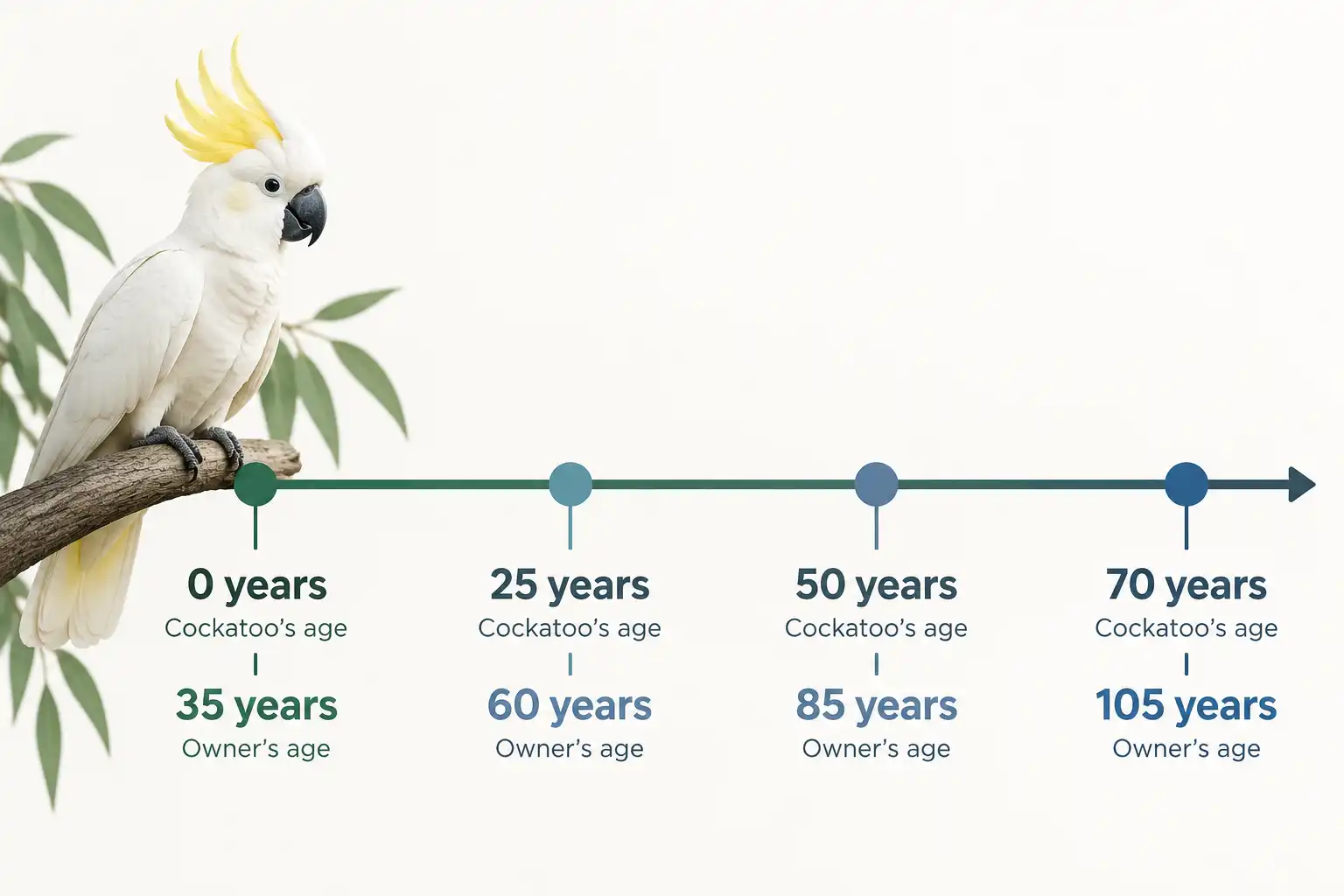
Adopting an adult changes the math. Say you’re 50 and adopt a 20-year-old umbrella cockatoo. Merck’s 25 to 50 years leaves it 5 to 30 more years. You’d be 55 to 80 at the end.
Planning for a Cockatoo That Outlives You
Many cockatoos change homes. VCA notes that thousands are given up to bird rescues every year because of loud or destructive behavior. So the plan for a cockatoo’s later years belongs in the decision, not after it. A workable plan covers four things:
- A named caregiver who has agreed, in writing, to take the bird
- Money set aside for food and avian vet care
- The bird’s vet records and diet notes, kept in one place
- A talk with an estate attorney about whether a pet trust suits your state
Rehoming a cockatoo isn’t a failure if your life changes. A rescue that takes large parrots is a responsible choice. The math also works in reverse. Adopting an adult cockatoo from a rescue shortens your commitment by every year the bird has lived.
FAQs
Do cockatoos live longer than cockatiels?
Yes, by decades: Merck lists 25 to 50 years for cockatoos and up to 20 years for cockatiels. Zoo records show the same gap, with sulphur-crested cockatoos at 25.2 years from birth and cockatiels at 8.3.
Which cockatoo lives the longest?
The record holder is Cookie, a Major Mitchell’s cockatoo who lived at least 82 years, per Guinness World Records. In zoo averages, bare-eyed cockatoos ranked highest among cockatoos at 28.6 years, ahead of sulphur-crested cockatoos at 25.2.
Can a cockatoo live 100 years?
No verified cockatoo has reached 100, so plan for 50 years with most species. The oldest on record, Cookie, reached at least 82, and VCA puts larger species at 70 to 80 years or more.
How long do Moluccan cockatoos live?
Moluccan cockatoos fall under Merck’s 25 to 50 years, and VCA counts them among the larger species that can pass 70. Zoo records give Moluccan cockatoos 18.2 years from birth, lower than umbrella or sulphur-crested cockatoos.
Does a pellet diet help a cockatoo live longer?
No published source puts a number of extra years on it. Still, Merck ties seed-and-nut diets to obesity and vitamin A deficiency, and VCA recommends pellets as a cockatoo’s base diet.
Before You Bring a Cockatoo Home
Plan for 50 years with most cockatoos, and longer with a large species like the Moluccan or greater sulphur-crested. Then run that number against your own age. Find an avian vet first, through the Association of Avian Veterinarians directory, and ask about a PBFD test. After that, set a daily routine, feed pellets with fresh vegetables, and weigh the bird every week. Those habits target what cuts cockatoo lives short.
