How Long Do Budgies Live? 5 to 15 Years and What Decides It
How long do budgies live? Long enough that a budgerigar (budgie) brought home in 2026 could still be chirping in the early 2040s. Below are the published lifespan figures, why they differ, and the care choices that move a bird toward the top.
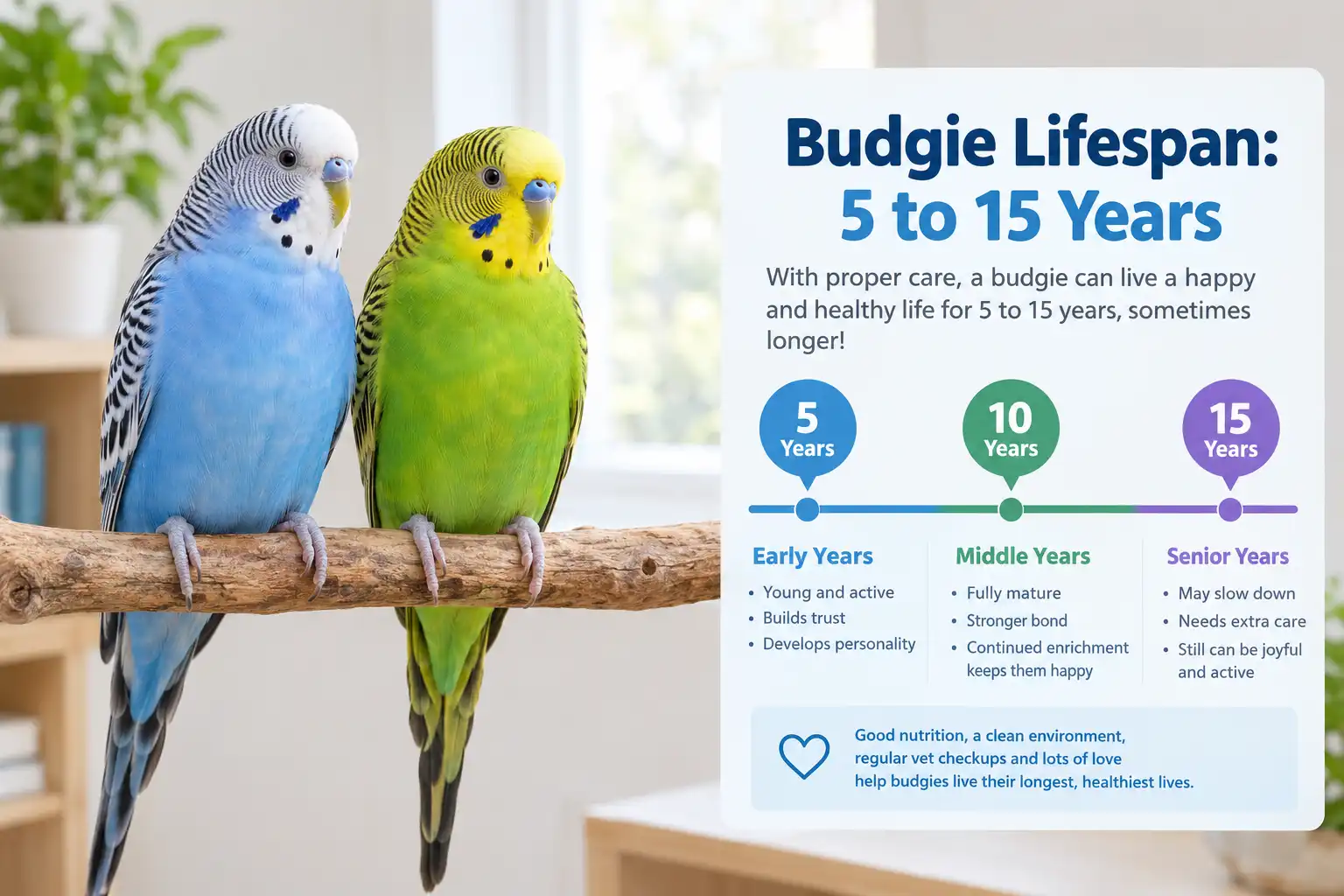
Pet budgies usually live 5 to 15 years, and care decides how long budgies live within that span. The Merck Veterinary Manual lists 5 to 10 years; the Royal Veterinary College gives 10 to 15 in captivity.
How Long Do Budgies Live in Captivity?
Pet budgies live about 5 to 15 years, and two veterinary references sit at either end of that span. The Merck Veterinary Manual’s table of popular pet birds lists an average lifespan of 5 to 10 years for budgerigars. The Royal Veterinary College’s budgie care sheet says budgies can live 10 to 15 years in captivity.
| Lifespan figure | Source | What it describes |
|---|---|---|
| 5 to 10 years | Merck Veterinary Manual | Average lifespan of pet budgerigars |
| 10 to 15 years | Royal Veterinary College | How long budgies can live in captivity |
| 5 to 15 years | Both sources together | The span to plan and budget around |
So which figure is right? Both, because they measure different things. An average counts every budgie, including birds lost young to a poor diet, an accident, or a missed illness. Those early losses pull the number down. A “can live” figure, by contrast, describes what a well-kept bird reaches.
That means most of the gap is a care gap, and care is the part you control. Still, luck and genetics play a role, so two well-kept budgies can die years apart. We give the full range instead of one number, because averaging the two would create a figure neither source published.
How Long Do Parakeets Live? Check the Species
A parakeet from a US pet store is usually a budgie, so it typically lives 5 to 15 years. A budgie parakeet and a budgerigar are the same bird. But “parakeet” also covers many other small, long-tailed parrots, and their lifespans differ by decades.
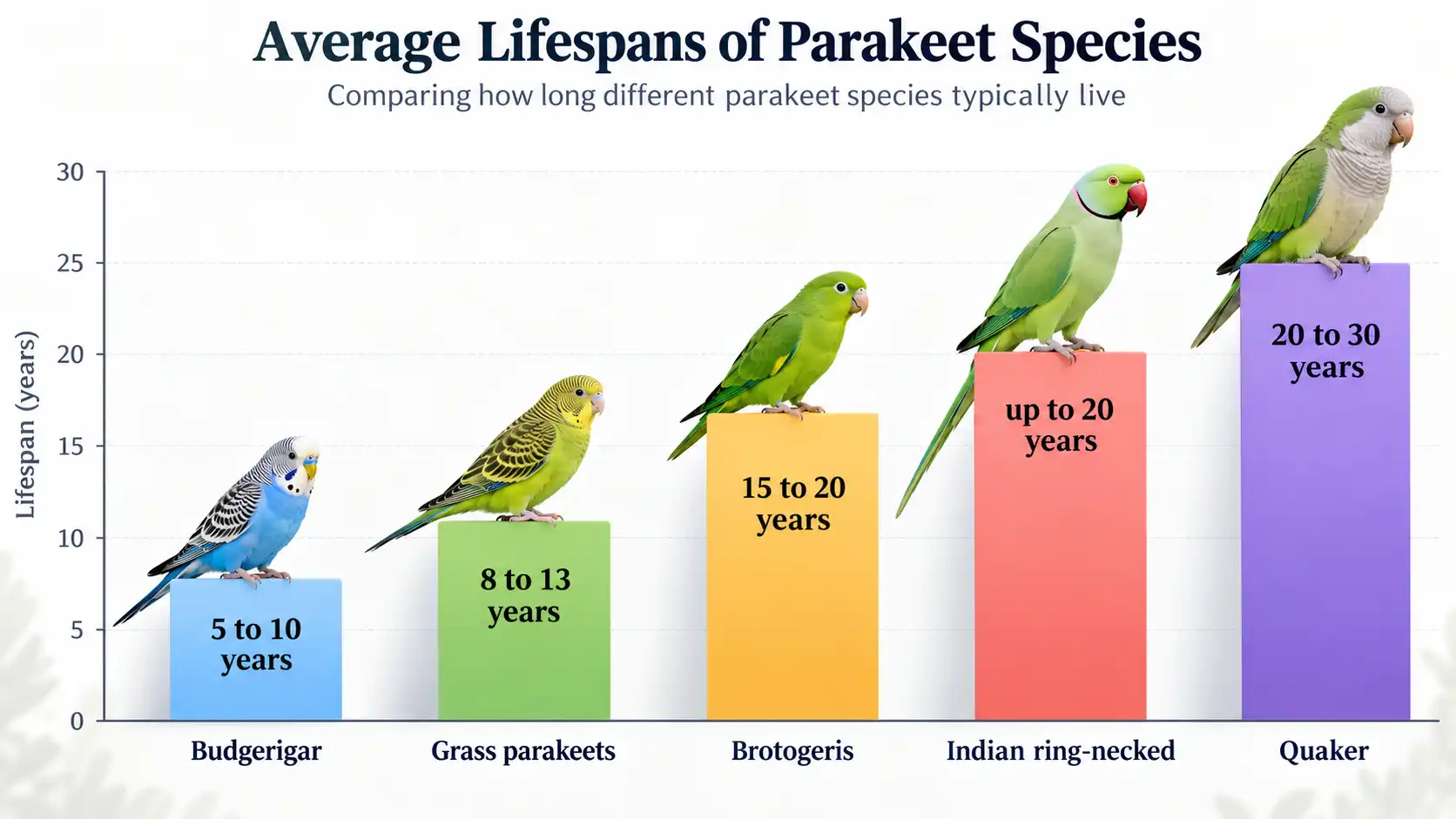
The Merck Veterinary Manual lists these average lifespans:
| Bird sold as a parakeet | Average lifespan (Merck) |
|---|---|
| Budgerigar (budgie) | 5 to 10 years |
| Grass parakeets, such as Bourke’s and scarlet-chested | 8 to 13 years |
| Brotogeris parakeets, such as gray-cheeked | 15 to 20 years |
| Psittacula parakeets, such as Indian ring-necked | Up to 20 years |
| Quaker (monk) parakeets | 20 to 30 years |
The Quaker parakeet also needs a legal check. Merck notes it is illegal to own in 12 states. Those states are California, Colorado, Connecticut, Georgia, Hawaii, Kentucky, Maryland, New Jersey, Pennsylvania, Rhode Island, Tennessee, and Wyoming. Rules can change, so confirm your state’s current law before buying one.
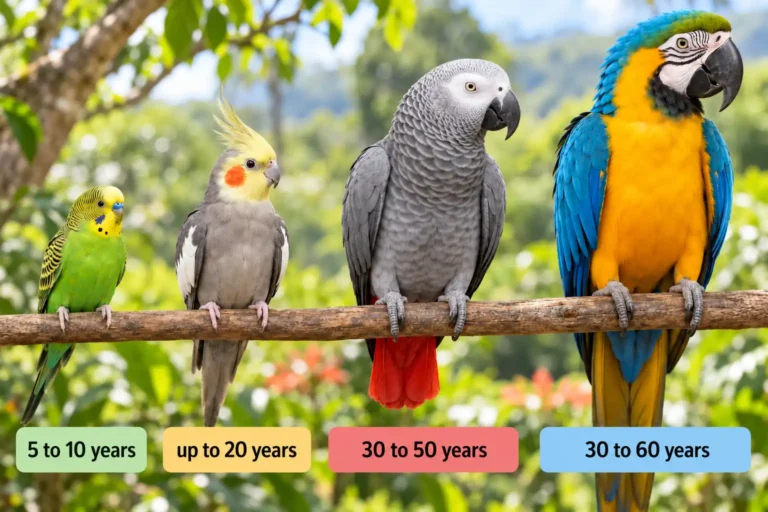
Still choosing a first bird? Lifespan is one of the clearest differences when comparing budgies with cockatiels. Merck lists up to 20 years for cockatiels.
Know more: Parrots Lifespan
How Long Do English Budgies Live?
English budgies have no lifespan figure of their own in the veterinary references we checked. So plan on the same 5 to 15 years as any budgie. English, or show, budgies belong to the same species as standard pet budgies. Breeders select them for exhibition, so they grow larger, with fuller head feathers.
Many care sites claim show budgies die younger and quote shorter lifespans. We couldn’t trace those numbers to a published study, though, so we don’t repeat them as fact. The honest answer is that nobody has measured the gap well.
That leaves a few practical steps. First, ask the breeder what ages its birds usually reach, since a breeder can speak to its own line. Second, weigh an English budgie against its own baseline, not a standard budgie’s, because show birds run heavier. Third, give it the same diet balance, vet checks, and safe room as any budgie. Those habits move any budgerigar toward the top of its range.
How Long Do Male Budgies Live?
Male budgies have no separate published lifespan, so plan on the same 5 to 15 years as for any budgie. None of the veterinary references we checked splits budgie lifespan by sex. What differs is the health risk each sex carries.
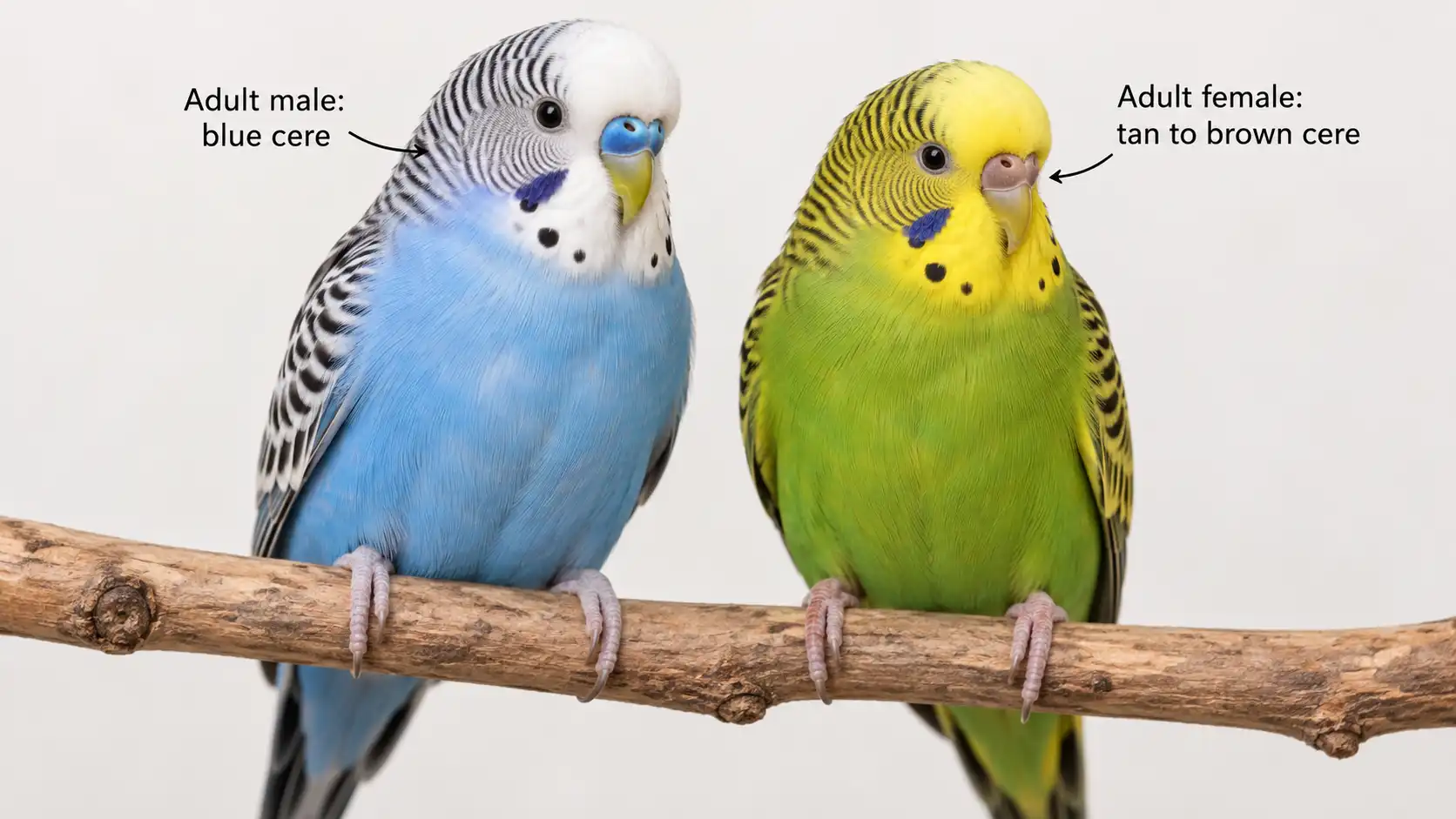
Males face testicular tumors. A 2022 autopsy study in Veterinary Pathology links these tumors to a change in cere color. In male budgerigars, the cere can shift from its normal light blue to brown. Vets have used that color change as an outward warning sign. In that small study of 21 males, the birds with these tumors were 3 to 7 years old. That sits well inside the usual lifespan range. So if an adult male’s blue cere starts turning brown, book an avian vet visit. A brown cere doesn’t confirm a tumor, though, and only a vet’s workup can find the cause.
Hens carry a different risk. Merck’s pet owner page on reproductive disorders lists budgies among the birds most often affected by egg binding. It notes the problem is most common in overweight, inactive birds. Chronic egg layers can also run short of calcium. A hen straining without passing an egg needs an avian vet the same day.
So neither sex comes out ahead on the evidence. Each just needs its own watch list.
Also know: Pigeons Lifespan
How Old Is My Budgie?
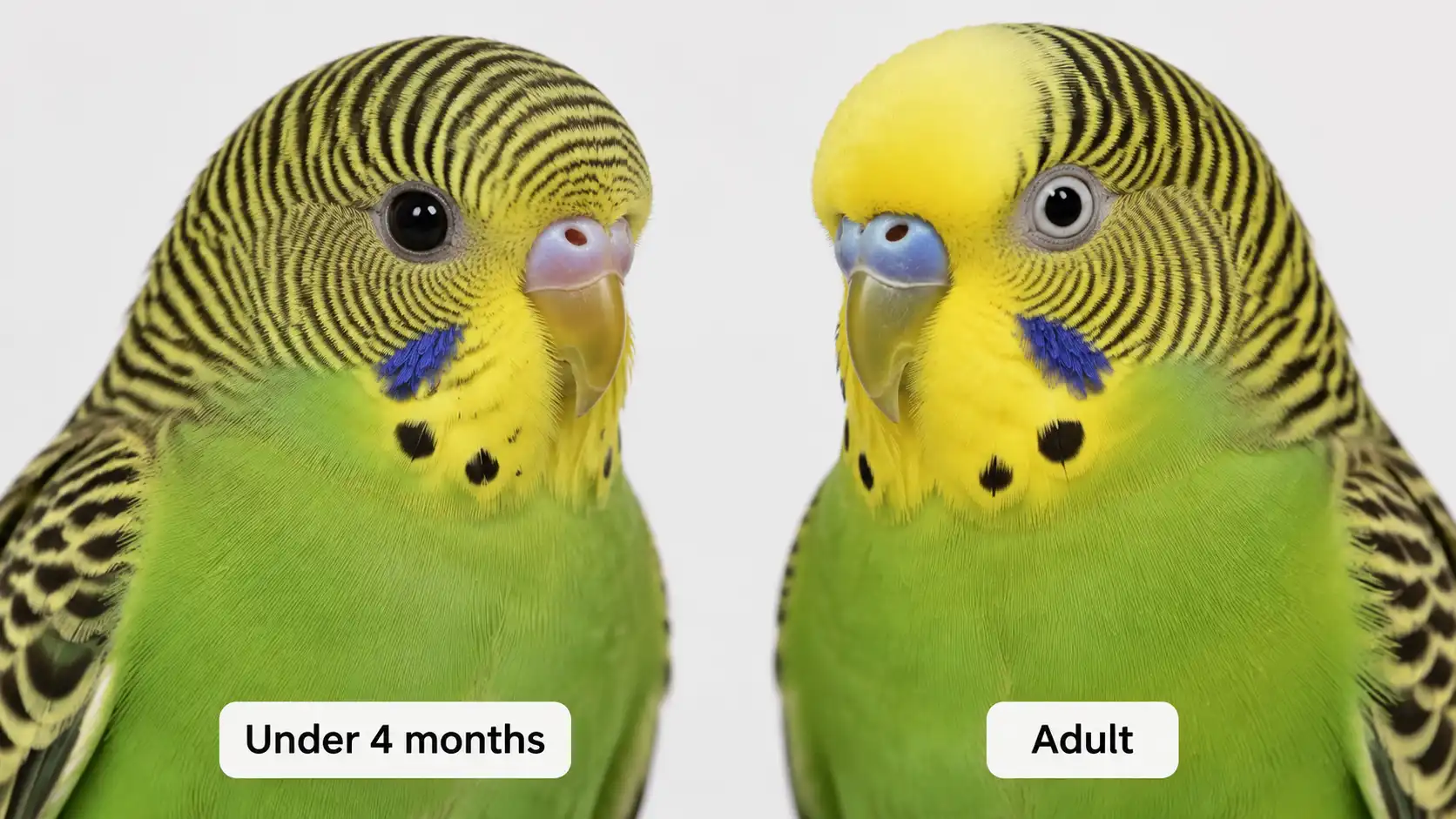
If your budgie still has bars running down to its cere, it is probably under 4 months old. After that, its looks can’t give a reliable age. The Australian Bird Study Association’s banding guide draws on the Handbook of Australian, New Zealand and Antarctic Birds. It lists these signs for wild-type budgerigars:
- Young budgie: forehead barred all the way to the cere, with a gray-black iris
- Adult budgie: forehead clear of bars, with a white to cream iris
- Molt into adult plumage: at 3 to 4 months old
After that molt, a 1-year-old and an 8-year-old budgie can look much alike. Also, color varieties without dark markings, such as all-yellow or all-white birds, never show bars. The test fails on them.
This matters for lifespan math. A pet store budgie with a clear forehead could be 4 months old or several years old. So if you know the hatch date, count from it. If you don’t, treat the ranges above as a rough guide rather than a countdown.
How Diet Changes a Budgie’s Lifespan
VCA Animal Hospitals veterinarians call poor nutrition a common reason for health problems in birds. They also note that budgies are prone to obesity and iodine deficiency. Seed mixes, they warn, run high in fat and carbohydrates and low in protein, vitamins, and minerals. In their view, a seed-only diet could lead to ill health and shorten a budgie’s life.
VCA’s budgie feeding guidance sets out this balance:
- Pellets made for small birds: about 60 to 80 percent of the diet
- Fruits, vegetables, and greens: 20 to 25 percent at most
- Seed: a very small part, never the whole diet
Switching takes patience. VCA notes a seed-eating budgie may take days, weeks, or months to accept pellets, so change the menu gradually. Weigh your budgie often during the switch, because a bird that refuses new food can lose weight fast. For fresh options that fit alongside pellets, see which foods suit a pet bird.
Two more VCA points are worth acting on. First, skip grit: budgies hull their seeds, and some overeat grit until it blocks the gut. Second, read labels with care, since no regulatory body certifies claims such as “complete avian nutrition” on bird food.

Tumors and Illness That Hides
Some signs mean a same-day call to an avian veterinarian. They include sitting fluffed on the cage floor, tail bobbing, open-mouth breathing, bleeding that won’t stop, and not eating. A hen straining without passing an egg needs the same urgent care. So does any contact with a cat’s teeth or claws, or possible exposure to fumes. Birds hide illness, so a budgie that looks sick is often very sick.
Tumors become more of a concern as budgies age. Merck’s pet owner page on bird tumors notes that vets diagnose tumors more often now that pet birds live longer. It adds that lipomas, benign fatty tumors, occur most often in budgies. They usually sit over the keel (breastbone) or chest. Even so, any lump needs an avian vet to identify it, because different growths look alike from the outside.
Hidden illness is the other quiet threat. Merck’s advice on choosing a bird describes healthy birds as bright and alert. It also warns that puffed-up feathers can signal sickness. So learn your budgie’s normal posture, appetite, and droppings. Treat any change as a reason to look closer. It also helps to know the early signs of illness in birds before you need them.
Household Dangers That Cut Budgie Lives Short
Some of the fastest threats to a budgie are ordinary household items. The Royal Veterinary College names several airborne risks: nonstick pan fumes, tobacco smoke, plug-in air fresheners, and deodorant sprays. These can irritate a bird’s airways, and they can prove fatal. So keep the cage out of the kitchen, and look into cookware that’s safer around birds. If your budgie breathes in fumes, call an avian vet the same day.
The RVC also flags zinc. It reports that vets increasingly see zinc poisoning in captive birds. Even a “zinc-free” toy can carry zinc in its fixings. Choose zinc-free cages and toys, then check the clips and chains too.
Out-of-cage flight needs a prepared room. Before a budgie flies, the RVC advises blocking windows, doors, and chimneys. It also advises switching off heaters and fans and removing toxic houseplants.
Food carries risks as well. VCA says avocado is potentially toxic, and chocolate, caffeine, alcohol, and very salty snacks should never reach a budgie.
Other pets matter, too. Any contact with a cat’s teeth or claws calls for a same-day vet visit. So plan carefully before a cat and a bird share a home.
Habits That Help a Budgie Live Longer
Small routines add up over 5 to 15 years.
Book regular vet checks. Sources differ on how often. VCA recommends checkups twice a year for budgies, while the RVC recommends a yearly health check. Twice a year gives a vet more chances to catch a problem your budgie is hiding. The Association of Avian Veterinarians runs a find-a-vet directory to help you locate a bird vet nearby.
Weigh weekly in grams. A kitchen scale that reads in grams spots weight loss before your eyes do. Weigh at the same time each week, log it, and run this check:
Weight change (%) = (this week's grams minus usual grams) / usual grams x 100For example, a budgie that usually weighs 40 grams (1.4 ounces) and now weighs 37 grams has lost 7.5 percent. Any unexplained loss is worth a call to your avian vet. A loss that continues week after week needs one.
Give it company. Budgies are flock birds. The RVC recommends pairing a bird with another of its species for lifetime companionship.
Let it fly daily. The RVC calls free flight an essential requirement and recommends daily exercise in a secure room.
What a Budgie’s Lifespan Means for You
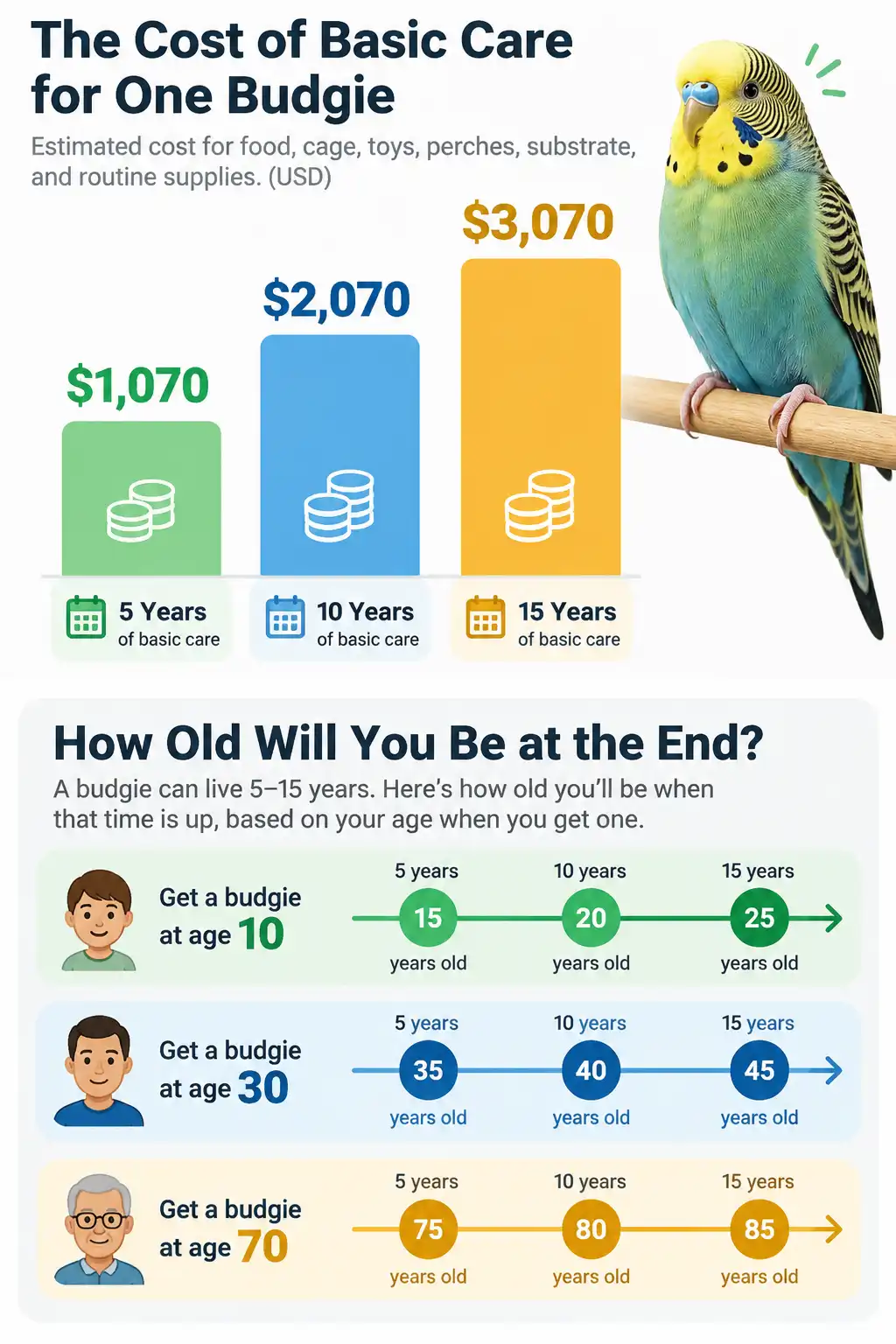
A budgie’s lifespan is also a budget and a time commitment. The ASPCA’s pet care cost chart puts a small bird’s first year at about $270, including a $70 cage. Each year after that runs about $200. Those yearly figures cover food, routine medical care, toys, and extras, but not the bird itself. The chart is several years old, so treat its numbers as a floor, not a forecast.
Here is the math for one budgie:
Lifetime basics = $270 first year + $200 x (lifespan in years minus 1)| If your budgie lives | Basic care cost (ASPCA floor) | Your age at the end if you start at 10 | If you start at 30 | If you start at 70 |
|---|---|---|---|---|
| 5 years | $1,070 | 15 | 35 | 75 |
| 10 years | $2,070 | 20 | 40 | 80 |
| 15 years | $3,070 | 25 | 45 | 85 |
Two points stand out. First, a budgie bought for a 10-year-old may still be alive when that child leaves home. Decide early who keeps it then. Second, an owner starting at 70 should name a backup caregiver for the bird’s later years. A pair roughly doubles the food and vet lines, though two budgies can share one cage.
FAQs about Budgies Lifespan
Can a budgie live 20 years?
It’s very unusual, and a 20-year-old budgie sits far beyond both published ranges. Merck lists 5 to 10 years for budgies, and the Royal Veterinary College gives 10 to 15.
Is 8 years old for a budgie?
Eight is old by Merck’s 5 to 10 year average, but short of the Royal Veterinary College’s 10 to 15. Keep up vet checks and weekly weigh-ins as your budgie ages.
How long do budgies live in the wild?
None of the veterinary references we checked gives a wild figure, and field data on wild budgerigar survival is thin. Wild budgies face predators and harsh weather a pet never meets, so the two don’t compare well.
Do budgies live longer in pairs?
No reference we checked measures it, so the lifespan effect is unknown. Budgies are flock birds, though, and the Royal Veterinary College recommends pairing one with another budgie for lifetime companionship.
What do budgies usually die from?
No reference we checked ranks causes of death for pet budgies. The same risks recur, though: seed-heavy diets and obesity (VCA), tumors (Merck), and toxins like nonstick fumes and zinc (RVC).
Key Points for Your Budgie
Plan for 5 to 15 years, the span between the Merck and RVC figures. Feed mostly pellets with fresh vegetables, keep seed small, and make the switch slowly. Book vet checks once or twice a year, and weigh your budgie weekly in grams. Then keep fumes, zinc, and cats away. Watch an adult male’s cere for a shift from blue to brown. Watch a hen for straining without passing an egg. A budgie that gets those basics has a fair shot at the top of the range.