How Long Do Pigeons Live? 2.4 Years Wild, 15 to 20 as Pets
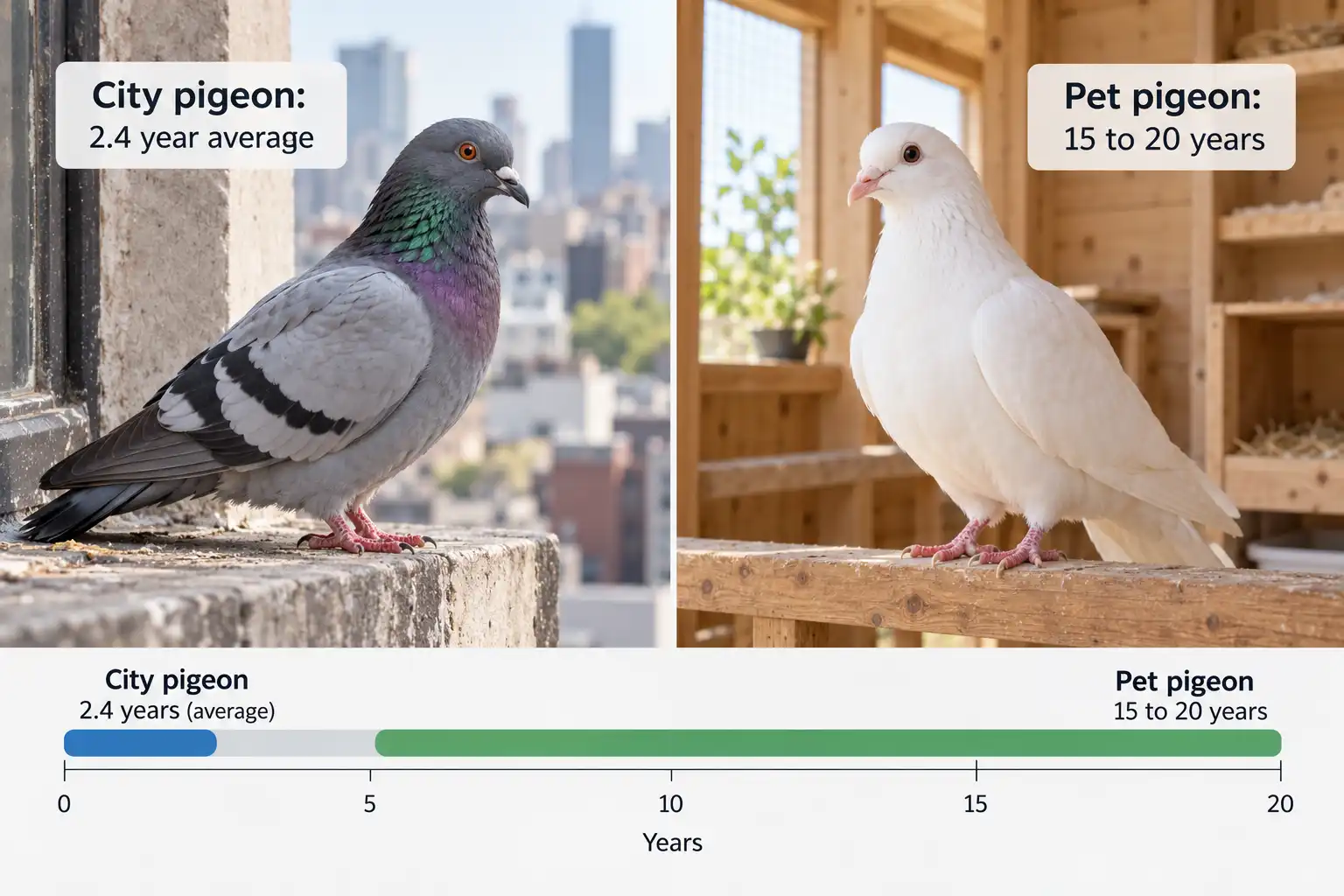
How long do pigeons live? The answer splits in two. A domestic pigeon and a feral city pigeon are the same species. Yet their lifespans differ sharply, and the reasons matter if you plan to keep one.
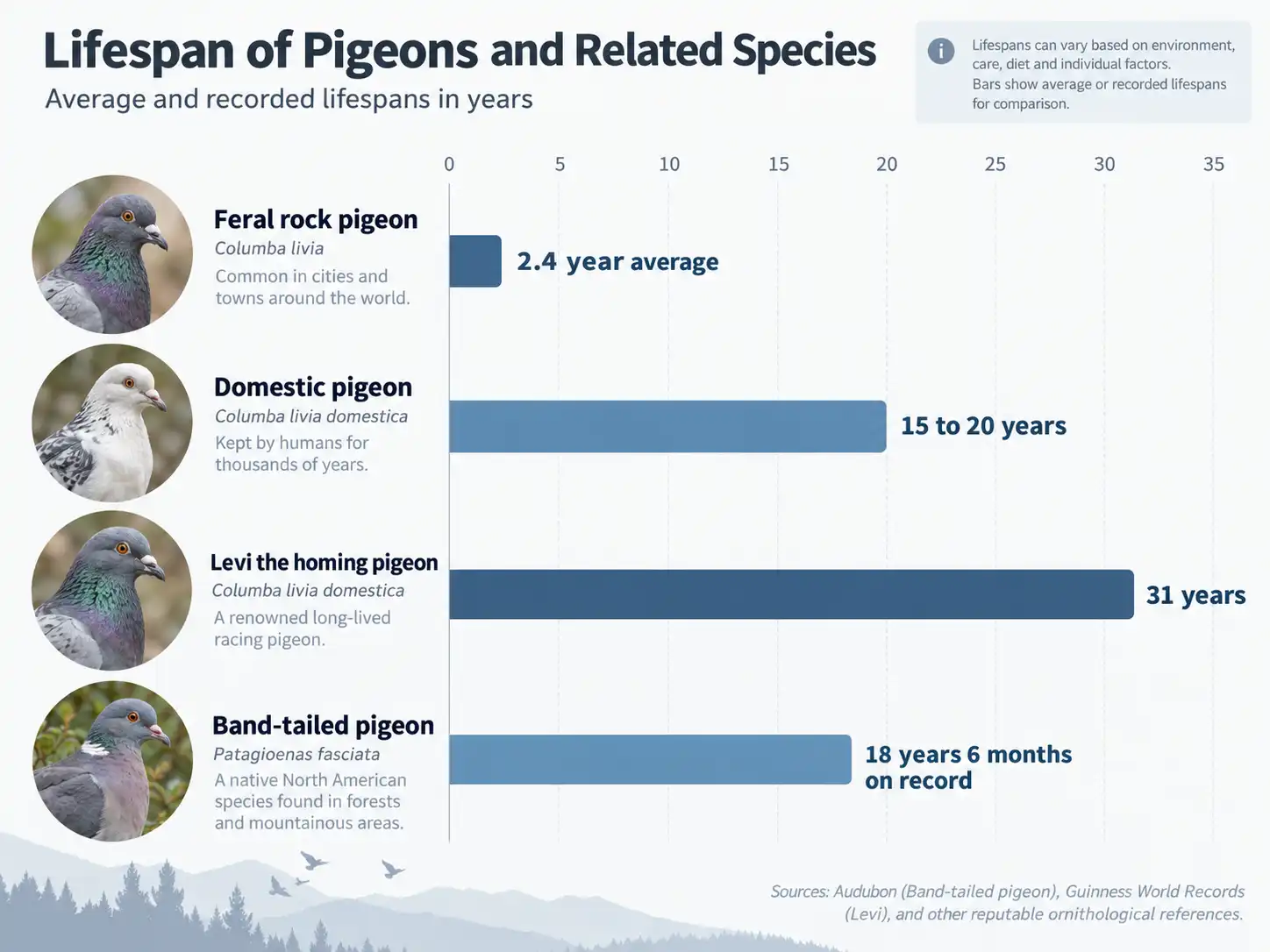
Living conditions decide how long pigeons live. Domestic pigeons can live 15 to 20 years, per University of Missouri Extension and the Merck Veterinary Manual. Feral rock pigeons average only 2.4 years, per the Cornell Lab of Ornithology.
Average Lifespan of a Pigeon at a Glance
The average lifespan of a rock pigeon swings by more than a decade between street life and a loft. This table sets out typical lifespans and how old pigeons can get.
| Pigeon | Typical lifespan | Long-lived example |
|---|---|---|
| Feral rock pigeon (city flocks) | 2.4-year average (Cornell Lab); few live past 3 or 4 years (MU Extension) | A banded Kansas bird, 6 years and 2 weeks old at recapture (Cornell Lab) |
| Domestic pigeon (pet, loft, or racing) | 15 or more years (MU Extension); up to 20 years (Merck) | Levi, a retired US Army homing pigeon, lived to 31 (Cornell Lab) |
| Band-tailed pigeon (native, wild) | No published average found | At least 18 years, 6 months on record (Cornell Lab) |
The first two rows describe one species, the rock pigeon (Columba livia). University of Missouri Extension explains that feral flocks formed when domestic pigeons escaped captivity. So the gap comes from how the birds live, not from what they are.
How Long Do Wild Pigeons Live?
Feral rock pigeons average just 2.4 years, according to the Cornell Lab of Ornithology. University of Missouri Extension adds that few urban pigeons live past 3 or 4 years.
Some do beat the odds. Cornell notes a banded feral rock pigeon in Kansas that was 6 years, 2 weeks old at its recapture.
In the US, “wild pigeon” can also mean a native species. The band-tailed pigeon lives in forests of the Pacific Coast and the Southwest. Per Cornell, the oldest band-tailed pigeon on record reached at least 18 years, 6 months. Still, no source we found gives a typical lifespan for the species. Treat that figure as a ceiling, not a norm.
Why City Pigeons Die Young
Hazards, not old age, cut most feral pigeons’ lives short. After all, domestic rock pigeons can live 15 years or more in captivity, per Missouri Extension. On the street, the threats add up:
- Predators: Peregrine falcons nest in cities, where local rock pigeons give them a reliable food supply, per Cornell.
- Cats: Pigeons feed on the ground, and Cornell warns that ground-feeding birds face extra danger from prowling cats.
- Parasites and disease: VCA veterinarians note that wild pigeons may carry external and intestinal parasites, chlamydia, and several viruses.
- Pest control: Missouri Extension calls the pigeon probably the most serious bird pest around buildings. Its guide covers trapping and registered pesticides.
If you find a sick or injured pigeon, call a licensed wildlife rehabilitator rather than treating it at home.
How Long Do Pigeons Live in Captivity?
Domestic pigeons can live 15 years or more, per University of Missouri Extension. The Merck Veterinary Manual’s table of popular pet birds lists up to 20 years for pigeons.
A few go much further. The Cornell Lab notes that Levi, a retired US Army Signal Corps homing pigeon, lived to 31.
Captivity removes most of what kills city birds. A well-kept pigeon gets steady food, shelter from hawks and cats, and a vet when it falls ill.
VCA veterinarians count more than 300 domestic breeds, all descended from the rock pigeon, in four groups:
- Utility pigeons, raised for meat
- Flying pigeons, such as rollers and tumblers, known for their flying skills
- Racing homers, bred for speed and homing
- Toy pigeons, such as fantails and pouters, the largest group
No source we found breaks lifespan out by breed or group. So use 15 to 20 years for any domestic pigeon. Merck also describes pigeons as relatively quiet and doves as less demanding than parrots. If you want a calmer bird, that makes pet doves and pigeons worth comparing before you choose.
Plan for 15 to 20 Years
Carry the lifespan through to your own age before you commit:
Your age at the end = your age today + 15 to 20 years (a domestic pigeon’s lifespan)
Take home a young domestic pigeon at 35, and expect to care for it until 50 to 55. If that pigeon matches Levi’s 31 years, you’d be 66. An adult bird of known age shortens the math. By these figures, a 6-year-old domestic pigeon has about 9 to 14 years left.
For scale, the Merck Veterinary Manual gives budgerigars 5 to 10 years. So a domestic pigeon often outlives a budgie, which matters if you’re weighing parrot lifespans by species against a pigeon’s.
What Helps a Pet Pigeon Live Longer
VCA veterinarians list fluffed feathers, poor appetite, and tail bobbing among the signs of illness in a bird. In a pigeon, any one of them means an avian vet the same day. VCA also warns that by the time a bird looks sick, it has likely been ill for days to weeks. Treat bleeding that won’t stop, a hen straining to pass an egg, and any cat contact the same way.
Vet Care
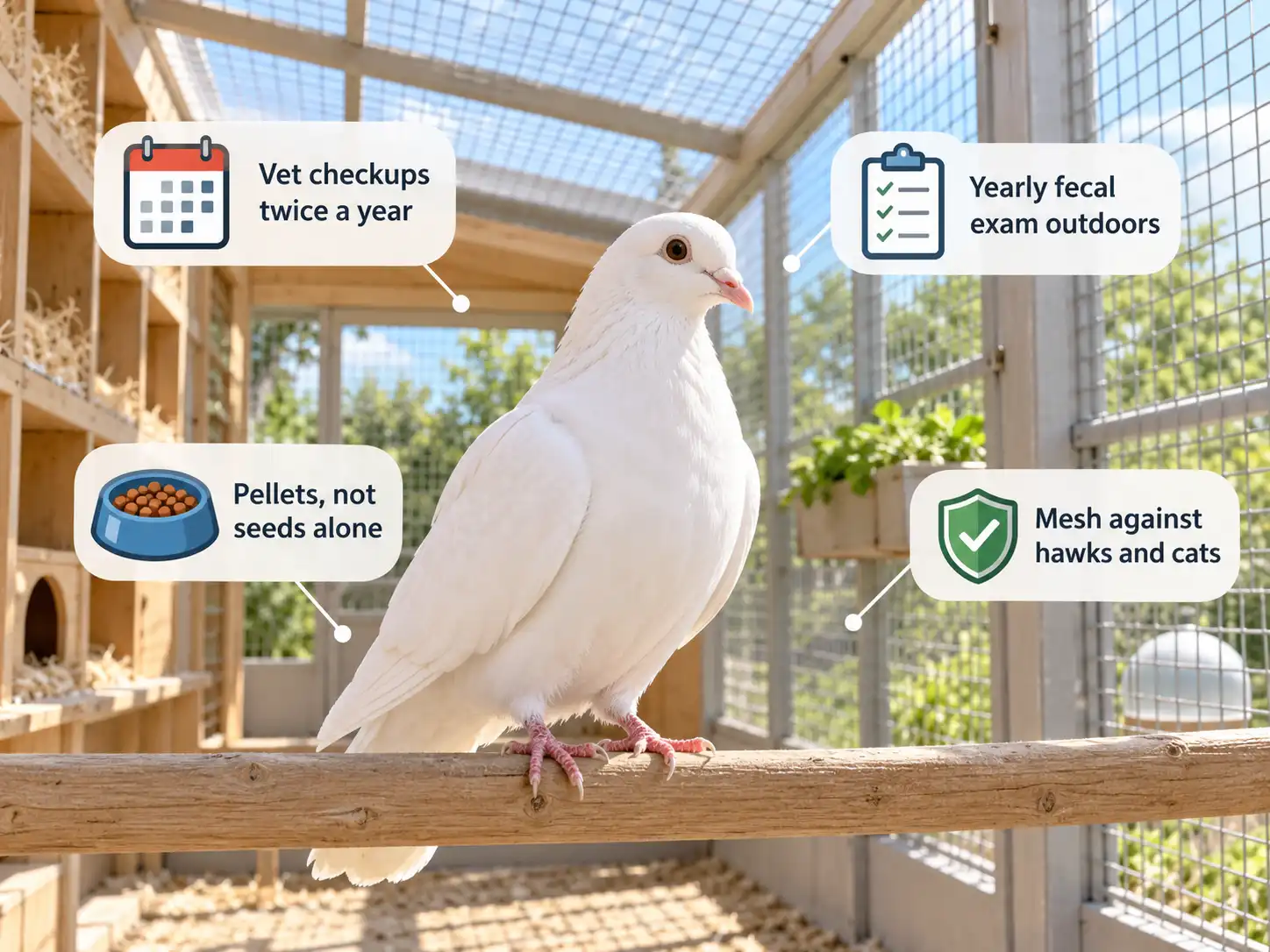
VCA advises a vet exam within 2 weeks of bringing a new pigeon home, then checkups twice a year. Pigeons kept outdoors also need a yearly fecal exam, VCA adds, because intestinal parasites are common there. Its vets highly recommend vaccines against pigeon paramyxovirus and Salmonella paratyphoid, and your vet sets the schedule.
Before the bird comes home, start finding an avian vet near you, since that first exam comes fast. The Association of Avian Veterinarians directory is one place to look.
Diet
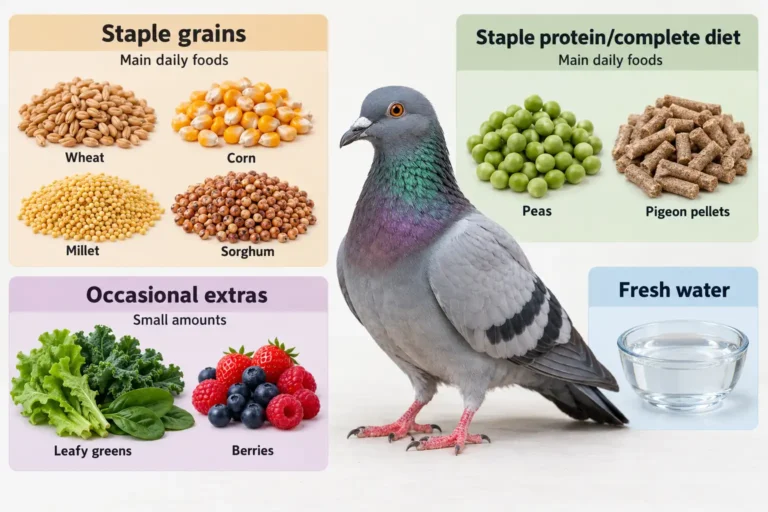
Seeds can be part of a pigeon’s diet but shouldn’t make up all of it, according to VCA’s feeding guidance. Because pigeons have small beaks, VCA favors small pellets made for pigeons and doves, plus vegetables cut into tiny pieces. Watch the bowl, too. Given a mix, pigeons tend to pick out the seeds and skip the pellets, VCA warns.
Racing and nesting seasons can change a pigeon’s needs, VCA adds, so ask your vet before those periods start.
Grit is where opinions split. VCA notes that pigeons swallow seeds whole yet seem to do fine without grit. It also warns that too much grit can upset digestion. So ask your vet whether digestible oyster shell or crushed eggshell, which also supply calcium, suits your bird.
Housing
Merck notes that keepers often house pigeons in colonies. Whatever the setup, it should block the hazards that shorten wild lives. That means mesh walls and a roof that hawks and cats can’t get through.
How Long Does It Take for Pigeon Eggs to Hatch?
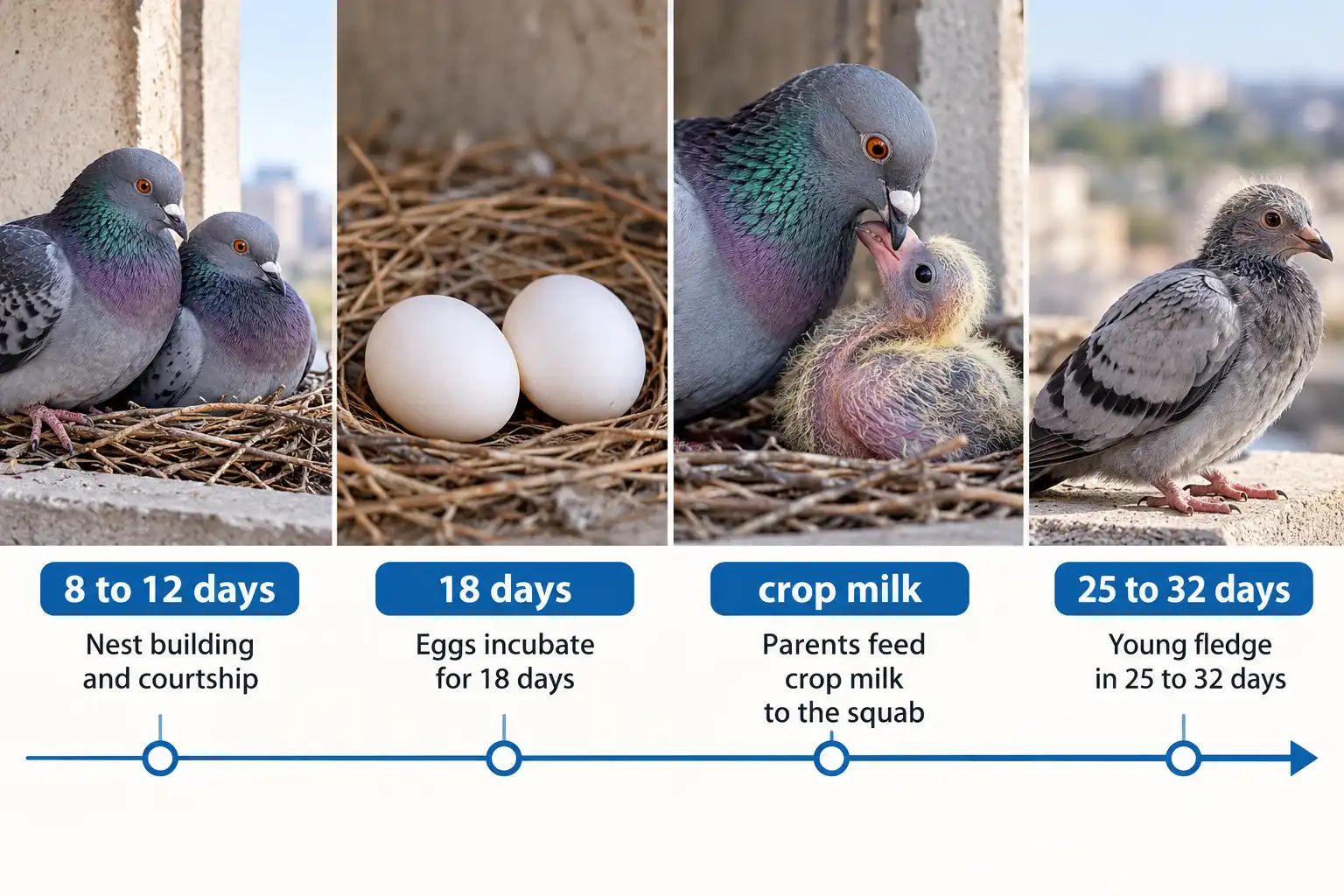
Rock pigeon eggs hatch in about 18 days, a figure the Cornell Lab and Missouri Extension agree on. Both parents share the sitting. Per Cornell’s nesting data, the male sits from mid-morning to late afternoon. The female takes the rest of the day and night.
The chicks, called squabs, hatch helpless with sparse yellow or white down, Cornell notes. Both parents then feed them crop milk, a liquid that the lining of the crop produces.
| Rock pigeon breeding stage | Timing |
|---|---|
| Mating to first egg | 8 to 12 days (MU Extension) |
| Eggs per clutch | 1 or 2 (MU Extension); 1 to 3 (Cornell Lab) |
| Incubation | About 18 days (both sources) |
| Hatching to leaving the nest | 25 to 32 days (Cornell Lab); 4 to 6 weeks (MU Extension) |
| Broods per year | 1 to 6 (Cornell Lab) |
Add the stages together for the full cycle:
Rock pigeon mating to leaving the nest = 8 to 12 days + 18 days + 25 to 42 days = 51 to 72 days
That’s roughly 7 to 10 weeks from mating to a young pigeon leaving the nest. The nest stage uses Cornell’s 25 days at the low end and Missouri’s 6 weeks at the high end.
The cycles also overlap. Missouri Extension notes that pairs usually lay again before the first young have left the nest. That pace helps explain how rock pigeons stay abundant despite short lives on the street.
Can You Keep a Wild Pigeon as a Pet?
Federal law doesn’t prohibit it for feral rock pigeons, but VCA veterinarians advise against it. Their concern is health: wild-caught pigeons may carry parasites, chlamydia, and viruses that can affect other birds.
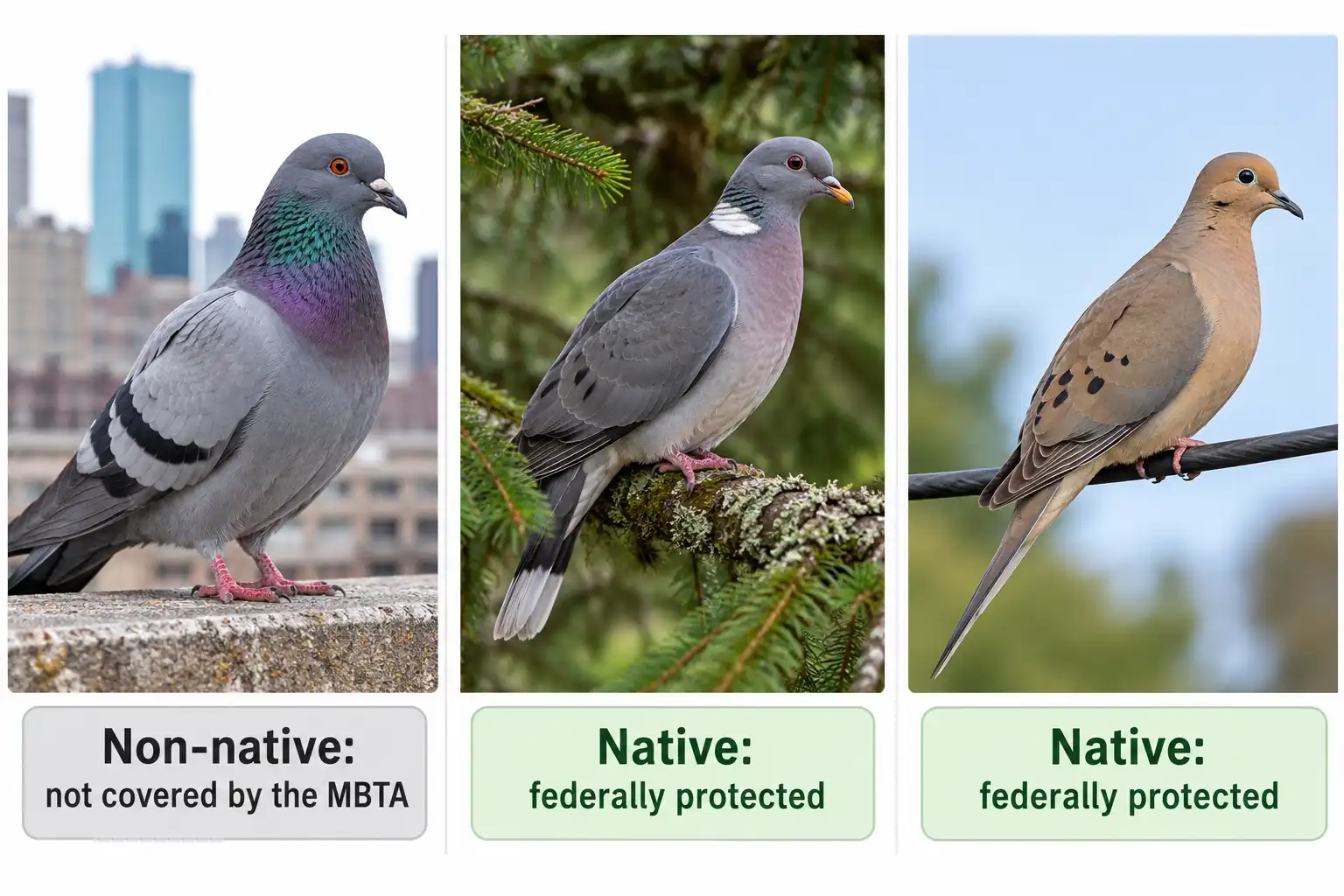
The US Fish and Wildlife Service lists the rock pigeon as a non-native bird the Migratory Bird Treaty Act doesn’t cover. Even so, the agency noted when it first published that list that states and communities can still protect non-native species. So check your state and city rules before you take one in.
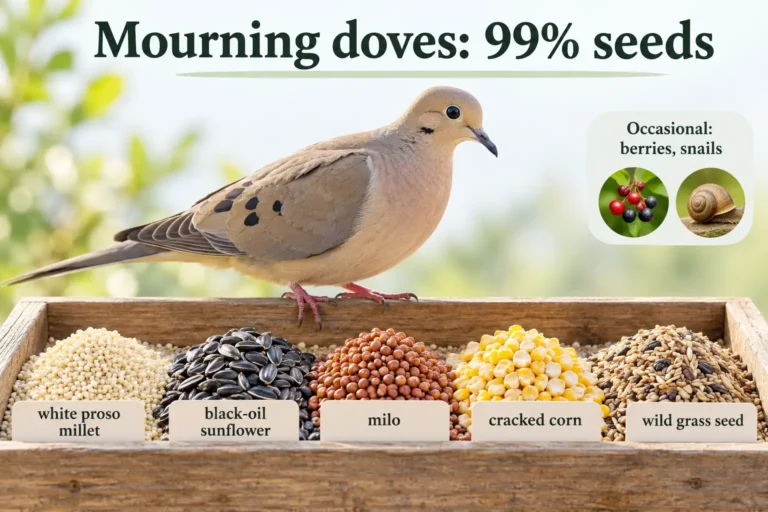
Native pigeons and doves are a different matter. The mourning dove and the band-tailed pigeon both appear on the federal list of protected migratory birds. The Migratory Bird Treaty Act covers their nests and eggs too, per the US Fish and Wildlife Service. Leave native birds in the wild.
Want a pet pigeon? Start with a domestic bird, and consider adopting from a bird rescue before buying one.
Fun Facts About Pigeons
A few facts about rock pigeons stand out:
- They find their way home. Pigeons released far away, even blindfolded, can return home, per the Cornell Lab. They sense the earth’s magnetic field, use the sun’s position, and may also use sound and smell.
- People domesticated them early. Mesopotamian cuneiform tablets and Egyptian hieroglyphics suggest people domesticated pigeons more than 5,000 years ago, Cornell notes.
- They served in two world wars. Rock pigeons carried messages for the US Army Signal Corps in World Wars I and II, per Cornell.
- They helped Darwin. Charles Darwin kept pigeons for years after his voyage on the Beagle. The variety among breeds helped him form parts of his theory of evolution, Cornell reports.
- They drink through the bill. Pigeons suck up water as if through a straw, without raising their heads, per Cornell.
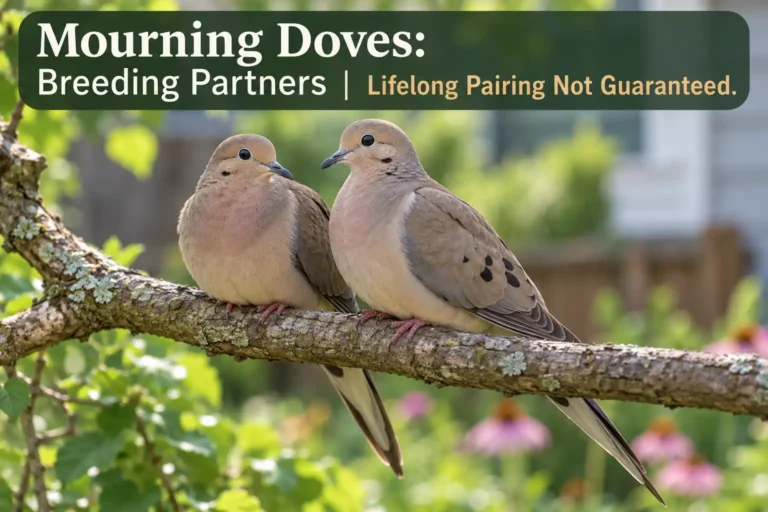
- “Mate for life” depends on the source. VCA describes pigeons as mating for life, while Missouri Extension says they keep one mate at a time.
- Their numbers have dropped. North American rock pigeon populations fell 46% from 1966 to 2015, per Breeding Bird Survey figures that Cornell reports.
FAQs on Pigeon Lifespan
Why don’t you ever see baby pigeons?
Rock pigeon squabs stay hidden in ledge and eave nests for 25 to 32 days, per the Cornell Lab. Most people only notice young pigeons after they leave the nest and join a flock.
How many times a year do pigeons lay eggs?
Rock pigeons can raise 1 to 6 broods a year, per the Cornell Lab. They breed in every season, with peaks in spring and fall, according to University of Missouri Extension.
Do doves live as long as pigeons?
As pets, about the same: the Merck Veterinary Manual lists up to 20 years for both doves and pigeons. In the wild, Cornell’s oldest known mourning dove reached at least 30 years, 4 months.
Are pigeons and doves the same bird?
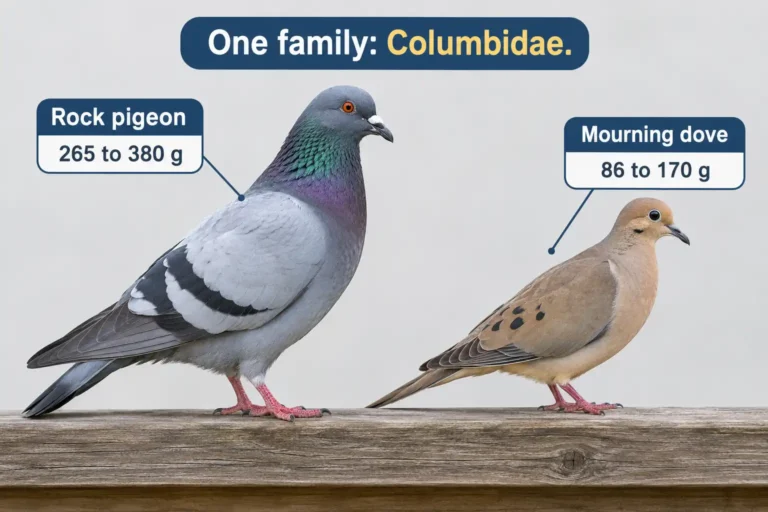
Yes and no: pigeons and doves share one family, Columbidae, per the Cornell Lab, but span many species. VCA even calls the common city pigeon by another name, the rock dove.
What should I do if I find a baby pigeon?
Call a licensed wildlife rehabilitator or your state wildlife agency before you move it. Don’t feed or raise it yourself, since squabs depend on crop milk from both parents, per the Cornell Lab.
Do racing pigeons live as long as pet pigeons?
No published source compares them directly, but racing homers are one of VCA’s four domestic pigeon groups. So Missouri Extension’s 15 or more years for domestic pigeons should apply to them too.
What the Research Supports
Plan on 15 to 20 years for any domestic pigeon, per Missouri Extension and Merck. A few live far longer. A feral rock pigeon’s short life reflects street hazards, not a built-in limit. For a pet, that means twice-yearly checkups, a diet that isn’t all seed, and a predator-proof loft. And leave mourning doves and band-tailed pigeons in the wild, where federal law protects them.