Do Doves Mate for Life? What Science Says About Their Bonds
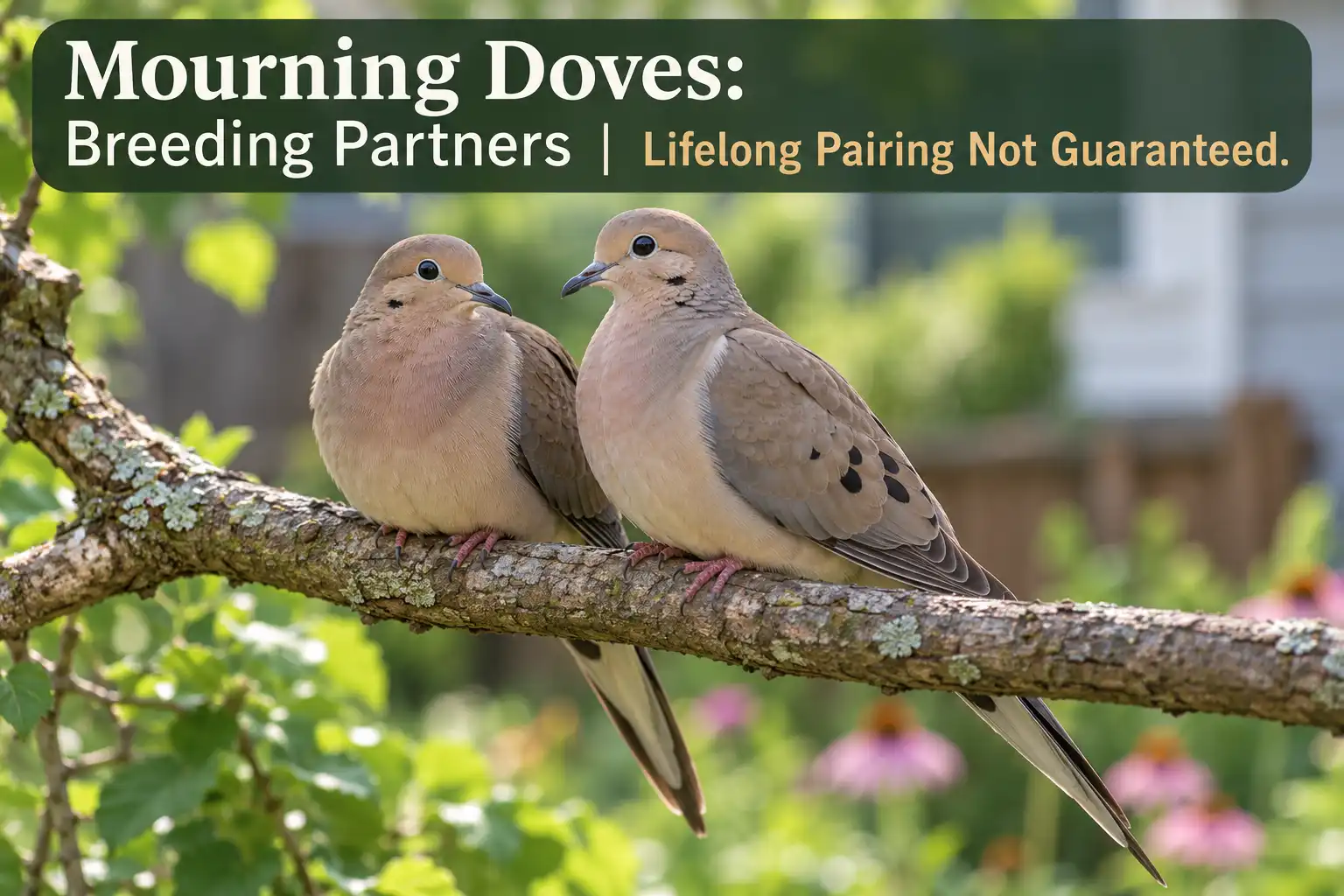
Do doves mate for life? Many form strong breeding partnerships, but their relationships do not always last forever. Mourning doves, turtle doves, and other species differ in how long they remain paired.
Doves often form monogamous breeding pairs, but lifelong pairing is not universal. Mourning doves typically stay together while nesting and sometimes reunite in later seasons. European turtle doves can form long-term bonds. The duration depends on the species.
Do Mourning Doves Mate for Life?
Mourning doves (Zenaida macroura) form monogamous breeding pairs, but there is insufficient evidence to establish lifelong mating as a universal behavior.
Monogamy means two birds maintain a breeding partnership. It does not necessarily mean they remain together throughout their lives.
The Minnesota Department of Natural Resources describes mourning doves as lifelong mates. However, the available research supports a more cautious interpretation.
In 1953, researchers Paul A. Stewart and James P. Mackey Jr. published a study involving two banded mourning doves.
The same male and female nested together in 1951 and returned to that nest in 1952.
However, the researchers could not determine whether the birds remained together throughout winter or reunited during the next breeding season.
Their findings appear in the scientific journal Bird-Banding.
The distinction matters: Some mourning doves maintain partnerships across breeding seasons. However, scientists have not established that every pair remains together for life.
How Do Mourning Doves Choose Their Mates?
Mourning doves develop pair bonds through courtship calls, displays, and mutual grooming. The National Audubon Society identifies several behaviors associated with their courtship.
These include:
- Cooing: Males produce repeated calls to attract females.
- Bowing: A male puffs out his chest and bows toward a female.
- Courtship flights: The male rises into the air before gliding downward with spread wings.
- Mutual preening: Paired birds gently groom each other’s feathers.
- Beak contact: Partners may grasp beaks and move their heads together.
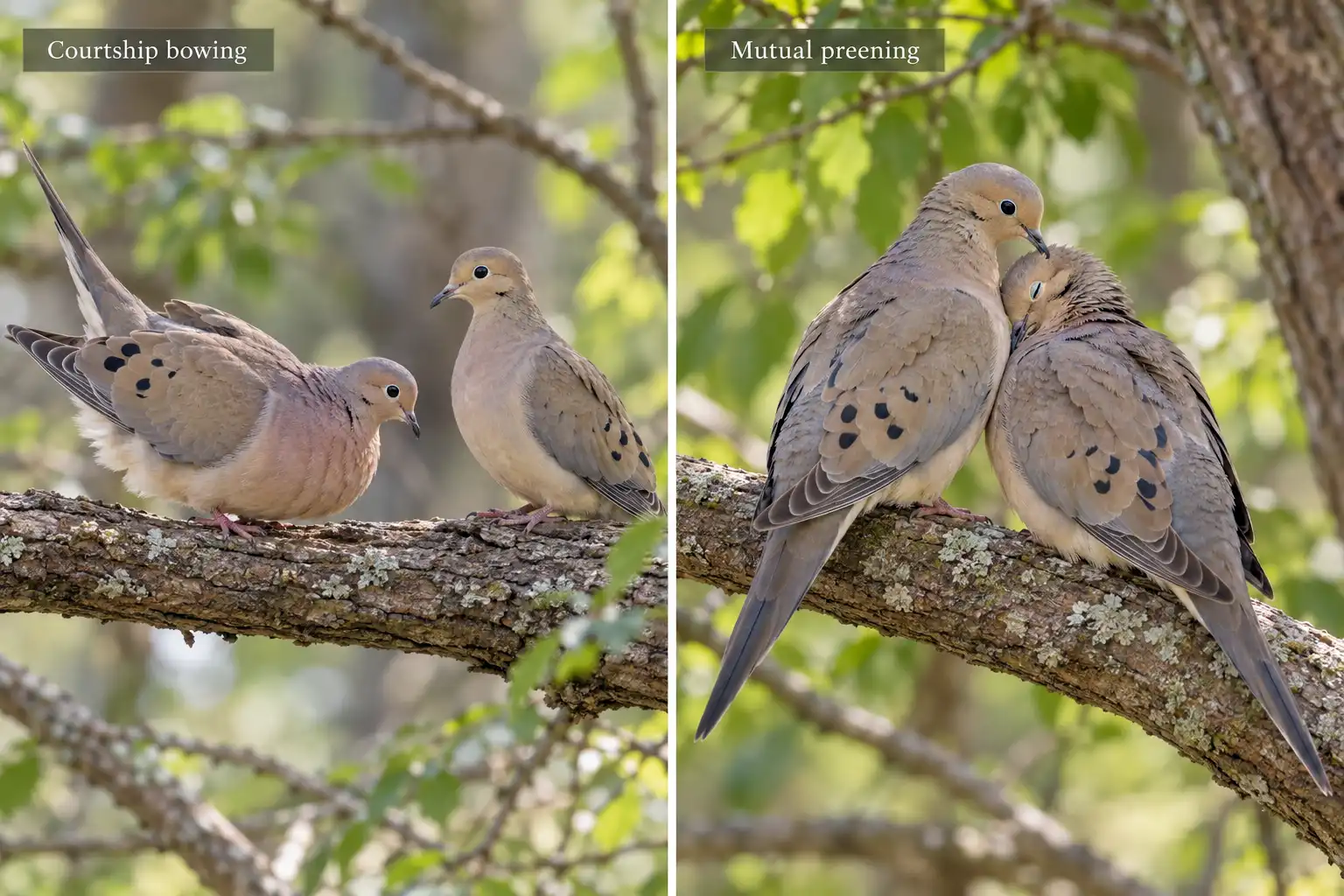
According to the Cornell Lab of Ornithology, mutual preening and synchronized head movements help strengthen pair bonds.
However, simply seeing two mourning doves sitting together does not prove they are mates.
Repeated courtship and shared nesting activities provide stronger evidence of a breeding partnership.
How Long Do Mourning Dove Pairs Stay Together?
Mourning dove pairs usually remain together throughout nesting and may cooperate in several breeding attempts.
Both parents contribute to raising their young.
The Cornell Lab of Ornithology documents the following nesting stages for mourning doves:
| Nesting stage | Typical behavior or duration |
|---|---|
| Courtship | Male attracts a female and establishes a pair bond |
| Nest construction | About 2 to 4 days |
| Egg laying | Usually 2 white eggs |
| Incubation | Approximately 14 days |
| Nestling period | About 12 to 15 days |
| Breeding attempts | 1 to 6 broods per season |
During nest construction, the male gathers materials while the female arranges them.
Both parents incubate the eggs and produce crop milk to feed their chicks.
Some mourning dove pairs raise several broods in one breeding season.
However, successfully raising young together does not prove that a partnership will last forever.
Do Mourning Doves Return to the Same Mate Every Year?
Some mourning doves reunite with previous partners, but annual reunion is not guaranteed.
Their breeding behavior creates an identification problem.
Mourning doves sometimes reuse successful nesting sites. Therefore, two birds returning to the same porch or tree are not necessarily the same individuals.
Without individual identification, such as scientific bird banding, it is difficult to confirm that the original pair has returned.
What Happens When a Mourning Dove Loses Its Mate?
A mourning dove can form a new partnership after losing its previous mate.
The Minnesota Department of Natural Resources specifically notes that surviving mourning doves can find another mate.
However, researchers have not established a fixed period before a surviving bird forms another partnership.
The timing may depend on the breeding season and whether potential mates are available.
Some people associate mourning doves with sadness after losing a partner.
However, there is insufficient scientific evidence to establish that their behavior represents grief in the human sense.
A solitary dove may also have a living mate elsewhere.
Losing a partner does not mean a mourning dove will remain alone for the rest of its life.
Do Turtle Doves Mate for Life?
European turtle doves (Streptopelia turtur) form monogamous breeding pairs and can maintain long-term relationships.
The University of Michigan’s Animal Diversity Web describes these partnerships as potentially long-lasting.
However, that does not mean every turtle dove keeps the same partner throughout life.
European turtle doves differ from mourning doves in several ways.
They breed across parts of Europe, Asia, and North Africa. Many migrate into sub-Saharan Africa during the nonbreeding season.
Like mourning doves, both male and female European turtle doves participate in nesting and raising their young.
Their connection with romance and lasting love also appears in literature and cultural traditions.
Still, symbolic associations are not scientific evidence of lifelong mating.
Do Other Dove Species Mate for Life?
Several dove species establish strong breeding partnerships, but the length of their relationships varies.
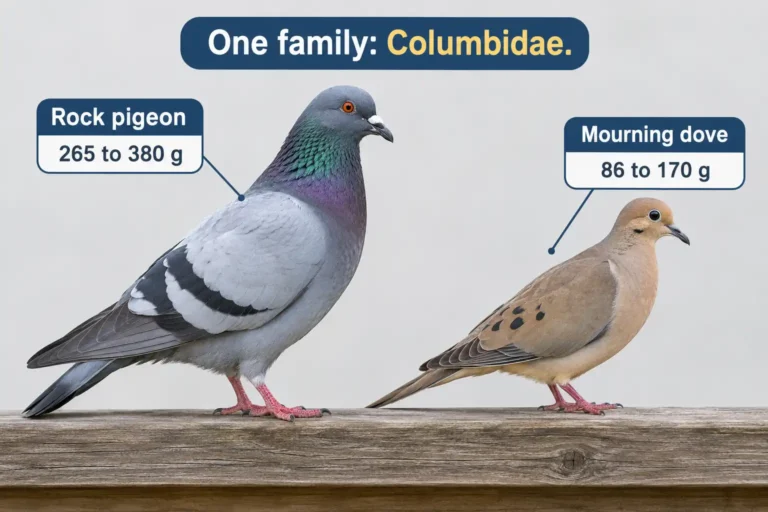
Doves and pigeons belong to the same family, Columbidae. However, not all dove and pigeon species have identical mating behavior.
The following comparison summarizes documented differences.
| Species | Mating behavior |
|---|---|
| Mourning dove (Zenaida macroura) | Forms breeding pairs; some partners reunite in later seasons |
| Common ground dove (Columbina passerina) | Pairs can remain together for several years |
| Eurasian collared-dove (Streptopelia decaocto) | Forms monogamous pairs that may raise several broods in a year |
| European turtle dove (Streptopelia turtur) | Forms monogamous pairs that can develop long-term relationships |
The Cornell Lab of Ornithology specifically reports that common ground dove pairs can remain together for several years.
It also describes Eurasian collared-doves as monogamous breeding partners.
The important difference is between remaining with one partner during breeding and maintaining that relationship throughout life.
Both behaviors occur among birds, but they are not the same.
Are Brown Doves the Same as Mourning Doves?
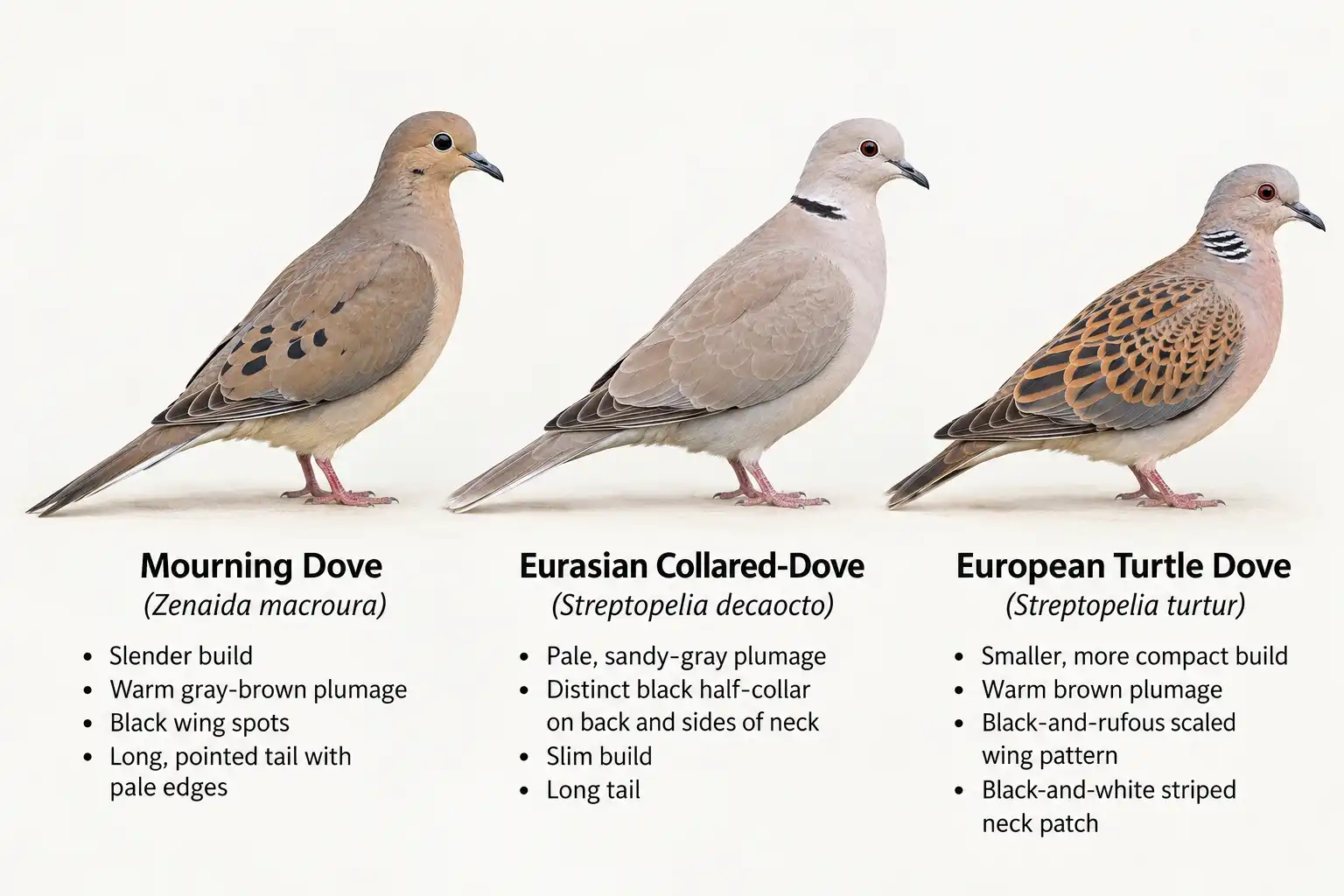
No. Several dove species have brown or gray-brown plumage. Their tail shapes, wing markings, and neck patterns provide more reliable identification clues.
Mourning dove
- Gray-brown body with small black wing spots
- Long, pointed tail with white-edged feathers
- Common throughout much of North America
Eurasian collared-dove
- Pale gray or sandy-brown plumage
- Distinctive black crescent on the back of the neck
- Broad, squared-off tail
European turtle dove
- Brown wings with strongly patterned feathers
- Black-and-white striped neck patches
- Primarily found across Europe, Asia, and Africa
The mourning dove and Eurasian collared-dove are especially easy to confuse at a distance. A closer look at the tail and neck markings usually helps distinguish them.
Why Are They Called Mourning Doves?
Mourning doves get their name from their soft, sad-sounding calls. Their familiar song consists of low, drawn-out coos.
To human listeners, these sounds can resemble a mournful cry. The National Audubon Society identifies the species’ characteristic cooing as the reason for its name.
However, the sound does not necessarily indicate sadness. Male mourning doves commonly use these calls to attract females and advertise their presence. They also defend favored calling perches against rival males.
Therefore, a lone mourning dove calling repeatedly is not necessarily grieving for a missing partner. It may simply be searching for a mate.
What Should You Do if One Mourning Dove Disappears From a Nest?
Do not assume a mourning dove nest is abandoned simply because only one adult is visible.
Male and female mourning doves share incubation and feeding duties. One parent may be away while the other remains nearby.
Young doves may also leave their nests before they become completely independent.
If you notice an unattended nest:
- Observe from a distance. Avoid repeatedly approaching the nest or disturbing the adults.
- Keep pets away. Cats can threaten ground-feeding doves and vulnerable young birds.
- Leave eggs and chicks alone. Do not move them or attempt to feed them.
- Contact a licensed wildlife rehabilitator. Seek professional guidance if an adult is injured or the chicks appear genuinely orphaned.
Homes with cats should also follow appropriate cat and bird separation practices to prevent contact with vulnerable birds.
Maintaining bird-friendly backyard conditions can also help reduce disturbance around nesting areas.
The U.S. Fish and Wildlife Service explains that the Migratory Bird Treaty Act protects native migratory birds and restricts disturbance or removal of protected nests containing eggs or dependent young.
Wild mourning doves should not be captured, kept as pets, or raised without lawful authorization.
Frequently Asked Questions
Do Mourning Doves Stay Together During Winter?
Some mourning doves remain within their breeding range during winter, while others migrate south. However, scientists have not established that every breeding pair stays together during winter or reunites the following spring.
Can One Mourning Dove Raise Chicks Alone?
Both mourning dove parents normally incubate eggs and feed their chicks. If one adult disappears, do not assume the young need human intervention. Contact a licensed wildlife rehabilitator if the chicks appear abandoned or distressed.
What Birds Are Known for Mating for Life?
Sandhill cranes are a well-documented example of birds that form lifelong pair bonds. The Cornell Lab of Ornithology reports that these cranes remain together throughout the year, although surviving birds can eventually find new mates.
Can You Keep a Wild Mourning Dove as a Pet?
Native mourning doves are protected under the Migratory Bird Treaty Act, and keeping one generally requires lawful authorization. If you find an injured or orphaned mourning dove, contact a licensed wildlife rehabilitator or state wildlife agency.
Are Doves and Pigeons From the Same Bird Family?
Yes. Doves and pigeons belong to the family Columbidae, and their common names do not indicate separate scientific families. Individual species differ in body size, appearance, nesting habits, and the duration of their breeding partnerships.
Understanding Dove Mating Behavior
Doves form cooperative breeding partnerships, but not all remain with the same mate throughout life.
Mourning doves commonly maintain bonds during nesting, and some reunite in later seasons. European turtle doves and common ground doves can also maintain lasting relationships.
If you notice a pair in your yard, watch their courtship and nesting behavior from a respectful distance. These activities reveal more about their relationship than simply seeing two birds together.