How Long Do Doves Live? Wild Mourning Doves vs Pet Doves
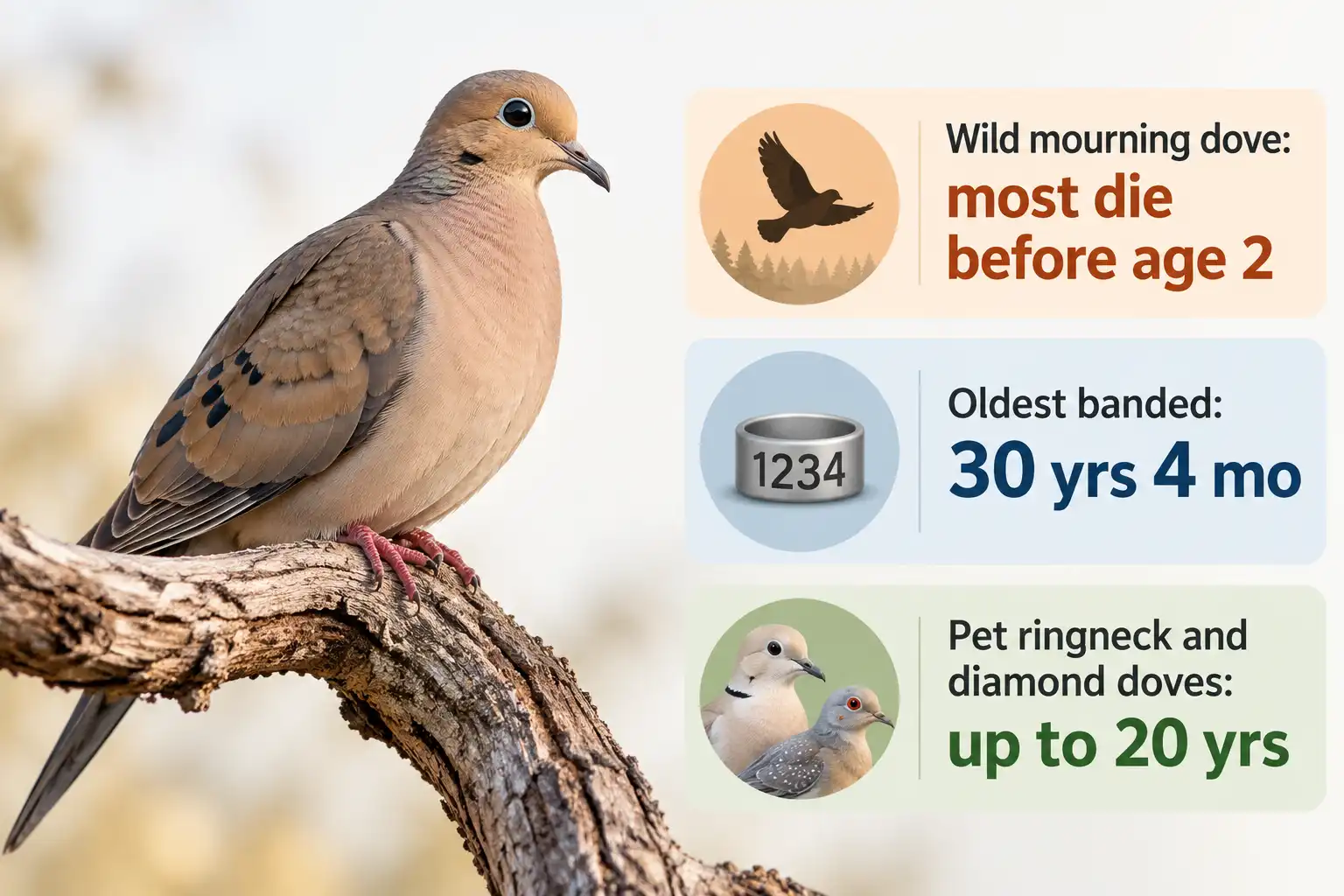
How long do doves live? It depends on which dove you mean. The mourning dove cooing on your fence lives a short, risky life. A pet ringneck or diamond dove, kept safe indoors, can last many times longer.
How long doves live depends on whether they are wild or pets. Most wild mourning doves die before age two, though one reached 30 years 4 months. Pet doves can live up to 20 years, per the Merck Veterinary Manual.
How Long Do Mourning Doves Live in the Wild?
Most wild mourning doves live only one to two years. Federal biologists track this closely, because the mourning dove is a game bird managed under federal law.
The US Fish and Wildlife Service’s 2026 mourning dove population status report averages banding data from 2007 to 2025. Across the Eastern, Central, and Western management units, 28 to 31 percent of young mourning doves survive their first year. Adults do a little better. Still, only 40 to 49 percent of adult mourning doves live through each following year.
In other words, a grown dove’s yearly odds of dying are about a coin toss, or slightly worse. And those odds don’t improve with age. USFWS models treat every adult the same, so a five-year-old dove faces the same yearly odds as a two-year-old.
Survival also shifts by region. The Central unit, which runs from Texas north to Montana, has the highest long-term adult survival at 49 percent. The Eastern unit has the lowest, at 40 percent.
The Survival Math, Year by Year
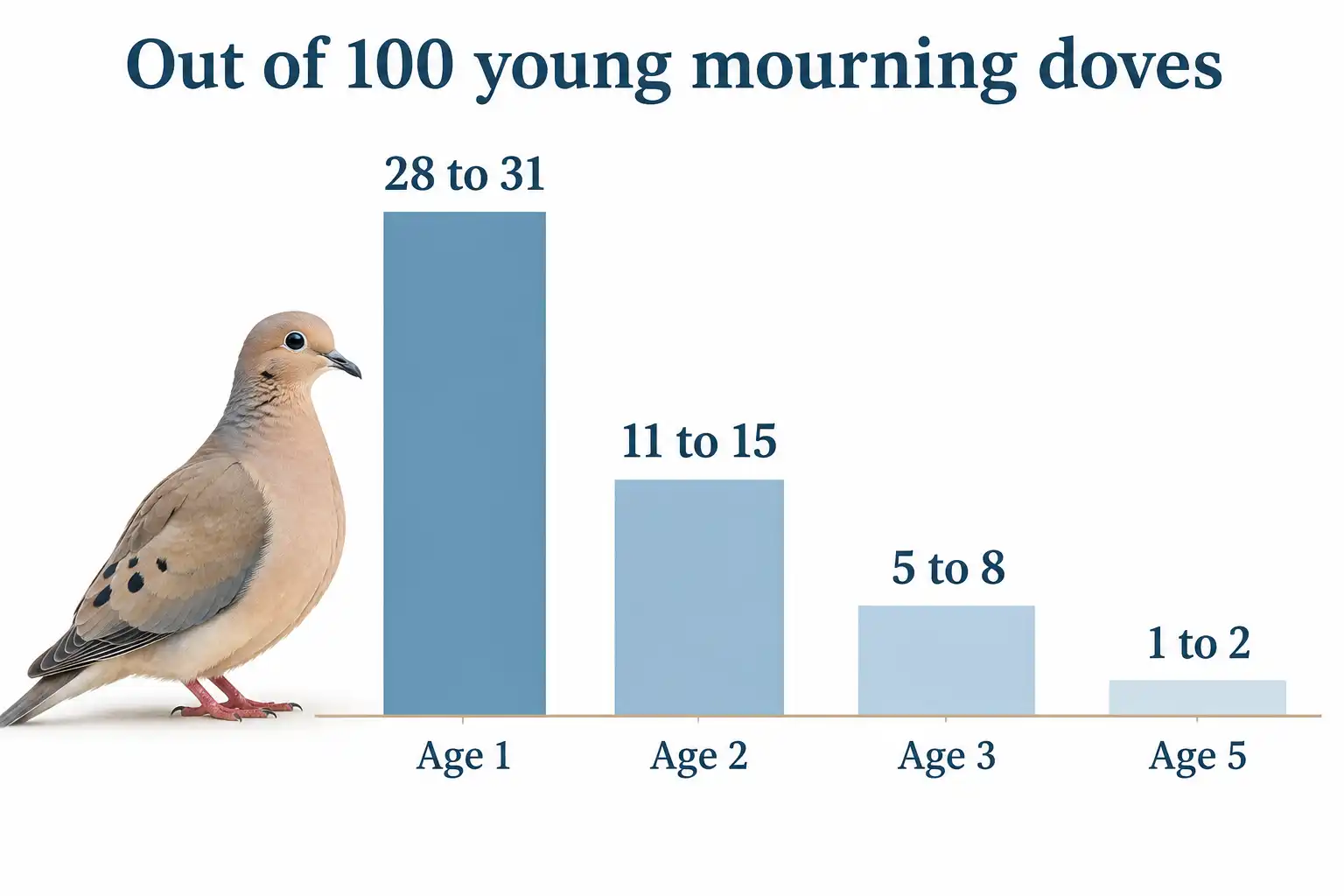
You can turn those rates into odds for any age. Multiply first-year survival by adult survival once for each extra year.
Share alive at age N = first-year survival x adult survival, repeated (N - 1) times
Central unit, age 2: 0.314 x 0.489 = 0.154, so about 15 in 100| Age reached | Young mourning doves still alive, out of 100 |
|---|---|
| 1 year | 28 to 31 |
| 2 years | 11 to 15 |
| 3 years | about 5 to 8 |
| 5 years | about 1 to 2 |
| 10 years | 1 in 2,000 to 1 in 13,000 |
These counts start with young birds banded in July and August. So they leave out eggs and nestlings lost earlier, and the real odds from the egg are lower. At these averages, a 30-year-old mourning dove works out to fewer than one in a billion. That’s why the record below stands out.
The Oldest Mourning Dove on Record
The oldest known wild mourning dove reached at least 30 years 4 months. The USGS Bird Banding Laboratory lists it in its longevity records, version 2025.1. The male was banded in Georgia in June 1968 and shot in Florida in October 1998.
You’ll often see 31 years 4 months quoted instead. That number comes from older editions of the same federal list. The current table gives 30 years 4 months, so we use that figure.
Treat the record as a ceiling, not a forecast. The Bird Banding Laboratory notes that its table only covers birds someone banded and reported. Every age is a minimum, too. It also points out that game birds carry far more bands than most species. So the chance of finding a very old mourning dove is higher than for a songbird.
Why Most Mourning Doves Die Young
Mourning doves live exposed lives from the egg onward. The Cornell Lab of Ornithology describes the nest as a loose, unlined platform of twigs and grass, about 8 inches across. It gives the young little warmth. Adults also feed on open ground in fields, yards, and roadsides, where hawks and cats can reach them.
Hunting plays a smaller part than many people expect. The USFWS estimates hunters took about 15.5 million mourning doves in the 2025 to 2026 season. That’s out of roughly 330 million in the US. Over the long term, hunters take 3 to 6 percent of adult mourning doves each year. Meanwhile, 51 to 60 percent of adults die each year from all causes. So most deaths come from something else.
One hidden cause is lead. Cornell notes that doves foraging in heavily hunted fields swallow spent lead shot. Around fields planted to attract doves, about 1 in 20 birds ends up eating it.
How a Short-Lived Bird Stays Common
Fast breeding makes up for short lives. Per Cornell, a mourning dove pair lays 2 eggs and incubates them for 14 days. The young leave the nest 12 to 15 days after hatching. Pairs raise 1 to 6 broods a year.
That means one nest cycle takes about four weeks, egg to fledgling. Both parents share the work. The male even passes twigs to the female as she builds, part of how dove pairs bond. As a result, a pair that survives a single season can still leave several broods behind.
Gray Dove or Brown Dove? Lifespans by Species
A gray or brown dove in a US yard is usually one of five wild species. Their oldest banded birds range from about 7 to 30 years, per the USGS longevity table. Color helps you tell them apart, but it doesn’t predict lifespan.
| Species | Look for | Oldest banded bird (USGS) |
|---|---|---|
| Mourning dove | Tan-gray body, black wing spots, long pointed tail edged in white | 30 years 4 months |
| White-winged dove | Gray-brown, bright white stripe along the folded wing | 21 years 9 months |
| Inca dove | Small, gray-brown, scaly pattern, long tail | 10 years 10 months |
| Eurasian collared-dove | Pale gray-tan, black half-collar on the neck, square tail | 9 years 3 months |
| Common ground dove | Sparrow-sized, brown, scaly breast, rusty wings in flight | 7 years 2 months |
Two of those records ended the same way. Cats killed both the Inca dove and the Eurasian collared-dove on the USGS list.

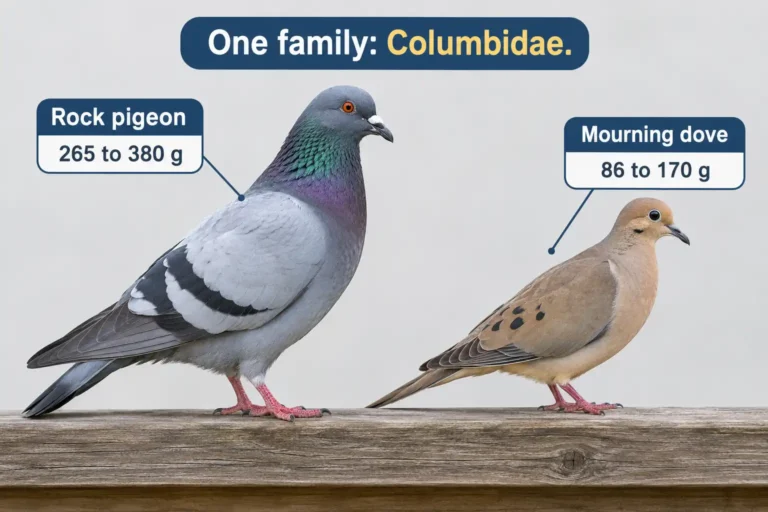
A pale dove with a black half-collar could also be an escaped pet ringneck dove. The wild Eurasian collared-dove is larger and grayer, while the ringneck looks creamier. Meanwhile, a stocky gray bird with dark wing bars, flocking around parking lots, is usually a rock pigeon. Rock pigeon lifespans follow their own pattern.
How Long Do Doves Live in Captivity?
Pet doves can live 10 to 20 years. The Merck Veterinary Manual’s table of popular pet birds lists up to 20 years for doves. A dove care sheet by veterinarian Maria Zayas, DVM, published by PetMD, gives 10 or more years. That figure assumes good care and varies by species.
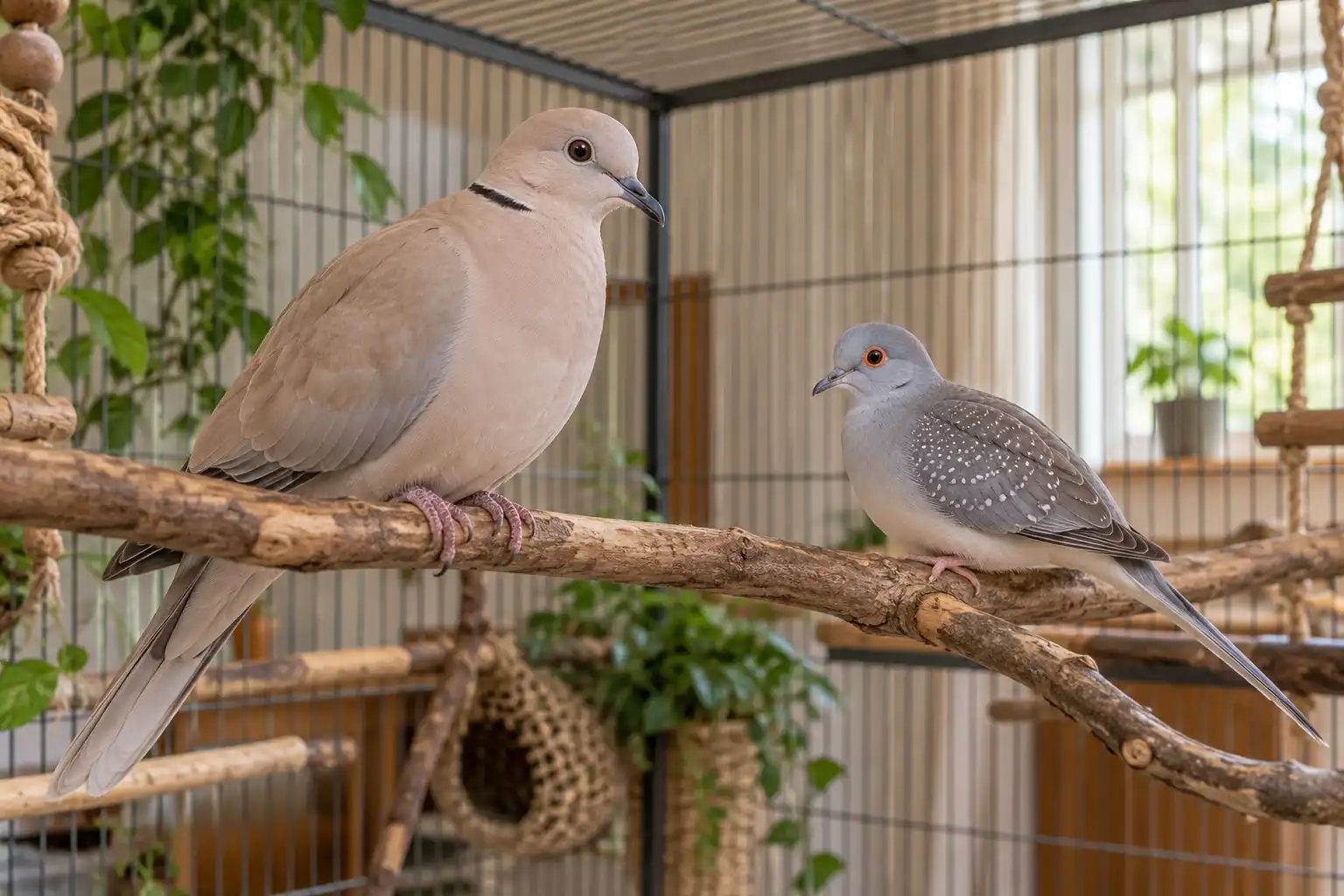
PetMD names two species as the doves most often kept as pets:
- Ringneck dove: native to Africa, light brown and white with a black neck ring, and the larger, hardier of the two
- Diamond dove: native to Australia, bluish-gray with white wing spots and a red ring around each eye
Neither reference gives a separate figure for each species. Many sites print exact spans for ringneck and diamond doves. But we could not trace those numbers to a veterinary source, so we don’t repeat them. Plan for the full 20 years either way.
Pet doves outlast wild ones for simple reasons. They face no hawks, no hunting season, and no winter food shortage. They also get veterinary care when something goes wrong.
Can a Mourning Dove Live in Captivity?
Not as a pet. The USFWS manages mourning doves under the Migratory Bird Treaty Act of 1918. That law makes it illegal to keep a protected bird, or its nest or eggs, without a federal permit.
That’s also why no published captive lifespan exists for the species. There is no pet population to measure.
If you find a hurt or orphaned mourning dove, call a licensed wildlife rehabilitator or your state wildlife agency. Don’t try to feed or raise it yourself.
Your Age When a Pet Dove Reaches Old Age
Run the numbers before you buy. Add the 10 to 20 years the sources give for pet doves to your age today.
Your age at the end = your age today + 10 to 20 years
Age 10 today:  20 to 30
Age 35 today:  45 to 55
Age 65 today:  75 to 85
So a dove bought for a 10-year-old can still be alive after that child moves out. Decide early who takes the bird if plans change.
What Helps a Pet Dove Live Longer
Most early losses in pet doves come from diet, missed vet care, and household hazards. Each one is fixable.
Diet
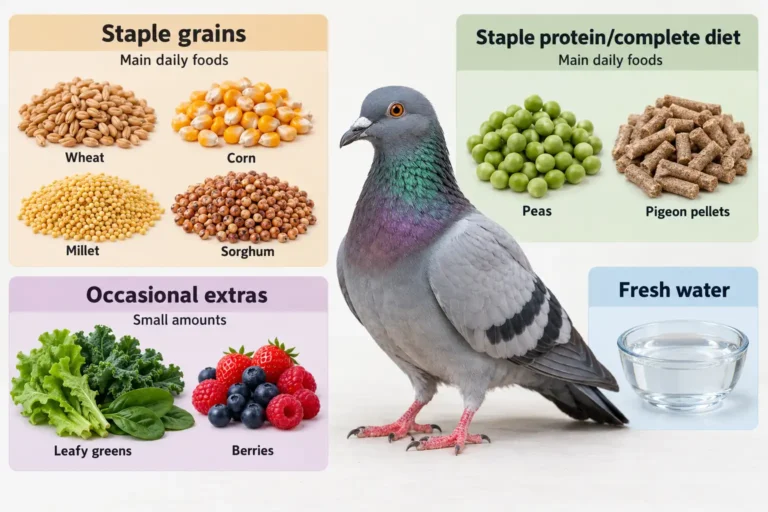
PetMD says pellets made for doves should be at least 60 to 70 percent of a pet dove’s diet. Treats should stay under 10 percent. Seeds alone are not nutritionally complete, so they work as treats, not staples. Getting the right mix of pellets, greens, and grit matters as much as the cage.
Vet Care
The two sources differ on timing. PetMD advises a vet exam at least once a year for pet doves. By contrast, a VCA Animal Hospitals handout describes checkups twice a year for pigeons and doves. Its authors, Gregory Rich, DVM, and Rick Axelson, DVM, also highly recommend vaccines against pigeon paramyxovirus and Salmonella paratyphoid. Your avian veterinarian, found through the Association of Avian Veterinarians directory, can set the schedule for your bird.
Some signs can’t wait for that schedule. A dove sitting fluffed on the cage floor or bobbing its tail needs an avian vet the same day. So does one breathing with its mouth open or refusing food. Learn the other warning signs that call for a vet before you need them.
Home Hazards
PetMD warns that heated nonstick (PTFE) coatings give off fumes that can kill pet birds. If a dove shares your home, switch to bird-safe pans.
PetMD also notes that doves have very few natural defenses against predators such as hawks and snakes. Indoors, the usual threat is a cat. So plan for a cat and a dove under one roof early. For the same reason, never release a pet dove outdoors. It faces the same predators as a wild bird, with none of the practice.
FAQs about Dove Lifespan
How long do mourning doves live in captivity?
No reliable figure exists, because federal law bars keeping mourning doves as pets without a permit. The few held by licensed rehabilitators are too small a group to produce an average, so treat any single number with doubt.
How long can a dove live at most?
The oldest confirmed wild dove is a mourning dove that reached at least 30 years 4 months, per the USGS Bird Banding Laboratory. For pet doves, the Merck Veterinary Manual lists a lifespan of up to 20 years.
Is the gray dove in my yard a mourning dove?
Not always, because the Eurasian collared-dove is grayer and common in many towns. Check for a black half-collar on the back of the neck and a square tail, since a mourning dove has neither of those marks.
Do brown doves live longer than gray doves?
No, color does not predict lifespan, but species does, according to the USGS longevity table. The brown common ground dove’s record is 7 years 2 months, while the gray-brown white-winged dove reached 21 years 9 months.
Can you tell a dove’s age by looking at it?
Only roughly, because adult doves look alike from year to year. USFWS biologists can tell a young mourning dove from an adult by its wing feathers, but not an adult’s exact age.
What should I do if I find a baby mourning dove?
Call a licensed wildlife rehabilitator or your state wildlife agency before you handle it. The Migratory Bird Treaty Act protects mourning doves, and a rehabilitator can tell you whether the bird needs help at all.
What the Research Supports
A wild mourning dove lives a fast, short life, and federal survival data shows most die before age two. The 30-year record shows what the species can do, not what it usually does. A pet ringneck or diamond dove is a different commitment. Plan for 10 to 20 years, regular avian vet exams, and a home kept clear of cats and nonstick fumes.