Are Pigeons Doves? Yes, and the Name Mostly Comes Down to Size

Are pigeons doves? The question comes up at feeders, in pet stores, and at weddings with white birds. The answer is simple. Still, the details decide how you tell the birds apart and which ones you can legally keep.
Yes, pigeons are doves, and doves are pigeons. Both belong to the family Columbidae, and science draws no line between them. “Pigeon” usually names larger species and “dove” smaller ones, though the names don’t follow that rule consistently.
Are Doves and Pigeons the Same Bird?
They’re the same kind of bird, but not the same species. The Cornell Lab of Ornithology places every pigeon and dove in one family, Columbidae. It simply calls the family “Pigeons and Doves.” Its North American guide lists 15 members: 5 named pigeons and 10 named doves.
So “pigeon” and “dove” are English labels, not scientific groups. In fact, the labels can swap. The city pigeon, Columba livia, was officially the rock dove until 2003. That year, the American Ornithologists’ Union renamed it the rock pigeon in its checklist of North American birds.
The old name never fully left, though. VCA veterinarians still call the species the rock dove. Likewise, the Missouri Department of Conservation files it under “Rock Pigeon (Rock Dove).”
What actually separates one bird from another is the species. Each has its own scientific name: Columba livia for the rock pigeon, Zenaida macroura for the mourning dove.
What Is the Difference Between a Dove and a Pigeon?
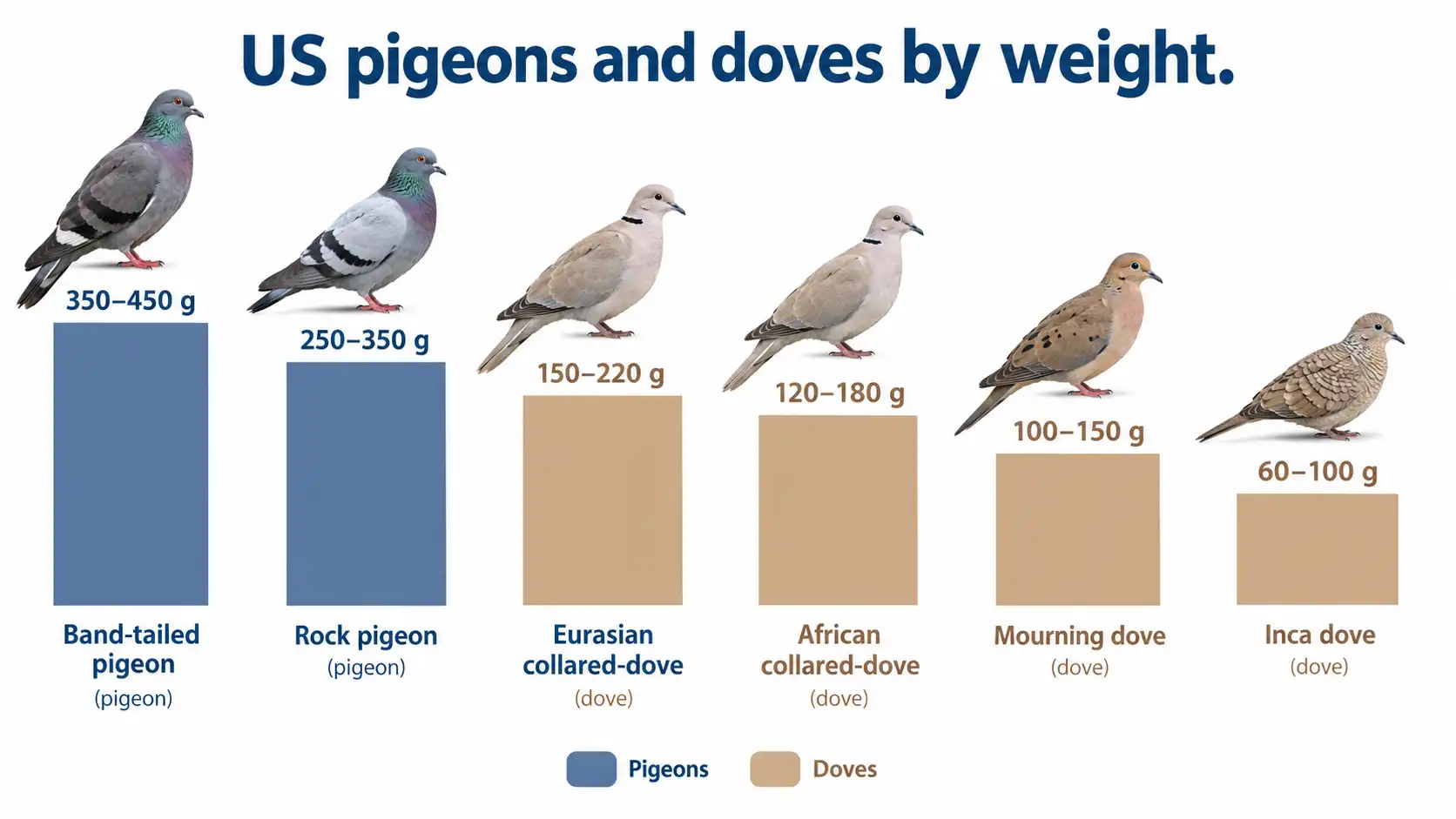
The main difference is size, and even that is a naming habit rather than a rule. In the US, however, the habit holds up well. Based on Cornell’s measurements, every bird named a pigeon below outweighs every bird named a dove.
| Species | Named a | Adult weight (Cornell) | Native to the US? | Covered by the Migratory Bird Treaty Act? |
|---|---|---|---|---|
| Band-tailed pigeon | Pigeon | 342 to 364 g (12.1 to 12.8 oz) | Yes, western North America | Yes |
| Rock pigeon (city pigeon) | Pigeon | 265 to 380 g (9.3 to 13.4 oz) | No, introduced in the early 1600s | No |
| Eurasian collared-dove | Dove | 140 to 180 g (4.9 to 6.3 oz) | No, reached Florida by the 1980s | No |
| African collared-dove (wild form of the ringneck dove) | Dove | 130 to 166 g (4.6 to 5.9 oz) | No, seen mostly as escaped pets | No |
| Mourning dove | Dove | 86 to 170 g (3.0 to 6.0 oz) | Yes | Yes |
| Inca dove | Dove | 30 to 58 g (1.1 to 2.0 oz) | Yes | Yes |
Federal status comes from two US Fish and Wildlife Service lists. One names the migratory birds the Act protects. The other names non-native species it doesn’t cover.
Length tells a messier story. Cornell measures mourning doves at 9.1 to 13.4 inches and rock pigeons at 11.8 to 14.2 inches. The dove’s long, pointed tail closes the gap. So judge bulk, not length. Cornell describes the rock pigeon as tubby, with a small head and short legs. The mourning dove, on the other hand, looks slender and long-tailed.
Rock Pigeon vs Mourning Dove by Weight
The weight gap is wide enough to settle most mix-ups. Run Cornell’s ranges through two quick checks:
Lightest rock pigeon minus heaviest mourning dove = 265 g minus 170 g = 95 g
Typical rock pigeon ÷ typical mourning dove = 322.5 g ÷ 128 g = about 2.5
The typical weights are the midpoints of each range. For the rock pigeon, that’s (265 + 380) ÷ 2. For the mourning dove, it’s (86 + 170) ÷ 2.
So even the lightest rock pigeon in Cornell’s range outweighs the heaviest mourning dove. On average, a rock pigeon carries about two and a half times a mourning dove’s weight.
What Pigeons and Doves Have in Common
A few traits run through the whole family, and they matter more than the name.
First, parents feed their chicks crop milk. Per the Merck Veterinary Manual, parents make it from shed cells and gland secretions in the crop. It’s rich in fat and protein, with no carbohydrates.
Second, they drink differently from most birds. The Missouri Department of Conservation notes that pigeons, like other members of the dove family, drink with the bill down. They don’t tilt their heads back to swallow.
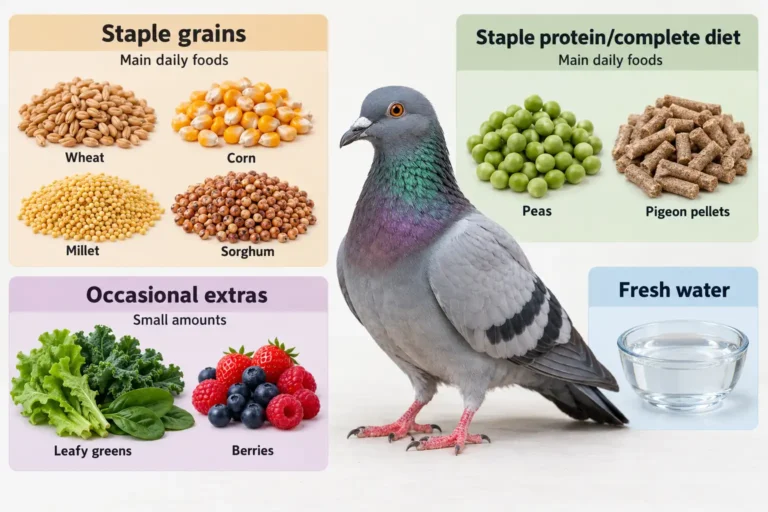
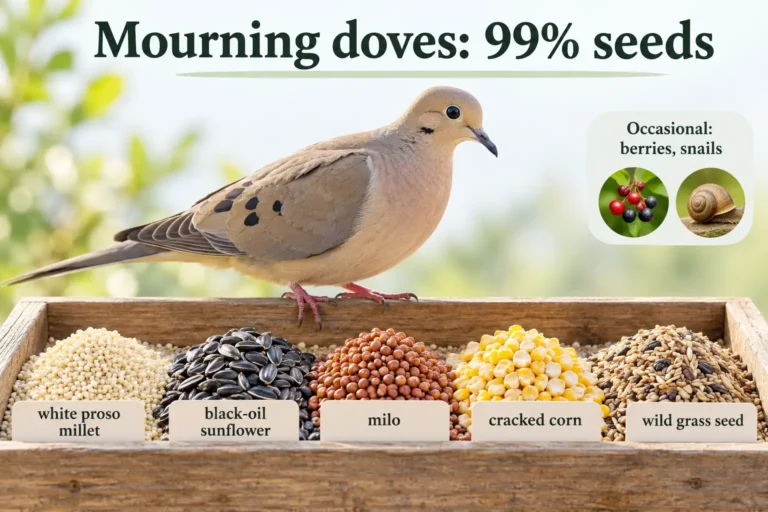
Third, they eat mostly plants. Merck says most species live mainly on seeds or mainly on fruit, plus a few invertebrates. The ones at US feeders are seed eaters. For example, Cornell suggests millet for mourning doves and dried corn, peas, or sorghum for rock pigeons.
Are Mourning Doves Pigeons?
Yes, in the family sense. A mourning dove belongs to Columbidae, so it’s as much a pigeon as any dove is. It isn’t a rock pigeon, though. The two species sit in different genera, Zenaida and Columba.
They also differ in ways that matter to you. The mourning dove is native and protected under the Migratory Bird Treaty Act. By contrast, the rock pigeon came from Europe in the early 1600s, per Cornell, and the Act doesn’t cover it.
Protected doesn’t mean rare. Cornell estimates 350 million mourning doves in the US, and they’re regulars at backyard seed feeders. The US Fish and Wildlife Service calls the mourning dove North America’s most hunted migratory game bird. The Act bars taking a protected bird, its nest, or its eggs except as regulations allow. Hunting seasons are one such regulation. Taking a wild mourning dove home as a pet isn’t.
How to Tell a Mourning Dove From a Pigeon
Cornell’s field marks make it quick:
- Mourning dove: brown to buffy-tan, black spots on the wings, a long pointed tail with white tips
- Rock pigeon: tubby, usually blue-gray with two dark wingbars, though flocks include plain, spotted, pale, and rusty-red birds
- Eurasian collared-dove: chalky gray-buff, a black crescent on the back of the neck, a square-tipped tail
Size backs up the marks. The collared-dove sits between the other two, larger than a mourning dove but smaller than a rock pigeon, per Cornell.
Is a Dove a White Pigeon?
No. Color doesn’t make a bird a pigeon or a dove. The Missouri Department of Conservation notes that rock pigeons range from all white to all black. So a pure white bird can be an ordinary domestic pigeon.
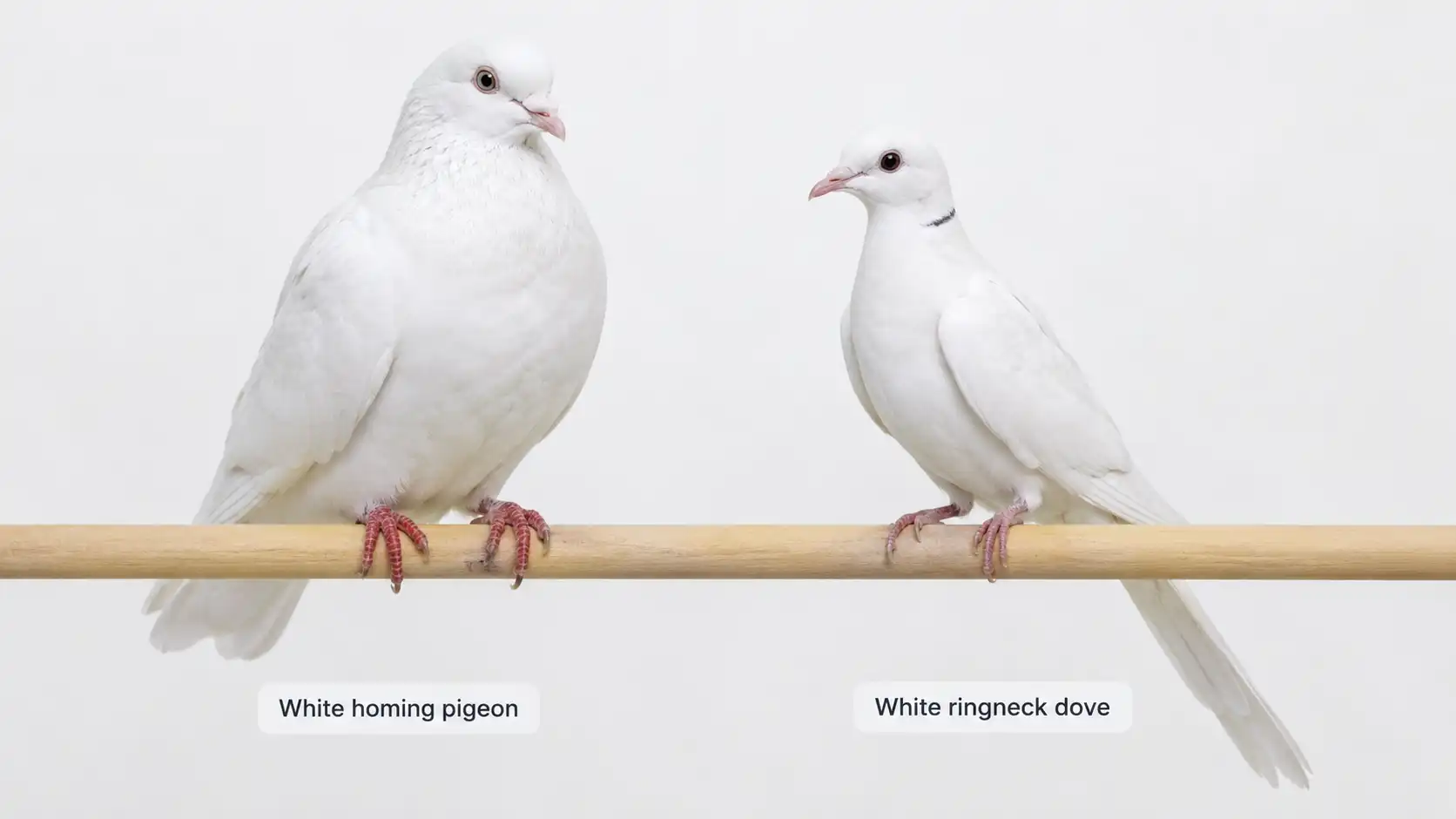
A white ringneck dove is a different bird altogether. Cornell calls it the ringed turtle-dove, a form of the African collared-dove that people have domesticated for centuries. Cornell weighs the African collared-dove at 130 to 166 grams. That’s roughly half a rock pigeon’s 265 to 380 grams.
The difference matters most at ceremonies. Homing is a pigeon skill. VCA veterinarians list racing homers as a pigeon group known for speed and homing. Missouri’s conservation department adds that pigeons find their way by the earth’s magnetic field, the sun, sounds, and smells. So a white bird released and expected to fly home has to be a homing pigeon.
Never release a pet ringneck dove. Cornell notes that the domestic form still freezes when a hawk appears. That old defense fails because its pale feathers stand out on a green lawn. If you can’t keep a dove or pigeon, a bird rescue is the safer route.
Types of Pigeons
Pigeons come in two broad kinds: wild species and domestic breeds.
Wild Pigeons in the US
Cornell’s guide lists five pigeons in North America. Three belong to the genus Patagioenas: the band-tailed, white-crowned, and red-billed pigeons. The band-tailed pigeon is native to western North America, per the Missouri Department of Conservation. The other two, the rock pigeon and the common wood-pigeon, both appear on the USFWS list of non-native species.
Domestic Pigeons
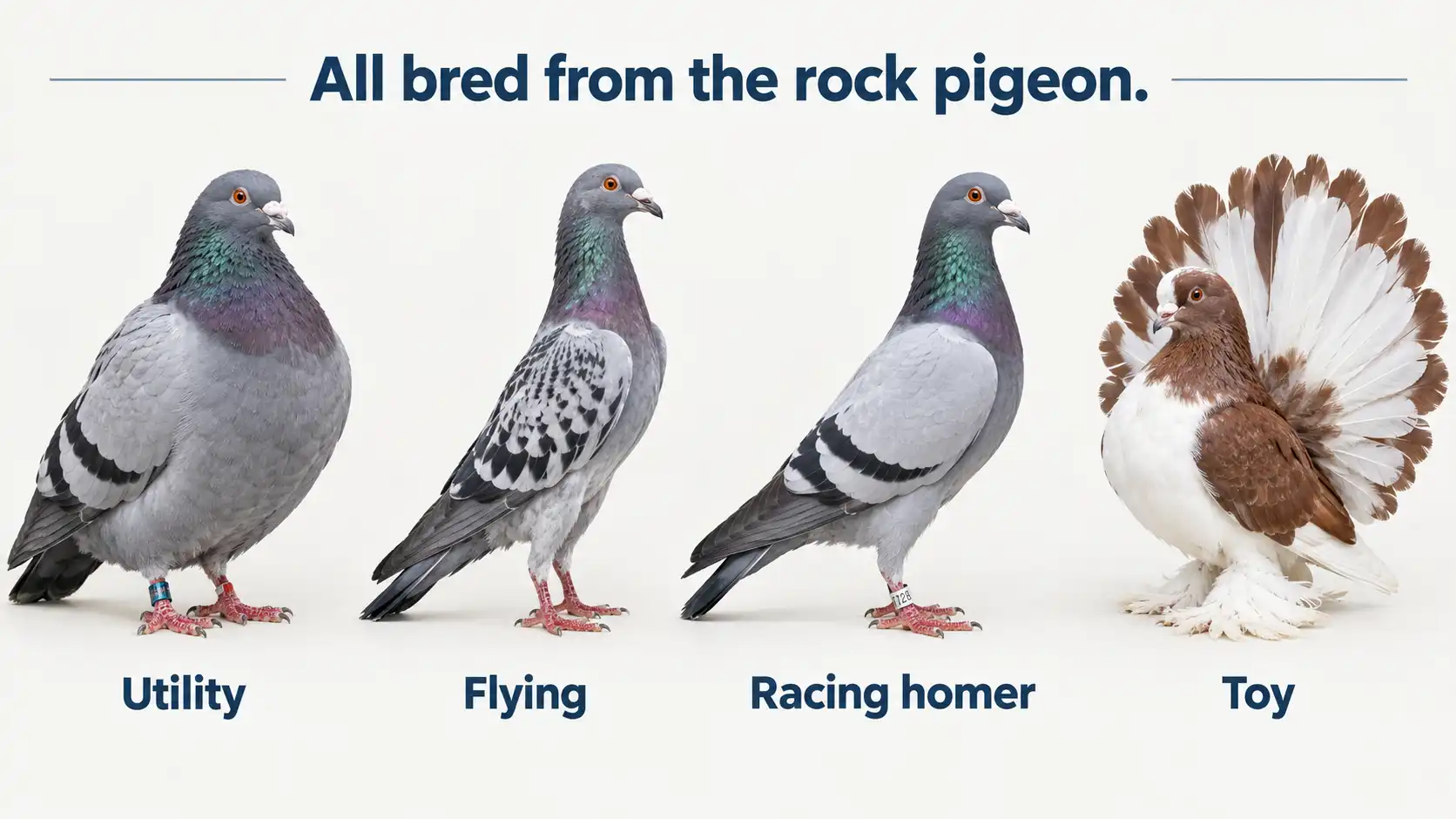
Every domestic pigeon descends from the rock pigeon. VCA veterinarians count more than 300 breeds in four groups:
- Utility pigeons, raised for meat
- Flying pigeons, such as rollers, tumblers, and tipplers, kept for their flying skills
- Racing homers, bred for speed and homing
- Toy pigeons, such as fantails and pouters, the largest group, bred for shape and color
People have bred them for a long time. Missouri’s conservation department says the rock pigeon has been domesticated for over 5,000 years. Domestic birds also live far longer than city flocks, as pigeon lifespans in and out of captivity show.
Types of Doves
Doves in the US fall into three groups: native, introduced, and pet species.
- Native doves: mourning, white-winged, Inca, common ground, ruddy ground, and white-tipped doves. All six appear on the federal list of protected migratory birds.
- Introduced doves: Eurasian collared-dove, African collared-dove, spotted dove, and zebra dove. The USFWS lists all four as non-native species the Act doesn’t cover.
- Pet doves: VCA veterinarians name the ringneck dove and the colorful bleeding-heart dove as pets.
Even here, the names drift. The USFWS lists one bleeding-heart species as the Luzon bleeding-heart, with no “dove” in its name at all. That’s one more reason to go by species, not by the word on the label.
Can You Keep a Pigeon or Dove as a Pet?
Yes, if it’s a domestic or non-native species and your state and city allow it. Native wild doves and pigeons stay wild.
Per the USFWS, the Migratory Bird Treaty Act doesn’t cover the rock pigeon, African collared-dove, diamond dove, or Luzon bleeding-heart. However, the agency notes that states and communities may still protect non-native species. So check state rules on keeping birds before you buy.
Don’t adopt a wild city pigeon, either. VCA veterinarians advise against it, since wild-caught pigeons may carry parasites, chlamydia, and viruses that can affect other birds.
As pets, the two behave much alike. The Merck Veterinary Manual lists up to 20 years for both its doves and its pigeons entries. It describes doves as quiet except for their cooing, and pigeons as relatively quiet birds often kept in colonies.
Carry that lifespan through to your own age:
Your age at the end = your age today + up to 20 years (Merck’s figure for pet doves and pigeons)
Bring home a young dove or pigeon at 30, and you could still be caring for it at 50. Care needs still vary by species, so compare pet doves and pigeons before you choose. VCA also advises a vet exam within 2 weeks of bringing a new pigeon home. After that, pigeons and doves alike need regular checkups.
Frequently Asked Questions
Do pigeons and doves make the same sound?
Both coo, but each species has its own call. Missouri’s conservation department calls the rock pigeon’s song a soft cooing, and Cornell says the Inca dove coos “no hope” at all hours.
Are homing pigeons doves?
Yes, in the family sense, since homing pigeons are domestic rock pigeons. VCA veterinarians trace every domestic breed, racing homers included, back to the rock dove, the species’ older name.
Do pigeons and doves carry the same diseases?
Some, yes. The Missouri Department of Conservation notes that healthy rock pigeons, Eurasian collared-doves, and mourning doves can all carry the trichomonosis parasite, so keep wild birds away from pet ones.
Do pigeons and doves mate for life?
Many form lasting pairs, but not every pair stays together for life. VCA veterinarians describe pigeons as faithful mates, while the evidence on mourning dove pair bonds shows only some pairs reunite.
What should I do if I find an injured pigeon or dove?
Call a licensed wildlife rehabilitator or your state wildlife agency before you move it. Don’t feed or treat it yourself, since native doves such as the mourning dove are federally protected.
The Practical Takeaway
Pigeons and doves are one family, and the word on a bird reflects naming habit, not science. What counts is the species. A native dove, such as the mourning dove, stays wild under federal law. A domestic pigeon or ringneck dove can be a quiet pet for up to 20 years, per Merck. Plan for that full span before you bring one home.